Published: September 27, 2026 | Last updated: September 27, 2026
Dr. Rajanbir Singh Thind, Thind Dental Clinic
A missing back tooth does not just leave a gap. Research published in the Open Access Macedonian Journal of Medical Sciences found that natural teeth generate roughly 200 newtons of biting force, while people relying on conventional dentures generate only 60 to 80 newtons, a drop of well over half (Shala et al., 2018). Most people never learn this until eating itself starts to feel like an effort.
Quick answer: Losing even one tooth can measurably cut your chewing efficiency, because the remaining teeth are forced to absorb loads they were never built to carry alone. Global data reviewed by the World Health Organization shows severe tooth loss already affects a meaningful share of older adults worldwide, and a 2025 Indian study of more than 7,500 adults aged 45 and above found tooth loss in 12 percent of the group, rising to 15.4 percent among those with more than one chronic health condition. The reassuring part is that modern replacement options, including dental implants, are engineered specifically to restore lost chewing function, not just the look of a tooth, as of September 2026.
A dental implant is a titanium or titanium-alloy post placed directly into the jawbone, designed to act as an artificial tooth root that supports a crown, bridge, or denture. Chewing, also called mastication, is the mechanical breakdown of food using the teeth and jaw muscles, and it depends on having enough functional biting surface and even force distribution across the arch.
What Actually Happens to Your Bite When a Tooth Goes Missing?
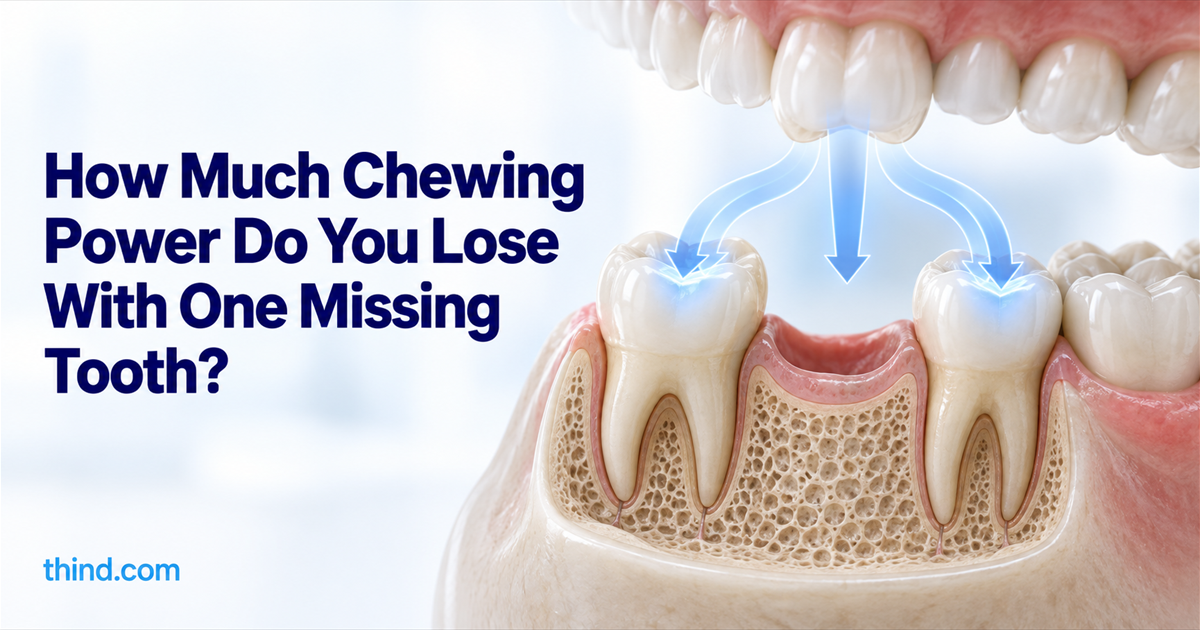
Your bite force drops immediately, and it keeps dropping the longer the gap is left unaddressed. When a tooth is lost, the neighboring and opposing teeth take on extra load, shift position over time, and gradually lose the stable contact points that made chewing efficient in the first place.
The numbers make this concrete. According to the study in the Open Access Macedonian Journal of Medical Sciences, the masticatory load most people generate with a full natural dentition is around 200 newtons, but that can fall to somewhere between 60 and 80 newtons once teeth are missing and replaced only with conventional dentures (Shala et al., 2018).
This is not a small or rare problem. A 2025 population-based study of 7,595 Indian adults aged 45 and older, published in Community Dental Health, found tooth loss in 12 percent of the sample overall, and 15.4 percent among adults living with more than one long-term health condition (Murmu et al., 2025). The same research linked tooth loss to a higher burden of chronic disease, not the other way around alone, which is a two-way relationship worth taking seriously.
- Chewing efficiency can fall well below half of normal levels once several teeth are missing.
- Adjacent teeth begin shifting and loosening within months of a gap being left unfilled.
- People with more chronic conditions show measurably higher rates of tooth loss, a pattern documented in Indian adults as of 2025.
Why Do So Many People Wait Years Before Replacing a Missing Tooth?
Most people delay because dental care has historically been treated as optional until it becomes an emergency, not because they do not care about their smile or their health. Oral health has long been under-prioritized relative to its real impact on daily life.
A World Health Organization regional review found that oral diseases affect more than 800 million people in the Western Pacific region alone, and the organization’s leadership has been direct about why. As Dr Zsuzsanna Jakab, WHO Acting Regional Director for the Western Pacific, put it: "Oral health has been the forgotten public health agenda, yet it impacts everyone at all ages."
"Oral health has been the forgotten public health agenda, yet it impacts everyone at all ages." (Dr Zsuzsanna Jakab, WHO Acting Regional Director for the Western Pacific, 2023)
What is changing now is patient behavior and technology together. The IMARC Group reports that India’s dental implants market reached USD 158.2 million in 2025 and is projected to grow to USD 279.5 million by 2034, a compound annual growth rate of 6.50 percent (IMARC Group, published February 2026). That growth reflects more patients choosing permanent, function-first solutions over temporary fixes than in previous years.
At the same time, digital scanning and 3D treatment planning have made replacement options more predictable, which is part of why long-term outcomes have improved. A 2024 meta-analysis in Clinical Oral Investigations tracking implants over 20 years found survival rates ranging from roughly 78 to 92 percent depending on study design, concluding that approximately four out of five implants remain functional after two decades (Kupka et al., 2024).
What Should You Actually Look For When Choosing How to Replace a Missing Tooth?
The smartest way to evaluate any tooth replacement decision in 2026 is to judge it against how well it restores real chewing function, not just how it looks in a photograph. A few criteria matter far more than most people realize going in.
- Diagnostic precision. Digital or 3D scanning before treatment reduces guesswork and helps match the right option (implant, bridge, or denture) to your specific bone and bite condition.
- Sterilization and infection control you can verify. Given how invasive some replacement procedures are, hygiene protocols that meet recognized accreditation standards are not a nice-to-have, they are the baseline.
- A team that handles both function and aesthetics. The strongest outcomes tend to come from clinicians experienced across surgical placement and cosmetic finishing, rather than treating the two as separate jobs.
- Realistic timelines and visit counts. A trustworthy provider tells you upfront how many appointments a solution actually needs, instead of underselling the process.
- Transparent, written cost estimates. Ambiguity about pricing is one of the biggest reasons people delay treatment for years past the point it stops making sense to wait.
Dental Implant vs Bridge vs Removable Denture: Which One Actually Restores Chewing Power?
A fixed dental implant restores chewing function closest to a natural tooth, a bridge comes next, and a removable denture restores the least biting force of the three common options. The right choice still depends on bone health, budget, and how many teeth are missing.
| Option | Chewing function restored | Bone health impact | Typical longevity | Daily care |
|---|---|---|---|---|
| Dental implant | Closest to natural biting force; fixed in the jaw | Helps preserve jawbone by transmitting normal chewing load | Around 4 in 5 implants remain functional at 20 years (Kupka et al., 2024) | Brush and floss as with natural teeth |
| Dental bridge | Good, fixed replacement, though it relies on neighboring teeth for support | Does not directly stimulate the jawbone at the gap site | Typically 10 to 15 years with good care | Brush normally plus specific floss threading under the bridge |
| Removable denture | Lowest of the three; bite force often falls to 60 to 80 newtons versus roughly 200 newtons for natural teeth (Shala et al., 2018) | Can accelerate bone loss over time without direct stimulation | Usually 5 to 8 years before relining or replacement | Removed nightly for cleaning and soaking |
What Should a Sensible Checklist Look Like Before You Commit to Treatment?
Before booking any procedure to replace a missing tooth, run the clinic and the plan through a short checklist. It takes fifteen minutes and can save years of regret.
- Look for a clinic that shows you its sterilization and infection-control protocol rather than simply stating it meets standards.
- Look for a clinic that uses digital or 3D scanning before recommending an implant, bridge, or denture, rather than working from a visual check alone.
- Look for a clinic with dentists experienced in both the surgical and cosmetic sides of treatment, so the result functions well and looks natural.
- Look for a clinic that can see you at more than one location or time slot, since follow-up visits matter as much as the first procedure.
- Look for a clinic that puts your treatment estimate in writing before any work begins, with no vague ranges.
- Look for a clinic offering minimally invasive or laser-assisted options where appropriate, since these can shorten recovery for certain procedures.
Every one of these criteria exists because patients who skip them are the ones most likely to end up needing the procedure redone, at greater cost, a year or two later.
Where a Smart Decision Actually Starts
This is exactly the standard Thind Dental Clinic was built around. As an NABH-approved dental practice across three locations in Ludhiana, it combines digital treatment planning with the surgical and cosmetic experience of a husband-and-wife dentist team, Dr. Rajanbir Singh Thind and Dr. Gurinder Kaur Thind, working across implants, bridges, root canal treatment, and full smile makeovers.
Whether the right answer for your bite turns out to be a dental implant, a bridge, or another option entirely depends on a proper clinical assessment, not a guess from a photo. You can book a free smile assessment and consultation to get a clear, written picture of what would actually restore your chewing function, with no obligation attached.
If you have been putting off replacing a missing tooth because you were not sure where to start, that assessment is a reasonable, low-pressure next step. You can schedule a consultation with Thind Dental Clinic and walk in with a specific plan instead of an open question, and if cosmetic concerns are part of what has kept you hesitant, the same visit can also cover options like teeth whitening and smile makeover consultations at thind.com.
Frequently Asked Questions
Can dental implants really feel like natural teeth?
Yes, for most patients a well-placed implant feels and functions very similarly to a natural tooth, because it is anchored in the jawbone rather than resting on the gum or neighboring teeth. It will not decay like a natural tooth, but the sensation of biting and chewing is close to normal for the large majority of patients.
How long do dental implants actually last?
A 2024 meta-analysis in Clinical Oral Investigations found that roughly four out of five implants remain functional after 20 years, with survival rates in the studies reviewed ranging from about 78 to 92 percent depending on how patients were tracked (Kupka et al., 2024). Individual results still depend on bone quality, oral hygiene, and regular checkups.
Can I eat normally again after getting dental implants?
Most patients return to a normal diet within a few weeks of full healing, once the implant has integrated with the jawbone. Chewing efficiency after implants is generally far closer to natural teeth than it is with removable dentures, which is the main functional advantage implants offer.
Are dental implants safe for older adults?
Age by itself is rarely a barrier to dental implants; what matters more is bone density, gum health, and how well-controlled any existing medical conditions are. A proper assessment, including imaging, is what determines candidacy, not age alone.
Can dental implants fail years after they are placed?
Yes, though it is not the most common outcome. Failure years later is usually linked to untreated gum disease around the implant, poor oral hygiene, or uncontrolled conditions like diabetes, which is why regular follow-up visits matter even after the initial healing period is complete.
Sources
- Murmu, J., Rout, B., et al., "Association between multiple long-term conditions and tooth loss among middle-aged and older Indians," Community Dental Health, 2025
- World Health Organization, Western Pacific Region, "Oral diseases affect more than 800 million people in the Western Pacific," 2023
- Shala, K., Tmava-Dragusha, A., Dula, L., et al., "Evaluation of Maximum Bite Force in Patients with Complete Dentures," Open Access Macedonian Journal of Medical Sciences, 2018
- IMARC Group, "India Dental Implants Market Report," published February 2026
- Kupka, J.R., König, J., Al-Nawas, B., Sagheb, K., Schiegnitz, E., "How far can we go? A 20-year meta-analysis of dental implant survival rates," Clinical Oral Investigations, 2024