Published: September 25, 2026 | Last updated: September 25, 2026
Dr. Rajanbir Singh Thind, Thind Dental Clinic
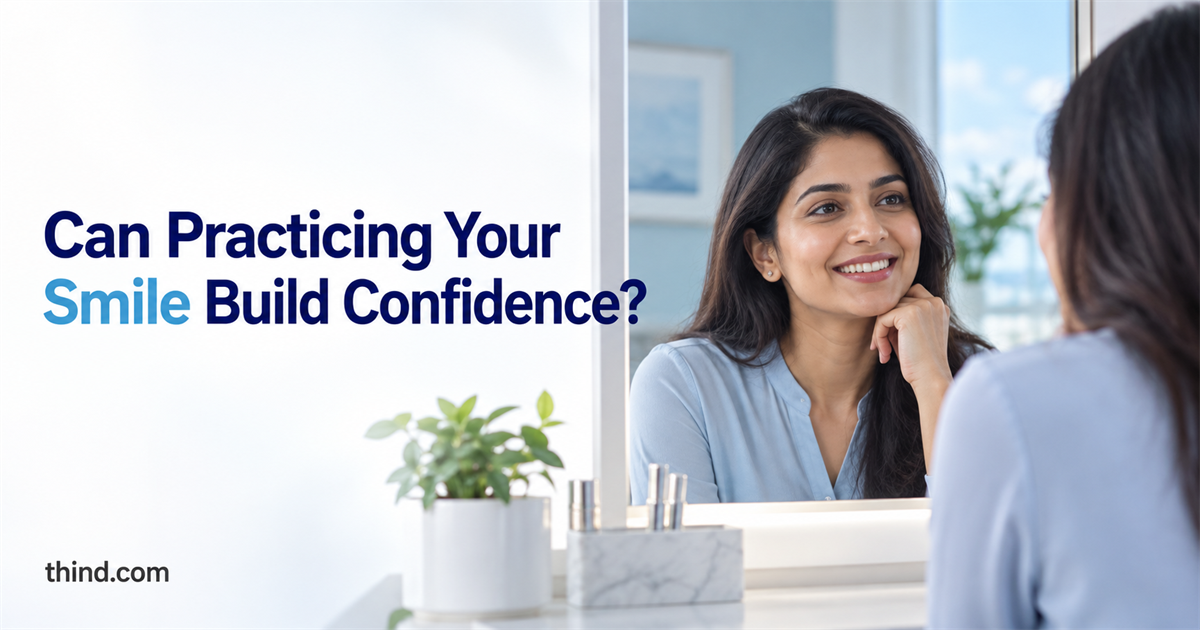
A Stanford-led study that pooled data from 3,878 people across 19 countries found that the simple act of forcing a smile can measurably lift a person’s mood, even when they are not trying to feel happier. That finding sounds like good news for anyone who has ever been told to "just smile more" before a photo, a meeting, or a video call. It is also, in a strange way, incomplete, because the same body of research shows that this trick works best on people who are not already avoiding the smile in the first place.
Quick answer: practicing a confident smile in the mirror can genuinely improve mood in the moment, because deliberately smiling activates the same facial feedback loop the brain uses to register happiness. But for the large share of adults who hide their smile because of stained, crooked, or damaged teeth, mirror practice does not resolve the underlying self-consciousness. As of September 2026, research and consumer surveys both point to the same conclusion: confidence-building techniques work on top of a smile someone is not ashamed of, not as a replacement for fixing the smile itself.
What Is the Facial Feedback Hypothesis, and Why Does "Smile More" Advice Come From It?
The facial feedback hypothesis is the psychological theory that a person’s facial expressions can influence, not just reflect, their emotional state. In simple terms, the muscle movement of smiling can send a signal back to the brain that nudges mood upward, independent of what triggered the expression.
This is the theory behind most "practice smiling in the mirror" advice. It is not baseless. A large registered multi-lab replication called the Many Smiles Collaboration, led by Nicholas Coles, a research scientist at Stanford University and co-director of the Stanford Big Team Science Lab, tested the idea across thousands of participants and found that deliberately posed smiles and smile mimicry did produce a small but real increase in felt happiness.
"The stretch of a smile can make people feel happy and the furrowed brow can make people feel angry," Coles said, describing the mechanism behind the effect. He was careful to note the limits of what this can do: "The effect isn’t strong enough to overcome something like depression, but it provides useful insight into what emotions are and where they come from."
How Many People Actually Feel Self-Conscious About Their Smile Right Now?
More than half of adults do, and it is not a fringe concern. A March 2024 Forbes Health and OnePoll survey of 2,000 U.S. social media users found that 56% hide their smile in various situations, and 34% specifically hide their teeth in photos. The same survey found that 45% of respondents said social media itself had harmed their smile confidence.
This is not only a social media problem. A separate 2026 study by SmileSet, run through the Pollfish survey platform among 1,200 U.S. adults, found that 56% say smile self-consciousness affects their overall confidence at least a moderate amount, and 44% say it has held them back professionally. Two independently run surveys, in different years, landed on the same headline number.
- 56% hide their smile in social situations (Forbes Health / OnePoll, 2024)
- 34% specifically hide their teeth in photos (Forbes Health / OnePoll, 2024)
- 45% say social media has harmed their smile confidence (Forbes Health / OnePoll, 2024)
- 44% say smile self-consciousness has held them back professionally (SmileSet / Pollfish, 2026)
Why Does Mirror Practice Often Fail to Fix the Underlying Problem?
Mirror practice fails when the reason someone hides their smile is physical, not habitual. Self-perception theory, a related idea in psychology, holds that people infer their own attitudes partly by observing their own behavior and appearance, not only by how they feel inside.
If someone avoids showing their teeth because of visible staining, gaps, or crowding, no amount of rehearsed smiling changes what they see reflected back at them. The rehearsal can lift mood for a moment. It does not change the input the brain is reacting to.
A 2019 Cigna study of 1,000 U.S. adults, titled "Behind the Smile," found that 93% of people who were completely satisfied with their smile rated their own self-confidence as excellent or very good, while 21% said their smile or oral health made them feel less confident specifically in job interviews. Satisfaction with the smile itself, not the ability to perform a confident expression on demand, was the variable that tracked most closely with real confidence.
This is why "practice smiling" content and "fix your smile" content are not competing pieces of advice. They solve two different problems. One manages a mood in the moment. The other removes the reason the moment felt uncomfortable to begin with.
What Is Actually Changing in How People Approach Smile Confidence in 2026?
What is changing is that more people are treating smile appearance as a solvable problem rather than a personality trait to manage around. India’s cosmetic dentistry market was valued at USD 1,523.1 million in 2022 and is projected to reach USD 4,406.9 million by 2030, a 14.2% compound annual growth rate, according to Grand View Research’s India Cosmetic Dentistry Market Outlook.
That growth reflects a shift in how working professionals and image-conscious young adults think about their smile. Instead of hiding a smile in every photo and every meeting indefinitely, more people are booking a single diagnostic visit to find out exactly what is fixable and how.
Digital diagnostic tools are a large part of why this shift is happening faster now than a decade ago. Cosmetic dentistry today typically starts with an intra-oral scan or digital photograph analysis, which turns a vague feeling of "I don’t like my smile" into a specific, treatable list: staining, spacing, chip, or alignment.
The most common starting point remains professional teeth whitening, since staining is the single most frequent reason people say they hide their smile in the first place.
What Should Actually Change the Way You Think About Fixing Your Smile?
The smartest way to approach smile confidence is to treat it as a diagnosis-first problem, not a discount-driven purchase. A few shifts in thinking separate people who solve the problem from people who keep managing around it.
- Get an objective read, not a subjective guess. A digital scan shows exactly what is causing the self-consciousness, rather than relying on a mirror or a filtered photo.
- Match the fix to the actual cause. Staining, misalignment, and structural damage need different treatments; a single generic whitening kit will not resolve crowding, and aligners will not resolve deep stains.
- Prioritize hygiene and sterilization standards. Any treatment that touches soft tissue or enamel carries some infection risk if sterilization protocols are weak, so this is not a cosmetic detail.
- Value continuity of care. A dentist who has seen the same mouth over several visits catches small changes earlier than a rotating cast of practitioners would.
- Ask about the full treatment range under one roof. Someone whose real issue is alignment does not want to discover that only whitening was on offer.
What Should You Look for Before Booking Any Smile-Confidence Treatment?
Look for a clinic that treats diagnosis as the first appointment, not an afterthought before a sales pitch. A short, practical checklist helps separate a clinic built around real outcomes from one built around volume.
- Look for a clinic that holds NABH or an equivalent structured quality accreditation, not just a clean-looking waiting room.
- Look for digital scanning or laser-based diagnostic tools that let you see the actual problem, not just hear a description of it.
- Look for a team you can see consistently over time, rather than a different dentist at every visit.
- Look for multiple clinic locations or flexible scheduling, since a treatment plan that requires a dozen visits only works if getting there is easy.
- Look for transparent, itemized estimates before treatment starts, including whether phased or EMI payment options exist.
- Look for a clinic willing to say plainly when a problem needs orthodontic correction rather than simply selling whitening for it.
How Do the Main Smile-Confidence Treatments Actually Compare?
The right treatment depends entirely on what is causing the self-consciousness in the first place, which is why a single option rarely fits everyone.
| Concern | Likely Treatment | What It Actually Fixes | Typical Timeline |
|---|---|---|---|
| Yellow or stained teeth | Professional teeth whitening | Surface and deep staining from tea, coffee, tobacco, or aging | 1 to 2 sittings |
| Crooked or gapped teeth | Clear aligners or orthodontic correction | Alignment, spacing, and bite issues | Several months to about 18 months |
| Chipped, worn, or uneven teeth | Cosmetic bonding or veneers | Shape, symmetry, and minor structural damage | 1 to 3 sittings |
| Multiple combined issues | Full smile makeover | Color, shape, and alignment addressed together | Varies by case, planned in stages |
Where Does This Leave Someone Ready to Stop Managing Their Smile and Start Fixing It?
Everything above points to the same practical step: get a real diagnosis before deciding whether the issue is staining, alignment, or something else entirely. This is exactly the kind of diagnosis-first, hygiene-first approach that Thind Dental Clinic in Ludhiana is built around, with digital and laser-based tools used to identify the specific cause of a self-conscious smile rather than guessing at it.
Dr. Rajanbir Singh Thind and Dr. Gurinder Kaur Thind run an NABH-approved practice across three Ludhiana locations, offering everything from teeth whitening and clear aligners to dental implants and full smile makeovers under one continuous care team, so a patient never has to start over with a new dentist mid-treatment.
If mirror-practiced confidence has been carrying the weight that an actual fix should, the more useful next step is a proper look at what is really happening with your smile, not another round of rehearsed expressions. A free smile assessment and consultation takes one visit, gives a clear, itemized picture of what is fixable and how, and leaves the decision entirely in your hands with no pressure to commit that same day.
Frequently Asked Questions
Does smiling more really make you happier, even if you are faking it?
Research from the Many Smiles Collaboration, a multi-lab study of 3,878 participants, found that deliberately posed smiles can produce a small, real increase in felt happiness. The effect was weaker when people were not consciously aware they were manipulating their expression, and it is not strong enough to address deeper issues like depression.
Why do I still feel self-conscious after practicing smiling in photos?
If the self-consciousness comes from a visible issue like staining, gaps, or crooked teeth, practicing an expression does not change what you or others actually see. Confidence tends to follow satisfaction with the smile itself more closely than it follows rehearsal.
Is teeth whitening enough to fix smile confidence on its own?
Whitening only addresses staining. If the underlying concern is alignment, spacing, or a chipped or worn tooth, whitening alone will not resolve it, which is why a diagnosis before treatment matters more than picking a single popular procedure.
How do I know if my smile issue needs orthodontic treatment instead of cosmetic work?
A digital scan or in-person assessment can usually tell within one visit whether the issue is purely cosmetic, such as color or minor chips, or structural, such as bite alignment, which needs orthodontic correction rather than bonding or whitening.
Is it normal for smile self-consciousness to affect work or professional situations?
Yes. A 2026 SmileSet survey found that 44% of respondents said smile self-consciousness had held them back professionally, and a 2019 Cigna study found 21% felt less confident specifically in job interviews because of their smile or oral health.
What should the first appointment for smile confidence actually involve?
It should involve an assessment of what is actually causing the self-consciousness, ideally with digital or laser-based diagnostic tools, before any treatment is recommended, rather than starting with a sales conversation about a single procedure.
Sources
- Forbes Health and OnePoll, "Survey: How Social Media Impacts Our Smiles" (March 2024)
- Stanford Report, "Posing smiles can brighten our mood," on the Many Smiles Collaboration study published in Nature Human Behaviour (2022)
- Dental Tribune India, reporting on the Cigna "Behind the Smile" study (2019)
- Grand View Research, India Cosmetic Dentistry Market Outlook (2026)
- SmileSet Smile Confidence Study via Pollfish (August 2026)