Published: July 26, 2026 | Last updated: July 26, 2026
By Dr. Rajanbir Singh Thind, Thind Dental Clinic
Here is something almost no one expects to hear about a root canal: it may be protective, not just corrective. A 2013 study in JAMA Otolaryngology, Head & Neck Surgery, reviewed on the American Association of Endodontists’ root canal safety page, found that patients who had undergone multiple root canal treatments showed a 45 percent lower risk of head and neck cancer than patients who had not. A root canal does not just stop pain. The data behind it points toward better long-term outcomes, not worse ones.
Quick answer: a root canal treatment is a dental procedure that removes infected or inflamed tissue from inside a tooth, cleans the empty space it leaves behind, and seals it so the natural tooth can stay in the mouth instead of being extracted. As of July 2026, a large systematic review of clinical outcomes found root canal treatment succeeds in preserving the tooth in roughly 8 to 9 out of 10 cases. Most people who delay treatment out of fear end up paying more, in money and in discomfort, because an untreated tooth infection does not resolve on its own. The earlier treatment happens after pain starts, the simpler, cheaper, and more predictable it tends to be.
How much does ignoring tooth pain actually cost you?
Ignoring tooth pain costs more the longer it continues, and the data shows most people are already waiting too long before they act. Two patterns stand out.
Nearly half of Gen Z and millennial adults surveyed admitted they only go to the dentist once they are already in pain, according to a June 2025 survey by the American Association of Endodontists. By the time pain is noticeable enough to force a decision, the infection has usually already reached the nerve, which is exactly the stage where a simple filling is no longer an option.
That waiting pattern has a measurable economic cost. In the United States, adults lose 243 million work and school hours a year to oral health problems, at an estimated cost of $45 billion to the economy, according to a February 2024 CareQuest Institute report.
“No one should have to sacrifice their schedule or pay because of preventable health issues,” said Myechia Minter-Jordan, MD, MBA, President and CEO of CareQuest Institute, describing the report’s findings.
Why doesn’t tooth pain ever just go away on its own?
Tooth pain does not resolve on its own because the tissue causing it has no way to heal itself once bacteria reach it. Understanding why removes most of the mystery around why dentists push for prompt treatment.
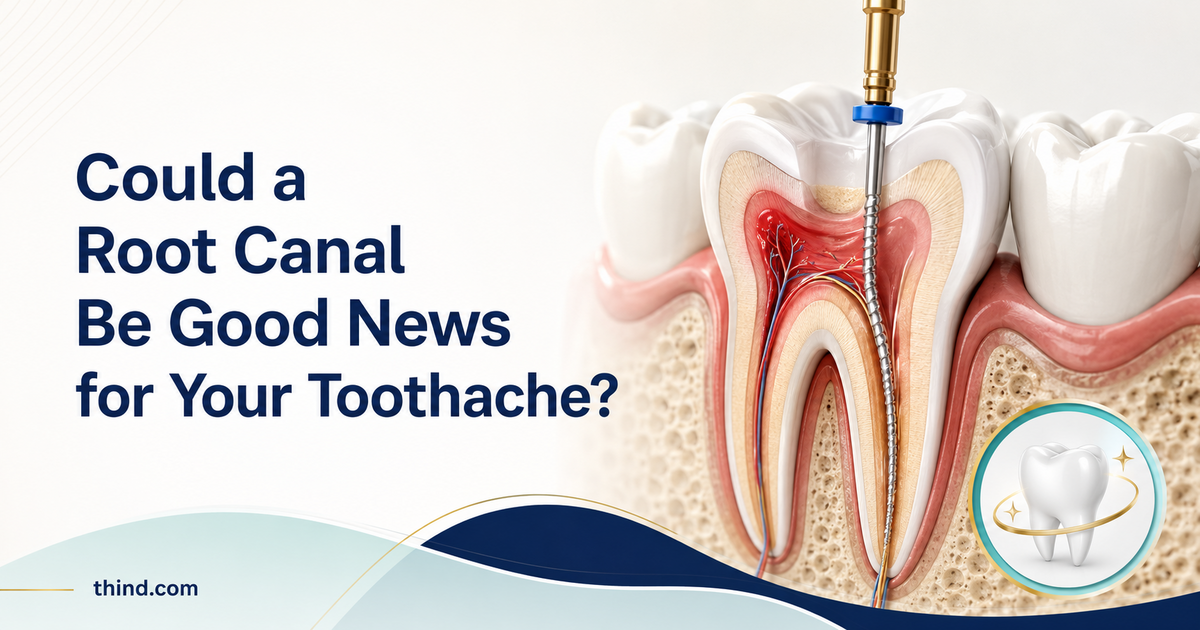
Pulpitis is the medical term for inflammation of the soft tissue inside a tooth, called the pulp, usually caused by deep decay or a crack that lets bacteria reach it. Once pulpitis becomes irreversible, the pulp tissue begins to die, and the infection can spread to the bone at the root tip, forming what is known as a dental abscess.
A pause in pain is not always good news. Sometimes it means the nerve inside the tooth has died and stopped signaling, while the infection underneath keeps spreading quietly. That is one reason dentists recommend an assessment even after sharp pain fades on its own.
Is a root canal really as painful as most people believe?
No, and the gap between the fear and the reality is one of the best documented patterns in dentistry today. Fear has stayed high even as pain management has improved.
As of mid-2026, the same AAE survey found that 38 percent of adults report being afraid of root canals specifically, a figure that rises to 48 percent among Gen Z and 46 percent among millennials. Confusion online appears to be part of the reason: 40 percent of Gen Z respondents said they always or often struggle to tell dental myths from facts on the internet.
“We are concerned that fear and misinformation is contributing to younger adults avoiding the dental chair, as nearly half of both Gen Z and millennial adults surveyed admitted to only going to the dentist when experiencing pain in their mouth,” said Steven J. Katz, DDS, MS, President of the American Association of Endodontists.
What the same survey also found rarely makes the headlines: 71 percent of adults who actually went through a root canal said they were glad they chose it over having the tooth pulled. Fear tends to fade fast once the procedure is behind someone, but it keeps people away right up until that point.
How often does root canal treatment actually succeed at saving the tooth?
Most of the time. A large 2022 systematic review in the International Endodontic Journal, covering 42 studies published between 2003 and 2020, found root canal treatment achieved a 92.6 percent success rate under looser clinical criteria and 82 percent under stricter radiographic criteria that require complete healing at the root tip.
Either figure means the overwhelming majority of treated teeth are saved and stay functional for years afterward. Endodontics, the branch of dentistry focused on the tooth’s internal tissue, exists precisely because saving a natural tooth usually serves a patient better than extracting and replacing it.
How should you actually judge where to get tooth pain treated?
Judge it by infection control, diagnostic technology, and pain management, not by how modern the waiting room looks. A smart patient weighs a short list of criteria before pain ever forces the decision.
- Infection control that is independently certified, not just described as clean by the clinic itself.
- Diagnostic technology, such as digital X-rays and intraoral scans, used as a routine part of every assessment rather than only on request.
- A pain-management approach built on modern anesthesia and gentler tools, including laser or non-contact options, rather than a vague promise of “you won’t feel much.”
- Continuity of care from the same treating dentist across visits, rather than a different clinician reviewing the case each time.
- Accessibility that fits a working professional’s week: convenient locations and appointment times, not a single office with limited hours.
What should you look for in a clinic before you ever need a root canal?
Look for objective signals of quality, not marketing language. The following checklist reflects what dental researchers and patient advocates consistently point to as markers of safe, modern care.
- Look for a clinic that displays NABH accreditation or an equivalent, independently verified hygiene standard.
- Look for a clinic that shows you your own digital X-ray or intraoral scan rather than only describing the problem verbally.
- Look for a clinic offering laser-based or non-contact treatment options for cavities and root canals, which can reduce how much drilling is needed.
- Look for a clinic with more than one location, so a future appointment does not depend on being near a single address.
- Look for a clinic where the same dentist follows your case at every visit, instead of a rotating roster of staff.
- Look for a clinic that gives a written cost estimate before treatment begins, not after.
How much does root canal treatment actually cost in India in 2026?
Cost depends mainly on which tooth is affected, since some teeth have more complex canal systems than others. According to a 2026 cost guide published by Bajaj Finserv, prices vary as follows.
Tooth or treatment type
Why the cost differs

Approx. cost in India (2026)

Front teeth (incisors and canines)

Easier to access, simpler canal structure

Rs. 2,000 to Rs. 6,000

Premolars

Slightly more complex canal anatomy

Rs. 3,000 to Rs. 8,000

Molars

Multiple roots and harder access

Rs. 5,000 to Rs. 12,000

Crown after root canal

Protects the treated tooth long term

Rs. 10,000 to Rs. 25,000 additional

These figures are inclusive of the clinical procedure itself; a clinic should confirm final billing, including any applicable GST, before treatment begins.
Where a trusted clinic fits into everything above
Everything covered so far, certified hygiene, routine digital diagnostics, gentler pain management, continuity of care, and transparent pricing, describes exactly what Thind Dental Clinic was built around. The NABH-approved clinic operates three locations across Ludhiana under Dr. Rajanbir Singh Thind and Dr. Gurinder Kaur Thind, offering root canal treatment, laser dentistry, including non-contact laser cavity treatment, dental implants, and full-mouth digital scanning under one roof.
If a tooth has started hurting, or has been quietly bothering you for weeks, the data above suggests waiting rarely helps and rarely saves money. A short, no-pressure conversation with a dentist who can actually show you what is happening inside the tooth is usually the fastest way out of the uncertainty. You can book a free smile assessment and consultation at Thind Dental Clinic to get a clear, written picture of what your tooth actually needs before deciding on anything.
Frequently asked questions
How do I know if I need a root canal or just a filling?
A filling is usually enough if decay has not yet reached the pulp, the soft tissue inside the tooth. Once pain lingers after hot or cold, wakes you up at night, or the tooth is tender to bite pressure, the infection has likely reached the nerve, and a root canal becomes the more reliable option. A dentist can confirm this quickly with a digital X-ray and a same-day assessment.
Is root canal treatment painful nowadays?
Most patients report the procedure itself feels similar to getting a filling, largely because modern anesthesia is more precise than it used to be. The lingering fear is more a legacy of outdated experiences than a reflection of current practice, which is part of why 71 percent of people who have had one say they were glad they chose it over extraction.
How long can I safely delay a root canal?
There is no safe fixed window, because infections progress at different speeds depending on the tooth and the person. What is consistent is the direction: delay tends to move a problem from reversible to irreversible, so pain, swelling, or sensitivity that lasts more than a few days is a signal to get an assessment rather than wait it out.
Will root canal treatment actually save my natural tooth?
In most cases, yes. Systematic review data puts the success rate at 82 to 92.6 percent depending on how strictly success is measured, which means the large majority of treated teeth remain functional for years afterward.
What happens if a tooth infection is left untreated and spreads?
Left untreated, an infection can progress from the tooth into the surrounding bone and soft tissue, forming a dental abscess, and in rare, advanced cases it can spread further and require urgent medical care. This is one reason dentists treat persistent swelling or fever alongside tooth pain as something to act on quickly, not wait out.
Sources
- American Association of Endodontists, Root Canal Safety, citing Tezal M. et al., JAMA Otolaryngology, Head & Neck Surgery, 2013
- American Association of Endodontists, New Survey Finds Gen Z, Millennials Most Vulnerable to Online Dental Misinformation, June 2025
- Burns L.E. et al., Outcomes of Primary Root Canal Therapy: An Updated Systematic Review, International Endodontic Journal, 2022 (PubMed)
- CareQuest Institute, US Adults Miss 243 Million Hours of Work or School Annually Due to Oral Health Problems, February 2024
- Bajaj Finserv, Tooth Canal Treatment Cost in India: 2026 Price Guide