Published: July 27, 2026 | Last updated: July 27, 2026
By Dr. Rajanbir Singh Thind, Thind Dental Clinic
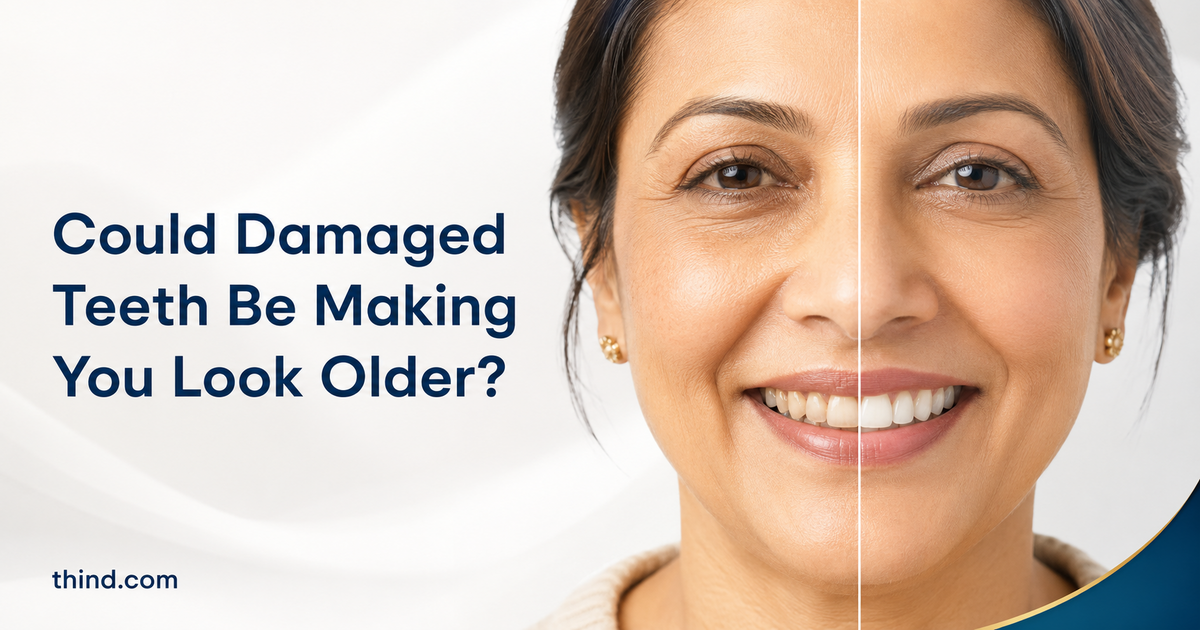
Here is something most people never connect to their own reflection: worn, shortened, discoloured teeth are one of the strongest visual signals of age the human eye picks up, often before a single grey hair or wrinkle is noticed. A 2025 study in Frontiers in Oral Health by Marchan, Rafeek, and Smith at the University of the West Indies found that 64 percent of adults aged 18 to 30 showed no visible tooth wear at all, compared with only 22 percent of adults over 60. Wear builds for decades, and by the time it is visible, it has usually already been reshaping how old a face looks for years.
Quick answer: tooth wear is the gradual loss of enamel and tooth structure from grinding, acid exposure, and everyday chewing, and it accelerates sharply after midlife. As teeth shorten and flatten, the lower face loses natural support, lips can appear thinner, and the yellow-brown dentine layer beneath the enamel starts showing through, all of which read visually as “older” regardless of skin condition. Cosmetic dentistry as of July 2026 treats this as a structural, correctable problem, and rebuilding tooth length, shade, and support is often what changes a face’s perceived age more than any skincare routine could.
How much older can worn or damaged teeth actually make your face look?
Worn and damaged teeth can add a visible decade or more to how old a face looks, because the change happens gradually and rarely gets connected back to the teeth themselves. The data shows this is not a rare, cosmetic-only concern.
The same 2025 Frontiers in Oral Health study found that severe tooth wear affected 11 percent of adults over 60, compared with just 3 percent of adults aged 51 to 60, a sharp jump in a single decade of life. Age, the researchers found, had the strongest statistical link to wear severity of any factor measured.
There is also a psychological cost to living with a smile that looks worn or aged. According to a February 2025 study in BMC Psychology by Zahra Ghorbani and colleagues at Shahid Beheshti University of Medical Sciences, 82.2 percent of laypeople with low self-esteem expressed interest in cosmetic dental treatment, compared with 66.6 percent of those with high self-esteem. The same study found that people who had already had one cosmetic dental treatment were 5.39 times more likely to seek another, a sign that most regret is about waiting, not about treating.
Why does tooth wear speed up how old you look, even when your skin looks fine?
Tooth wear ages a face because teeth quietly do structural work most people never think about: they support the lips, hold the lower third of the face at its natural height, and reflect light evenly when they are intact. Losing that structure changes the whole lower face, not just the smile.
Bruxism, the clinical term for chronic teeth grinding or clenching, is one of the most common drivers of accelerated wear, often happening at night without the person ever realising it. Combined with acid from coffee, tea, and carbonated drinks, and decades of ordinary chewing, enamel gradually thins in a way that cannot reverse itself once it is gone.
As enamel thins, the darker dentine layer underneath becomes more visible, which most people read simply as “yellowing,” without realising it is also a sign of structural loss. Shortened front teeth reduce the natural support behind the upper lip, which is part of why some older adults appear to have thinner lips even without any change in the lips themselves.
What is actually changing in how dentists treat aging, worn teeth as of 2026?
What has changed most is that patients no longer have to accept worn or damaged teeth as a fixed part of getting older, because restorative and cosmetic techniques have matured enough to rebuild both appearance and function together. The scale of demand shows how fast this shift is moving.
Grand View Research values India’s cosmetic dentistry market at USD 1,523.1 million in 2022, projecting it to reach USD 4,406.9 million by 2030, a 14.2 percent annual growth rate. Globally, the same research house’s dental veneers market report values the category at USD 7.9 billion in 2025, growing to USD 14.3 billion by 2033 at a 7.7 percent yearly rate.
Growth at that scale usually reflects a population catching up on years of delayed treatment, not a passing trend. Alongside that demand, digital scanning and shade-matching tools have made it possible to plan a natural-looking result before any tooth is touched, reducing much of the guesswork that once made cosmetic treatment feel risky.
How should a smart patient actually think about fixing worn or damaged teeth?
Choosing the right approach to aging, worn teeth means looking past a single procedure name and evaluating the whole plan behind it. A handful of criteria separate a durable, natural-looking result from a rushed one.
- Function first, appearance second. A plan that restores bite height and even chewing tends to hold its look longer than one aimed only at whitening or shape.
- Digital planning before treatment. Seeing a simulated result on your own face, not a generic sample smile, sets realistic expectations early.
- Sterilisation and hygiene protocols you can verify. Restorative and cosmetic work often involves multiple visits, so verified infection-control standards matter more here than for a single quick procedure.
- Technology suited to precision work. Laser and digital tools reduce guesswork in shade matching, gum contouring, and minimally invasive preparation.
- A team, not a single opinion. Aging smiles often involve more than one issue at once (wear, colour, gum position), so a practice with more than one experienced clinician tends to catch more of them.
What should you look for in a clinic before treating an aging, worn smile?
Look for a clinic that treats an aging smile as a structural and aesthetic project, not a single transaction, since worn teeth rarely have a one-step fix. A short checklist keeps that evaluation objective.
- Look for a clinic accredited to a recognised hygiene and safety standard, not just one that claims to be clean.
- Look for digital or laser-assisted tools used in daily practice, not just mentioned on a website.
- Look for a treatment plan that explains bite and jaw function, not only shade and shape.
- Look for more than one experienced dentist on staff, ideally covering both general and cosmetic dentistry.
- Look for multiple clinic locations or flexible scheduling, since restorative work often needs several visits.
- Look for a free or low-cost initial assessment before any treatment commitment is asked of you.
What does treating worn or damaged teeth typically cost in India in 2026?
Treatment cost depends entirely on how much structure needs rebuilding, from a single chipped edge to a full smile of worn teeth. The table below outlines typical approaches and approximate 2026 price bands in India, inclusive of GST where applicable.
Treatment approach
What it addresses

Typical visits

Approx. cost in India (2026)

Composite bonding

Minor chips, small shape correction

1 visit

₹1,500 to ₹6,000 per tooth

Porcelain or ceramic veneers

Wear, discolouration, shape, moderate damage

2 to 3 visits

₹8,000 to ₹25,000 per tooth

Full-coverage crowns

Significant wear or structural damage

2 to 3 visits

₹8,000 to ₹20,000 per tooth

Full smile or bite rehabilitation

Widespread wear affecting the whole bite

Multiple visits over weeks

₹80,000 to ₹3,00,000 or more

Given everything the data shows about how quietly tooth wear compounds with age, Thind Dental Clinic in Ludhiana was built around exactly this kind of structural, whole-smile evaluation. As an NABH-approved general and cosmetic dental practice run by Dr. Rajanbir Singh Thind and Dr. Gurinder Kaur Thind, the clinic uses digital smile design and laser-based dentistry to plan treatment around both function and appearance before a single tooth is touched. Patients can visit any of the three Ludhiana clinic locations to find out exactly what is driving an aged or worn appearance in their own smile.
If any of the patterns above sound familiar, whether it is a shorter smile in photos, a shade that keeps drifting darker, or a jaw that feels tired by evening, the next step does not need to be a big decision. A short, no-obligation visit to book a free smile assessment and consultation is usually enough to know whether the fix is small or structural, and what it would actually involve. Booking that first conversation, rather than waiting for the wear to become obvious to everyone else, is the one step the data above suggests most people put off far longer than they should.
Frequently asked questions
Can worn teeth really be reversed, or only managed?
Enamel itself does not regenerate once it is worn away, but the appearance and function it once provided can be rebuilt using veneers, crowns, or bonding. The right option depends on how much structure has already been lost.
Is tooth wear only caused by grinding at night?
No. Bruxism is a major cause, but acidic foods and drinks, aggressive brushing, and simple decades of chewing all contribute as well. Most cases involve more than one cause at once.
At what age does tooth wear usually become noticeable?
Data from the 2025 Frontiers in Oral Health study shows a sharp rise after age 60, though earlier signs like flattened edges or duller shade often start appearing in the 40s and 50s, well before most people seek treatment.
Do veneers look fake or unnaturally white?
Modern porcelain veneers are shade-matched and shaped using digital planning, so a well-planned result generally looks like a healthier version of a patient’s own teeth rather than an obviously artificial one.
Is a smile assessment the same as committing to treatment?
No. An initial smile and bite assessment is a diagnostic step that identifies what is actually causing an aged or worn appearance, such as wear, shade, or bite alignment. Treatment is always a separate decision made afterward.
Can fixing worn teeth actually make someone look younger?
Restoring tooth length, shade, and lip support directly addresses several of the visual signals the eye associates with age, which is why patients and dentists both commonly describe the result as looking refreshed rather than simply “fixed.”
Sources
- Marchan, S. M., Rafeek, R. N., and Smith, W. A. J., “Tooth Wear in a Trinidadian Adult Population,” Frontiers in Oral Health, July 2025
- Ghorbani, Z. et al., “Self-esteem and its influence on the inclination toward esthetic dental treatments,” BMC Psychology, February 2025
- Grand View Research, India Cosmetic Dentistry Market Outlook, 2022-2030
- Grand View Research, Global Dental Veneers Market Size and Share Report, 2025-2033