Published: October 15, 2026 | Last updated: October 15, 2026
By Dr. Rajanbir Singh Thind, Thind Dental Clinic
A 2019 meta-analysis in BMC Oral Health by Ke, Zhu and Zhu found that patients treated with clear aligners finished about 6.3 months sooner, on average, than patients treated with braces. That is a large gap for a treatment most people assume will take a year or two. Yet the same body of research also shows that the timeline depends heavily on the case, and that a single average hides a wide range.
Quick Answer: How Many Months Do Aligners Take?
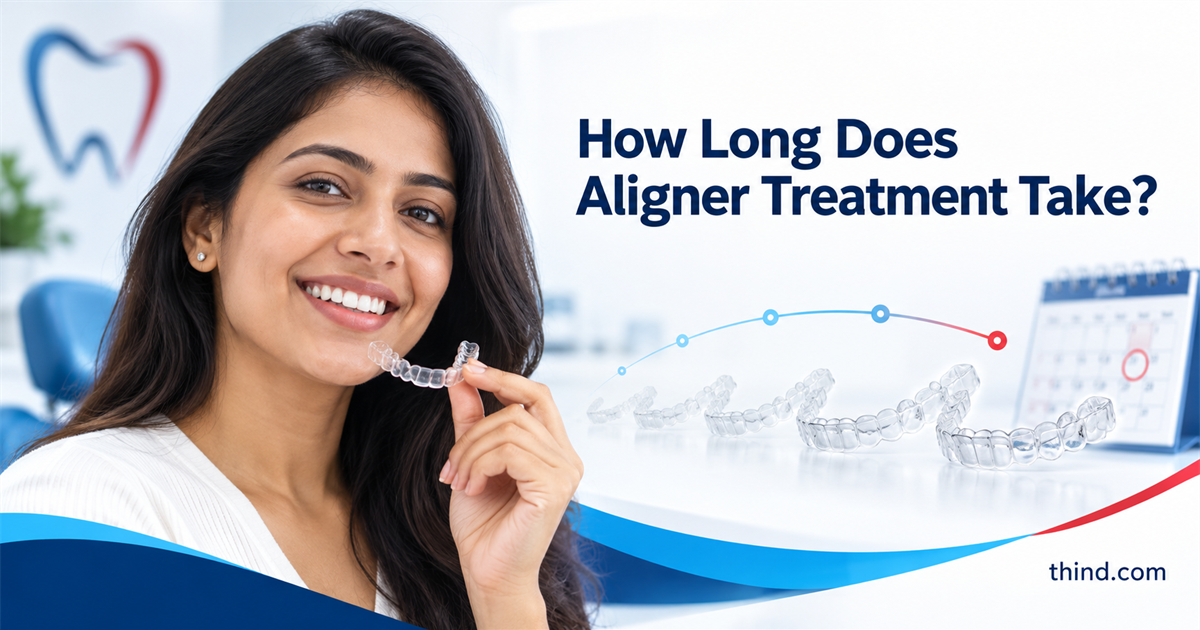
Aligner treatment usually falls inside the 6 to 36 month window that applies to orthodontics in general, and simpler cases sit at the shorter end. The Harvard School of Dental Medicine notes that comprehensive orthodontic treatment of any kind runs between 6 and 36 months. In a 2020 cohort of 155 aligner patients, average treatment lasted about 14 months. Your own timeline depends on how crowded or misaligned your teeth are, how many hours a day you wear the trays, and whether a refinement stage is needed. A scan-based plan from your dentist gives the most reliable estimate.
Clear aligners are a series of custom-made, removable plastic trays that move teeth in small steps. They are one of several tools used in orthodontics, the branch of dentistry that corrects tooth and jaw alignment. You can read the general background on clear aligners before comparing options.
How Long Does Treatment Really Take, and Why Is the Range So Wide?
The honest answer is a range, not a number: the Harvard School of Dental Medicine states that comprehensive orthodontic treatment can vary between 6 and 36 months, depending on how severe the problem is and how well the patient follows care instructions. Aligners sit inside that same window, not outside it.
A real-world snapshot comes from a 2020 study in Progress in Orthodontics. In that cohort, Hansa, Semaan and Vaid reported mean aligner treatment of 14.58 months in one group and 13.91 months in the other, across 155 patients. Those patients also needed an average of 0.79 to 1.00 refinement rounds each.
Are Aligners Actually Faster Than Braces?
For mild to moderate cases, often yes, but for complex cases the evidence is mixed. The Ke meta-analysis pooled three studies and reported a weighted mean difference of -6.31 months (95% CI -8.37 to -4.24) in favour of aligners.
A broader 2022 overview in Clinical Oral Investigations looked at more evidence. Yassir and colleagues reviewed 18 systematic reviews, selected from 361 potentially eligible ones, and concluded there were conflicting results regarding treatment duration. They added that aligner treatment may be associated with shorter treatment in mild to moderate cases.
In plain terms, aligners can save months when the problem is simple, but they are not automatically quicker for every mouth.
What Makes Aligner Treatment Take Longer?
Three things drive most delays: the starting complexity of the bite, inconsistent wear, and refinement rounds. The table below links each factor to its effect and to what you can influence.
| Factor | How it affects the timeline | Can you influence it? |
|---|---|---|
| Severity of crowding, gaps or bite problems | More complex movement means more trays and more months | No, but accurate planning sets realistic expectations |
| Daily wear time | Trays worn too little move teeth slowly and can force repeats of earlier stages | Yes, entirely |
| Refinement rounds | Final fine-tuning adds a stage after the main series is complete | Partly, through good planning and consistent wear |
| Missed or delayed check-ups | Problems are caught late, so corrections take longer | Yes |
| Age and tooth condition | Gum health and bone support affect how safely teeth can be moved | Partly, by treating gum issues first |
Refinements are normal rather than a sign of failure. In the Hansa cohort, patients averaged close to one refinement round, so planning for one is more realistic than hoping to avoid it.
Why Does a Reliable Timeline Matter More Than a Fast One?
Because crooked or crowded teeth are common, and an unclear timeline makes the decision to start easy to postpone. A 2021 systematic review in the Journal of Oral Biology and Craniofacial Research found that Balachandran and Janakiram pooled a malocclusion prevalence of 35.40 percent among Indian children aged 8 to 15, across 54 studies and 97,959 participants. A malocclusion is simply a misalignment of the teeth or bite.
The cost of waiting is rarely dramatic, but it is real. Treatment decisions get pushed past weddings, promotions and busy seasons, and every postponed year is a year of living with the same alignment concern.
How Should You Judge an Aligner Timeline Before You Start?
A trustworthy timeline is built from your own scans and a written plan, not from a marketing promise. Treat these as the criteria that matter most.
- A timeline based on digital scans and a preview of your tooth movement, not a generic estimate.
- Hygiene and sterilisation standards that are independently verified, such as NABH approval.
- One consistent dentist team who will see you through every stage, including refinements.
- Clinic locations and appointment times that fit a working schedule, since missed visits add months.
- Pricing agreed in writing, in rupees and inclusive of GST, with refinements explained in advance.
What Should You Look for Before Starting Aligners?
Use this checklist to compare any clinic, anywhere in India.
- Ask for a digital scan and a visual preview of the planned tooth movement before you commit.
- Ask for the expected number of trays, the expected number of check-ups, and whether refinements are included.
- Ask what happens if your wear time slips, and how the plan is adjusted.
- Ask which retainer you will use afterwards, and how long it should be worn.
- Confirm that your gums and teeth are checked and treated before any tooth movement begins.
- Check for hygiene accreditation, and for modern options such as laser dentistry if comfort is a concern.
Where Can You Get a Timeline You Can Rely On in Ludhiana?
Thind Dental Clinic is a NABH-approved general and cosmetic dentistry practice with three clinic locations in Ludhiana, Punjab, led by Dr. Rajanbir Singh Thind and Dr. Gurinder Kaur Thind. The team offers clear aligners and orthodontics alongside smile makeovers, laser dentistry and implants, so your plan is built around your whole mouth rather than one treatment.
If you want a realistic number of months for your own teeth, you can book a free smile assessment and consultation at thind.com. You will leave with a clear explanation of your options, and you can decide at your own pace on the treatment that fits your schedule.
Frequently Asked Questions
How many months do aligners usually take?
The Harvard School of Dental Medicine gives a 6 to 36 month range for orthodontic treatment in general, and aligners sit inside that range. Simple alignment problems sit at the shorter end. A scan-based plan gives your own estimate.
Can severe crowding increase treatment time?
Yes. Crowded teeth need to move further, which usually means more trays, more check-ups and a higher chance of a refinement stage. A clear plan and consistent wear keep that extra time as small as possible.
Can inconsistent aligner use delay results?
Yes. Aligners only move teeth while they are in your mouth, so trays worn for too few hours each day slow progress and can force you to repeat a stage. Wearing them as prescribed is the single biggest factor within your control.
Can aligners work faster than braces?
For mild to moderate cases they often do. A 2019 meta-analysis found aligner patients finished about 6.3 months sooner, though a 2022 overview found the evidence on duration is conflicting overall.
Will retainers be needed after aligners?
Yes, in most cases. Retainers hold your teeth in their new position after the active stage ends. Your dentist will tell you how long and how often to wear them.
Sources
- Ke Y, Zhu Y, Zhu M. A comparison of treatment effectiveness between clear aligner and fixed appliance therapies. BMC Oral Health, 2019;19:24
- Yassir YA, Nabbat SA, McIntyre GT, Bearn DR. Clinical effectiveness of clear aligner treatment compared to fixed appliance treatment: an overview of systematic reviews. Clinical Oral Investigations, 2022;26:2353-2370
- Hansa I, Semaan SJ, Vaid NR. Clinical outcomes and patient perspectives of Dental Monitoring GoLive with Invisalign: a retrospective cohort study. Progress in Orthodontics, 2020;21:16
- Balachandran P, Janakiram C. Prevalence of malocclusion among 8-15 years old children, India: a systematic review and meta-analysis. Journal of Oral Biology and Craniofacial Research, 2021;11(2):192-199
- Harvard School of Dental Medicine. How long does orthodontic treatment take?
- Wikipedia: Clear aligners
- Wikipedia: Orthodontics
- Wikipedia: Malocclusion
- Wikipedia: Retainer (orthodontics)