*Published: August 11, 2026 | Last updated: August 11, 2026*
**Dr. Rajanbir Singh Thind, Thind Dental Clinic**
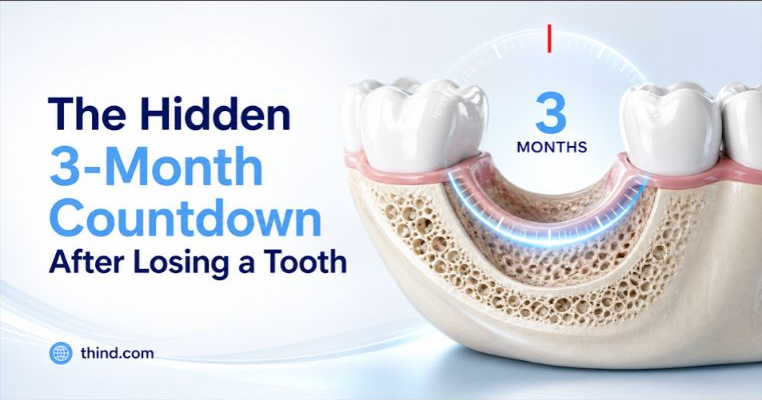
Losing a tooth starts a countdown most people never hear about: the jawbone beneath the gap can lose a large share of its width within months, not years. Replacing a missing tooth is not just about restoring a smile. It is a race against bone loss, bite changes, and shifting neighboring teeth.
**Quick answer:** The three main ways to replace a missing tooth are dental implants, bridges, and dentures, and each affects the jawbone differently. A [dental implant](https://en.wikipedia.org/wiki/Dental_implant) acts as an artificial root and slows bone loss, with survival rates above 90% at 10 years according to a 2024 study in Clinical Oral Investigations. A [dental bridge](https://en.wikipedia.org/wiki/Bridge_\(dentistry\)) is faster and cheaper but relies on neighboring teeth for support, while [dentures](https://en.wikipedia.org/wiki/Dentures) are the least invasive option but do the least to protect the bone underneath. The right choice depends on the size of the gap, your bone health, budget, and how soon you act after losing the tooth.
## **What Actually Happens Inside Your Jaw After You Lose a Tooth?**
A tooth root normally keeps the jawbone around it stimulated and healthy. Once that root is gone, the bone starts to resorb almost immediately, and the loss is measurable within weeks.
A 2022 review published in the [Journal of Research in Medical and Dental Science](https://www.jrmds.in/articles/changes-in-alveolar-bone-dimension-after-extraction-sockets-and-methods-of-ridge-preservation-94906.html) found that the ridge of bone around an extraction site can lose 40% to 60% of its width and height in as little as three months. The same review cites earlier research showing the ridge can shrink by up to 50% in width within a year of losing the tooth.
This is why dentists rarely say “wait and see” about a missing back tooth. The bone that would anchor a future implant is disappearing while you wait, which is also why timing matters as much as the treatment you eventually choose.
## **How Many People in India Are Actually Living With Unreplaced Missing Teeth?**
A meaningful share of Indian adults have already lost all their natural teeth, and many more are missing individual teeth they never replaced. A study using data from the World Health Organization’s Study on global AGEing and adult health, published in the [International Journal of Environmental Research and Public Health](https://www.mdpi.com/1660-4601/11/11/11308) (Peltzer et al., 2014), found that 16.3% of Indian adults aged 50 and older were completely edentulous, meaning they had no natural teeth left at all.
That figure covers only complete [tooth loss](https://en.wikipedia.org/wiki/Tooth_loss). It does not count the far larger number of people walking around with one or two gaps they have simply learned to live with, chewing on one side, or avoiding certain foods entirely.
## **Why Does One Missing Tooth Affect the Teeth Next to It?**
A gap does not stay empty. Neighboring and opposing teeth gradually tip, drift, and extrude into the space, which changes your bite over time.
Dr. Avinash Bidra, National Chair of National Prosthodontics Awareness Week at the [UConn School of Dental Medicine](https://today.uconn.edu/2014/04/missing-teeth-more-common-than-you-think/), put it plainly: “When you lose even a single tooth, it will result in bone loss, change the bite, cause food impaction and result in adjacent teeth moving towards the missing space.”
Once teeth have drifted and the bite has shifted, replacing the original gap becomes more complicated and often more expensive than it would have been at the start.
## **Why Is Tooth Replacement Changing So Fast in 2026?**
Patient behavior around missing teeth is shifting from “live with it” to “fix it properly,” and the numbers back that up. According to a January 2026 report by [Astute Analytica](https://www.globenewswire.com/news-release/2026/01/26/3225725/0/en/india-dental-implant-market-projected-to-reach-us-300-71-million-by-2035-supported-by-demographic-trends-and-expanding-treatment-adoption-says-astute-analytica.html), India’s dental implant market was valued at US$153.01 million in 2025 and is projected to reach US$300.71 million by 2035, growing at a compound annual rate of 6.99%.
Part of this shift is confidence in long-term results. A 2024 meta-analysis in [Clinical Oral Investigations](https://link.springer.com/article/10.1007/s00784-024-05929-3) (Schiegnitz et al.) found implant survival rates above 90% at the 10-year mark, with roughly 4 out of 5 implants still functioning after 20 years, the longest follow-up period studied to date.
Digital scanning and 3D treatment planning have also made it easier to predict outcomes before treatment even begins, which is a large part of why more patients are choosing to replace a tooth rather than leave a gap.
## **Dental Implants vs Bridges vs Dentures: Which Option Actually Fits You?**
There is no single “best” option. Each replacement type trades off differently on bone protection, durability, number of visits, and upfront cost, so the right fit depends on your specific gap and priorities.
| Option | Protects jawbone? | Typical lifespan | Involves neighboring teeth? | Approximate cost range (INR)\* |
| :—- | :—- | :—- | :—- | :—- |
| Dental implant | Yes, acts as an artificial root | 15+ years, often decades with care | No, stands independently | ₹25,000 to ₹90,000 per tooth |
| Dental bridge | No, does not stop resorption | 8 to 15 years typically | Yes, anchored to adjacent teeth | ₹4,000 to ₹15,000 per unit |
| Dentures (partial or complete) | No, bone continues to shrink | 5 to 8 years before refitting | Partial dentures may clasp onto teeth | ₹5,000 to ₹40,000+ |
\*Prices vary by clinic, materials, and city, and are typically quoted inclusive of applicable GST. These are general market ranges, not a quote from any single provider.
## **How Should You Actually Decide Between These Options?**
Choosing a tooth replacement is less about which treatment sounds most advanced and more about matching the option to your bone health, timeline, and how the gap affects your daily life. A few criteria matter more than most people realize.
> * **How much bone is left at the site.** Waiting months after losing a tooth can shrink the available bone, which affects whether an implant is straightforward or needs bone grafting first.
> * **How the treatment is planned, not just performed.** Clinics using digital scans and 3D imaging can show you the plan before starting, rather than deciding mid-treatment.
> * **How the option affects your other teeth.** A bridge relies on grinding down healthy neighboring teeth, while an implant does not touch them at all.
> * **How many visits and how much downtime it realistically takes.** Busy professionals often rule out options requiring frequent, spread-out appointments.
> * **How transparent the cost estimate is upfront.** A clear, written treatment plan and cost breakdown before you commit prevents surprises midway through care.
## **What Should You Look for Before Booking Any Tooth Replacement Treatment?**
A good outcome depends as much on the clinic and process as on the treatment itself. Before booking anything, it is worth checking for the following:
> * A clinic that performs a full-mouth digital scan or X-ray before recommending a specific treatment, rather than guessing from a visual check.
> * Visible, verifiable hygiene standards, ideally a nationally recognized accreditation rather than just a clean-looking waiting room.
> * Dentists who explain multiple options (implant, bridge, denture) with honest trade-offs, instead of pushing one treatment by default.
> * A written cost estimate with no vague “we’ll decide later” pricing for the core procedure.
> * Experience specifically with the type of replacement you need, not just general dentistry.
> * A location and scheduling setup that fits around a working professional’s calendar, not the other way around.
Everything on that checklist points toward the same conclusion: the clinic matters as much as the material used in your mouth.
This is exactly the gap Thind Dental Clinic was built to close. As an NABH-approved clinic across three locations in Ludhiana, run by Dr. Rajanbir Singh Thind and Dr. Gurinder Kaur Thind, the practice combines digital diagnostics, laser dentistry, and a husband-wife dentist team with decades of combined experience in implants, bridges, and full smile restoration. You can [explore tooth replacement options and pricing on thind.com](https://www.thind.com/), including [details on the clinic’s implant and laser dentistry services](https://www.thind.com/).
If you have been putting off replacing a missing tooth, the most useful next step is not necessarily committing to a treatment today. It is getting a clear, honest picture of your bone health and options before more time passes. You can [book a free smile assessment and consultation](https://www.thind.com/) to get a digital scan, a straightforward explanation of your options, and a written cost estimate, with no pressure to decide on the spot. You can also [check current clinic locations and appointment availability](https://www.thind.com/) before you visit.
## **Frequently Asked Questions**
**How long can I safely wait before replacing a missing tooth?**
There is no universally safe waiting period, but research shows meaningful bone loss can begin within the first three months. The longer you wait, the more likely you will need additional procedures, such as bone grafting, before an implant can be placed.
**Is a dental implant always better than a bridge?**
Not always. Implants generally protect the jawbone better and last longer, but a bridge can be a reasonable choice when the adjacent teeth already need crowns or when bone grafting is not an option. The right choice depends on your specific gap and overall dental health.
**Do dentures stop the jawbone from shrinking?**
No. Dentures rest on top of the gum and bone rather than replacing the root, so the bone underneath continues to resorb over time. This is why denture fit often changes and refitting is commonly needed every few years.
**Can one missing tooth really affect teeth that are still healthy?**
Yes. Neighboring and opposing teeth can tip, drift, or extrude into the empty space over time, gradually changing your bite. Left unaddressed, this can make future treatment more complex than replacing the original gap early.
**How much does a dental implant cost in India as of 2026?**
Costs vary by city, material, and case complexity, but single-tooth implants in India commonly range from roughly ₹25,000 to ₹90,000 per tooth, inclusive of applicable GST. A clinic should give you a written estimate after a proper scan rather than a phone-quoted number.
**Is replacing a missing tooth a painful procedure?**
Modern techniques, including laser and digitally guided approaches, have significantly reduced discomfort compared to older methods. Most patients describe the experience as far less painful than the toothache or dental problem that led them to treatment in the first place.
## **Sources**
> * [Changes in Alveolar Bone Dimension after Extraction Sockets and Methods of Ridge Preservation, Journal of Research in Medical and Dental Science, 2022](https://www.jrmds.in/articles/changes-in-alveolar-bone-dimension-after-extraction-sockets-and-methods-of-ridge-preservation-94906.html)
> * [Peltzer et al., Prevalence of Loss of All Teeth (Edentulism) and Associated Factors in Older Adults in China, Ghana, India, Mexico, Russia and South Africa, International Journal of Environmental Research and Public Health, 2014](https://www.mdpi.com/1660-4601/11/11/11308)
> * [India Dental Implant Market Projected to Reach US$300.71 Million by 2035, Astute Analytica, January 2026](https://www.globenewswire.com/news-release/2026/01/26/3225725/0/en/india-dental-implant-market-projected-to-reach-us-300-71-million-by-2035-supported-by-demographic-trends-and-expanding-treatment-adoption-says-astute-analytica.html)
> * [Schiegnitz et al., How Far Can We Go? A 20-Year Meta-Analysis of Dental Implant Survival Rates, Clinical Oral Investigations, 2024](https://link.springer.com/article/10.1007/s00784-024-05929-3)
> * [Missing Teeth? More Common Than You Think, UConn Today, 2014](https://today.uconn.edu/2014/04/missing-teeth-more-common-than-you-think/)