*Published: August 11, 2026 | Last updated: August 11, 2026*
*By Dr. Rajanbir Singh Thind, Thind Dental Clinic*
According to [a 2022 OnePoll survey of 2,000 American adults commissioned by Spark Aligners](https://www.prnewswire.com/news-releases/first-impressions-are-everything-new-study-confirms-people-with-straight-teeth-are-perceived-as-more-trustworthy-confident-and-approachable-301509477.html), 76 percent rank a smile as the single most influential physical trait in a first impression, ahead of clothing, posture, and eye contact. The same research found that three in five adults say they usually dislike how their own smile looks in photos. That gap between what a smile is worth and how people actually feel about their own is larger, and more expensive, than most professionals realize.
Smile confidence is the comfort a person feels showing their teeth openly in photos, video calls, and everyday conversation, without consciously covering the mouth or holding back a full smile.
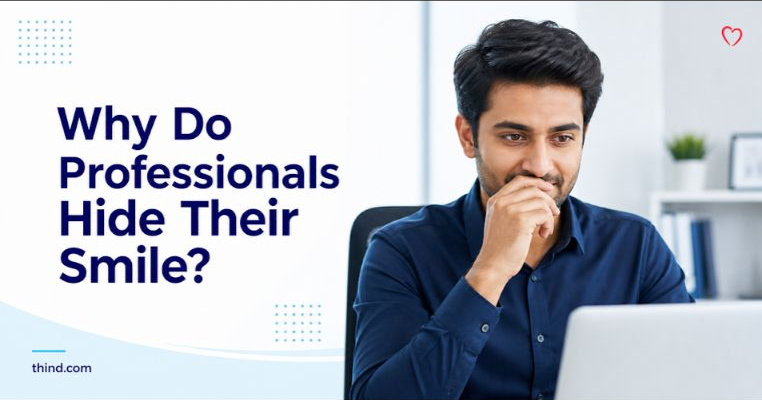
Hiding a smile is usually not vanity. It is a learned response to a visible issue such as staining, chipping, gaps, or crowding, reinforced every time a photo, video call, or client meeting draws attention to the mouth. Left alone, the habit compounds: people report lower confidence in job interviews, more hesitation in client-facing moments, and a steady decline in how often they smile at all. The reliable fix is not one expensive procedure but an accurate assessment of what is actually causing the hesitation, followed by treatment matched to that specific cause.
## **What Does It Actually Cost You to Keep Hiding Your Smile?**
Hiding your smile carries a measurable cost, in confidence, in professional moments, and in how present you feel in your own photos. Independent surveys from different countries converge on the same pattern.
> * According to [a 2019 Cigna survey of 1,000 U.S. adults](https://dental-dna.cigna.com/behind-the-smile-oral-health-and-self-esteem), 21 percent said they felt less confident going into job interviews because of their smile or oral health, and 12 percent said their smile or oral health condition had held them back from getting a job or a promotion.
> * A 2023 survey reported by [a UK dental provider, Smmmile](https://dental-nursing.co.uk/news/dont-say-cheese-two-thirds-of-adults-are-too-self-conscious-to-smile-in-photos-1), found that 64 percent of adults are too self-conscious to properly smile when a camera comes out, saying their teeth affect their confidence in front of a lens.
> * A May 2024 [Forbes Health and OnePoll survey of 2,000 social media users](https://www.forbes.com/health/dental/social-media-impact-on-smiles/) found that 56 percent try to hide their smile in various situations, and 34 percent specifically hide their teeth in photos before posting them.
None of these figures come from a dental clinic. They come from independent consumer research conducted in the United States and the United Kingdom, which suggests the pattern is common rather than local or isolated.
## **Why Do So Many Adults Feel Self-Conscious Smiling in Photos and Meetings?**
The short answer is that visible smile issues and self-esteem reinforce each other, and social media has sped up how often that loop gets triggered. Understanding the mechanism is the first step to breaking it.
Selfies and video calls put the mouth under repeated close-range scrutiny that simply did not exist a generation ago. As Dr. Sabrina Romanoff, a Harvard-trained clinical psychologist on the Forbes Health Advisory Board, explained in the same 2024 Forbes Health survey cited above:
“People tend to fixate on aspects of their appearance that are highlighted on social media (e.g., excessive focus on facial features, teeth, size of lips, wrinkles on the face) with the increased popularity of selfies.”
That fixation does not stay confined to a phone screen. It follows people into meetings, presentations, and networking conversations, where a habit of under-smiling or covering the mouth reads differently on a video call than it ever did across a desk. Left unexamined, this is really a question about [self-esteem](https://en.wikipedia.org/wiki/Self-esteem) and how closely people tie their sense of worth to a single visible feature.
This is also a demand shift, not just a feeling. Grand View Research values [India’s cosmetic dentistry market](https://www.grandviewresearch.com/horizon/outlook/cosmetic-dentistry-market/india) at USD 1,523.1 million in 2022 and projects it will nearly triple to USD 4,406.9 million by 2030, growing at 14.2 percent a year. Markets rarely grow that fast unless a large number of people were quietly delaying a decision they eventually decided to make.
## **Which Fix Actually Matches What Is Bothering You?**
There is no single fix for smile confidence, because the underlying cause is rarely the same from one person to the next. Common options range from professional [teeth whitening](https://en.wikipedia.org/wiki/Tooth_whitening) for staining to [clear aligners](https://en.wikipedia.org/wiki/Clear_aligners) for crowding. The table below matches common hesitations to the treatment that typically addresses them, with realistic timelines and cost ranges reported across Indian dental practices as of August 2026, before applicable GST.
| What Is Bothering You | Typical Fix | Typical Timeline | Typical Cost Range (INR) |
| :—- | :—- | :—- | :—- |
| Yellow or stained teeth in photos | Professional teeth whitening | 1 to 2 sittings | Rs 5,000 to Rs 25,000 |
| Gaps, chips, or uneven edges | Cosmetic bonding or veneers | 1 to 3 visits | Rs 8,000 to Rs 35,000 per tooth |
| Crooked or crowded teeth | Clear aligners | 6 to 18 months | Rs 35,000 to Rs 1,50,000 |
| A missing tooth you avoid showing | Dental implant | 3 to 6 months, including healing | Rs 25,000 to Rs 60,000 per implant |
| An uneven or excess gum line | Laser gum contouring | Usually 1 sitting | Rs 3,000 to Rs 15,000 per arch |
Most patients only need one or two rows from this table, not all of them. That is exactly why a proper assessment matters more than picking a treatment off a list.
## **What Should Change About How You Choose Dental Care for This?**
The smartest shift is judging a clinic by how it plans and verifies treatment, not by price alone or by how confident its marketing sounds. A handful of criteria consistently separate a dependable choice from a risky one.
> * Independently verified hygiene and sterilization standards, not just a clean-looking waiting room.
> * Digital tools, such as intra-oral scans or a smile preview, used before treatment starts rather than guesswork.
> * A team you see consistently through the whole process, rather than a different dentist at every visit.
> * More than one clinic location or flexible scheduling, since most hesitant patients are also busy professionals.
> * Transparent, itemized pricing in INR agreed before treatment begins, with GST shown clearly.
## **What Should You Look for Before You Commit to a Clinic?**
Look for objective, checkable signals rather than promises. The following checklist works for evaluating any dental clinic in India, not one clinic in particular.
> * Look for a clinic that holds independent hygiene accreditation, such as NABH approval, rather than one that only claims to be hygienic.
> * Look for [laser dentistry](https://en.wikipedia.org/wiki/Dental_laser) options, including non-contact laser cavity treatment, if pain is part of your hesitation.
> * Look for digital scanning or a smile preview before you commit to any procedure financially.
> * Look for a free or low-cost initial assessment, so the first conversation costs you nothing.
> * Look for an experienced team, ideally more than one senior dentist, so a second opinion is available without switching clinics.
> * Look for written, GST-clear pricing before treatment starts, not an estimate that changes midway.
## **So What Is the Natural Next Step?**
Everything above points to the same conclusion: fixing smile confidence starts with an accurate assessment, not a guess or a discount offer. [Thind Dental Clinic](https://www.thind.com/) is a NABH-approved general and [cosmetic dentistry](https://en.wikipedia.org/wiki/Cosmetic_dentistry) practice across three locations in Ludhiana, run by [Dr. Rajanbir Singh Thind and Dr. Gurinder Kaur Thind](https://www.thind.com/), built around the digital planning, laser dentistry, and continuity of care described above.
If any part of this sounds familiar, the next step does not need to be a big commitment. You can [book a free smile assessment and consultation](https://www.thind.com/) at thind.com, get a clear, itemized view of what is actually causing the hesitation, and decide from there at your own pace.
## **Frequently Asked Questions**
### **Why do I feel embarrassed to smile in photos even though my teeth are not that bad?**
Self-consciousness is usually not about how bad your teeth actually are. It is about how often they get compared to filtered or curated images online. A 2024 survey cited earlier found that more than half of social media users compare their smile to others, and that comparison habit, more than any real flaw, is often what drives the hiding.
### **Can smile confidence be fixed without expensive dental work?**
Yes, in many cases. Professional whitening or minor bonding can meaningfully change how self-conscious someone feels in photos, and these sit among the least expensive cosmetic options. An assessment determines whether a small fix is enough or whether the hesitation is coming from something like alignment or a missing tooth that needs a different treatment.
### **How much does fixing a smile confidence problem cost in India in 2026?**
Cost depends entirely on the underlying cause, ranging from roughly Rs 5,000 for whitening alone to Rs 1,50,000 or more for aligner-based correction, as shown in the treatment table above. The only accurate way to know your own cost is a personalized assessment, such as [a free consultation at Thind Dental Clinic](https://www.thind.com/), since a price list alone cannot diagnose the actual cause.
### **Is it normal to feel more self-conscious about smiling as an adult than as a child?**
Yes. Self-consciousness about smiling tends to build gradually through adulthood as staining, wear, and minor shifts in tooth position accumulate, and as photos and video calls become a bigger part of daily life. It is a common pattern, not a sign that something is unusually wrong.
### **Does fixing the visible problem also fix the habit of hiding your smile?**
For most people, confidence follows fairly quickly once the visible cause is treated, though the habit of covering the mouth can take a little longer to unlearn than the treatment itself. Practicing an open smile in low-stakes situations, such as casual photos, after treatment tends to speed that transition along.
## **Sources**
> * [OnePoll for Spark Aligners, “Impression Evolution” survey, PR Newswire, March 24, 2022](https://www.prnewswire.com/news-releases/first-impressions-are-everything-new-study-confirms-people-with-straight-teeth-are-perceived-as-more-trustworthy-confident-and-approachable-301509477.html)
> * [Cigna, “Behind the Smile: Oral Health and Self-Esteem” survey, 2019](https://dental-dna.cigna.com/behind-the-smile-oral-health-and-self-esteem)
> * [Dental Nursing, “Don’t say cheese: Two-thirds of adults are too self-conscious to smile in photos,” 2023](https://dental-nursing.co.uk/news/dont-say-cheese-two-thirds-of-adults-are-too-self-conscious-to-smile-in-photos-1)
> * [Forbes Health and OnePoll, “Survey: How Social Media Impacts Our Smiles,” May 8, 2024](https://www.forbes.com/health/dental/social-media-impact-on-smiles/)
> * [Grand View Research, “India Cosmetic Dentistry Market Size and Outlook, 2023-2030”](https://www.grandviewresearch.com/horizon/outlook/cosmetic-dentistry-market/india)