Published: September 11, 2026
Last updated: September 11, 2026
By Dr. Rajanbir Singh Thind, Thind Dental Clinic
A root canal is a procedure that removes infected or damaged pulp from inside a tooth, then cleans and seals it so the tooth stays in place. A tooth extraction is the complete removal of a tooth, usually followed by a bridge, denture, or implant. For a tooth that can still be treated, long-term data favors keeping it: a 2023 study following root canal treated teeth for up to 37 years found most were still functioning and pain free decades later, while extraction starts bone and bite changes within weeks. The better choice usually comes down to what happens to the jaw and neighboring teeth afterward, not which procedure sounds simpler.
What Does a 37-Year Study Show About Root Canal Treated Teeth?
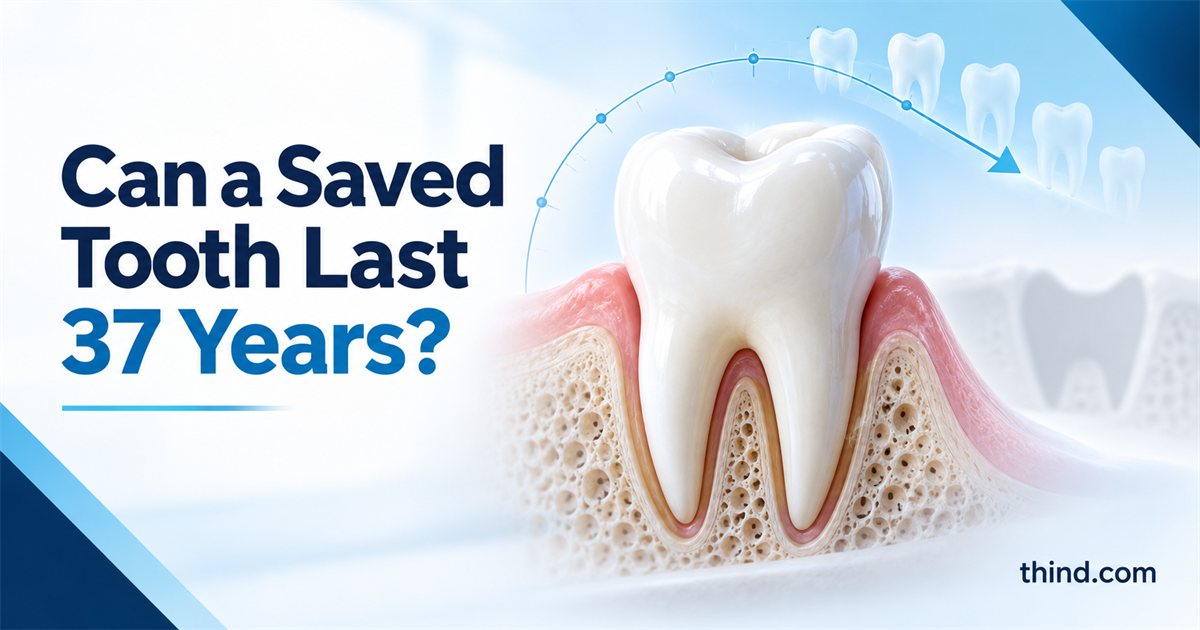
Root canal treated teeth can function for most of a lifetime when treatment happens in time. A 2023 retrospective study in Clinical Oral Investigations followed 598 root canal treated teeth in 312 patients for an average of 21 years, with some tracked for as long as 37 years.
The survival numbers held up well over time. Ninety-seven percent of treated teeth were still in painless function at 10 years, 81 percent at 20 years, and 68 percent even at the 37 year mark. Endodontic success, meaning no infection or symptoms visible on an X-ray, stayed above 80 percent from the 20 year point onward.
That is a different picture from how many people imagine a root canal treated tooth, as a temporary fix rather than a long-term one. As Ashraf F. Fouad, D.D.S., M.S., an endodontist at the University of Alabama at Birmingham School of Dentistry, put it in a UAB Dentistry interview: "Root canal treatment has a very high success rate. However, even for the small percentage that continue to have disease, an endodontist can perform re-treatment or a small surgery at the tip of the root to save many of these cases."
What Happens to Your Jaw and Bite If a Tooth Is Extracted Instead?
Once a tooth is pulled, the bone that held it starts to shrink almost immediately, and neighboring teeth begin drifting into the gap within months. These changes are the real cost of extraction, and they happen whether or not the tooth is ever replaced.
Bone loss moves the fastest. A widely cited study by Schropp and colleagues, described in a review by Oral Health Group, found that the alveolar ridge, the bone that anchors the teeth, loses about 50 percent of its width within 12 months of extraction, with roughly two-thirds of that shrinkage happening in just the first three months.
Neighboring teeth move too. A 2019 study in Scientific Reports that tracked patients after premolar extraction found the adjacent molar tipped by an average of 6.76 degrees and shifted about 2.3 millimeters toward the empty space within just six months.
Both changes make later treatment harder. A shrunken ridge often needs bone grafting before a dental implant can be placed, and tilted neighboring teeth can throw off the bite well beyond the site of the original tooth.
Root Canal Treatment vs Tooth Extraction: How Do the Options Actually Compare?
Root canal treatment and extraction differ mainly in upfront cost, timeline, and what happens to the jawbone and bite afterward. The table below lays out typical figures for India as of 2026. Individual cases vary, so treat these as starting ranges rather than fixed quotes.
|
Factor |
Root canal treatment and crown |
Extraction and dental implant |
|---|---|---|
|
What stays in the mouth |
The natural tooth root and structure |
An artificial replacement anchored in the jawbone |
|
Typical cost per tooth in India |
Roughly ₹2,000 to ₹7,000 for the root canal itself, plus a crown (Clove Dental, 2024) |
Roughly ₹25,000 to ₹60,000 (Dental Arch India, 2026) |
|
Typical timeline |
1 to 2 visits for the root canal, then a separate crown fitting |
Extraction, a healing period of 3 to 6 months, then implant placement |
|
Effect on jawbone |
Minimal, since the natural root stays in place |
Ridge narrowing begins within weeks unless bone is preserved at the time of extraction |
|
Long-term outcome data |
Survival tracked up to 37 years in published research |
Depends heavily on implant integration and bone quality at placement |
Why Are Dentists Increasingly Trying to Save the Tooth Before Extracting It?
Dentistry has shifted toward preservation because the tools for detecting and treating problems early have improved faster than most patients realize. A tooth that once had to be pulled can often now be diagnosed accurately enough to save.
Digital imaging is a big part of this shift. Full mouth X-rays and intra-oral scans let a dentist see the actual extent of decay or infection before recommending a plan, rather than judging from a visual exam alone. The same symptom, like a toothache, can mean very different things depending on how far an infection has actually spread.
Cost plays a role too. As of September 2026, root canal treatment plus a crown remains the cheaper path per tooth compared with extraction followed by an implant, and it avoids the bone loss described above entirely. For a patient weighing options, lower cost combined with a tooth that still functions like a natural one is difficult to beat when the tooth can still be saved.
None of this means every tooth should be saved. Severely fractured roots, advanced gum disease, or teeth with too little remaining structure are still better candidates for extraction. The shift is toward making that judgment with better information, not toward saving teeth regardless of condition.
What Should Actually Decide Whether You Keep or Pull a Damaged Tooth?
The right decision depends on specific, checkable factors rather than instinct or fear. A patient can reasonably ask about each of these before agreeing to either option.
-
How much healthy tooth structure remains. A tooth with enough remaining structure to support a crown is usually a better candidate for a root canal than one fractured below the gum line.
-
Whether the infection has reached the bone. Digital X-rays or a scan can show this clearly, rather than relying on pain alone as a signal.
-
How the tooth fits into the surrounding bite. Losing a molar that other teeth depend on for chewing has different consequences than losing a tooth carrying less functional load.
-
Whether the diagnosis came from someone who can do both procedures. A dentist trained in both root canal treatment and implant placement has less reason to steer a recommendation toward whichever procedure they personally prefer to perform.
-
The realistic long-term cost, not just the upfront price. A cheaper extraction today can mean bone grafting, an implant, and a longer timeline later if the site is not managed well from the start.
What Should You Look for in a Clinic Before Making This Decision?
A short checklist can prevent a decision that is driven by convenience rather than the actual condition of the tooth.
-
Look for a clinic that takes a digital X-ray or intra-oral scan before recommending extraction, not after.
-
Look for a clinic that can explain, in plain language, why a tooth is or is not a good candidate for treatment.
-
Look for a clinic that follows documented, NABH-standard sterilization protocols and is willing to describe them when asked.
-
Look for a clinic where the same team can perform both root canal treatment and implant placement, so the recommendation is not limited by what one specialist happens to offer.
-
Look for a clinic that provides a written treatment plan with itemized costs before any procedure begins.
-
Look for a clinic with more than one location, since follow-up visits and crown fittings usually take more than a single appointment.
Where Should You Go From Here?
Thind Dental Clinic, an NABH-approved practice with three locations across Ludhiana, is built around exactly this kind of decision-making. Dr. Rajanbir Singh Thind and Dr. Gurinder Kaur Thind evaluate every damaged tooth with digital imaging before recommending root canal treatment, extraction, or a replacement option, and their team can carry out whichever path actually fits the tooth rather than only one specialty. The digital diagnostic imaging used at Thind Dental Clinic is the same kind of technology referenced throughout this article.
If a tooth has been bothering you, or you were told it needs to come out, it is worth getting a clear, unhurried look before deciding anything. You can book a free smile assessment and consultation to have that specific tooth examined and explained in plain language, with no pressure to choose on the spot. Thind Dental Clinic’s root canal and implant team can walk you through exactly what a root canal, an extraction, or a replacement would involve for your case, and what it would cost either way.
Frequently Asked Questions About Root Canal Treatment and Tooth Extraction
Is a root canal better than an extraction?
For a tooth that still has enough healthy structure and has not lost too much supporting bone, a root canal is usually the better option because it preserves the natural tooth and avoids the bone loss that follows extraction. Extraction is generally reserved for teeth that are too damaged, fractured, or infected to be saved.
Does a root canal hurt more than having a tooth pulled?
Modern root canal treatment is performed under local anesthesia and is not typically more painful than an extraction. Most of the discomfort historically associated with root canals came from the infection itself, not the procedure, and soreness after either option is usually manageable with standard aftercare.
How long does a root canal treated tooth actually last?
A 2023 study that followed root canal treated teeth for up to 37 years found survival rates of 97 percent at 10 years and 68 percent even at the 37 year mark. That is longer than most patients expect the first time they hear the words root canal.
What happens to the jawbone after a tooth is extracted?
The alveolar bone that supported the tooth begins to shrink almost immediately, with research showing about 50 percent of ridge width can be lost within the first year if nothing is done to preserve it. That bone loss can make a later implant more complicated if the site is not managed early.
Is it cheaper to get a root canal or to have a tooth extracted and replaced with an implant?
Root canal treatment plus a crown is typically less expensive per tooth than extraction followed by an implant, since implant treatment involves surgery, a healing period, and often additional bone grafting. The exact gap varies by clinic and case, but it is usually significant.
Can every damaged tooth be saved with a root canal?
No. Teeth with severe fractures below the gum line, advanced gum disease, or very little remaining healthy structure are usually better candidates for extraction, and a dentist should evaluate each case individually with imaging rather than assumption.