Published: September 12, 2026 | Last updated: September 12, 2026
Dr. Rajanbir Singh Thind, Thind Dental Clinic
A dental crown used to mean two separate visits: a messy putty impression, a temporary cap, and a two to three week wait while a lab built the real one. As of September 2026, many dentists finish that same crown in a single 50 to 90 minute appointment, designed and milled entirely inside the clinic.
Quick answer: Modern dental technology, intraoral scanners, chairside CAD/CAM crown systems, laser treatment, and AI-assisted diagnostics, is measurably cutting the time patients spend in old-style, multi-visit dental care. According to the American Dental Association, a ceramic crown that once needed a lab and a second visit can now often be completed chairside in 50 to 90 minutes. More than half of dentists already use digital scanners instead of traditional putty impressions, and laser-based treatment now lets many cavity procedures skip the injection altogether.
For anyone judging whether a clinic is genuinely current, these specific technologies, not marketing language, are the real test.
What Does "Digital Dentistry" Actually Mean?
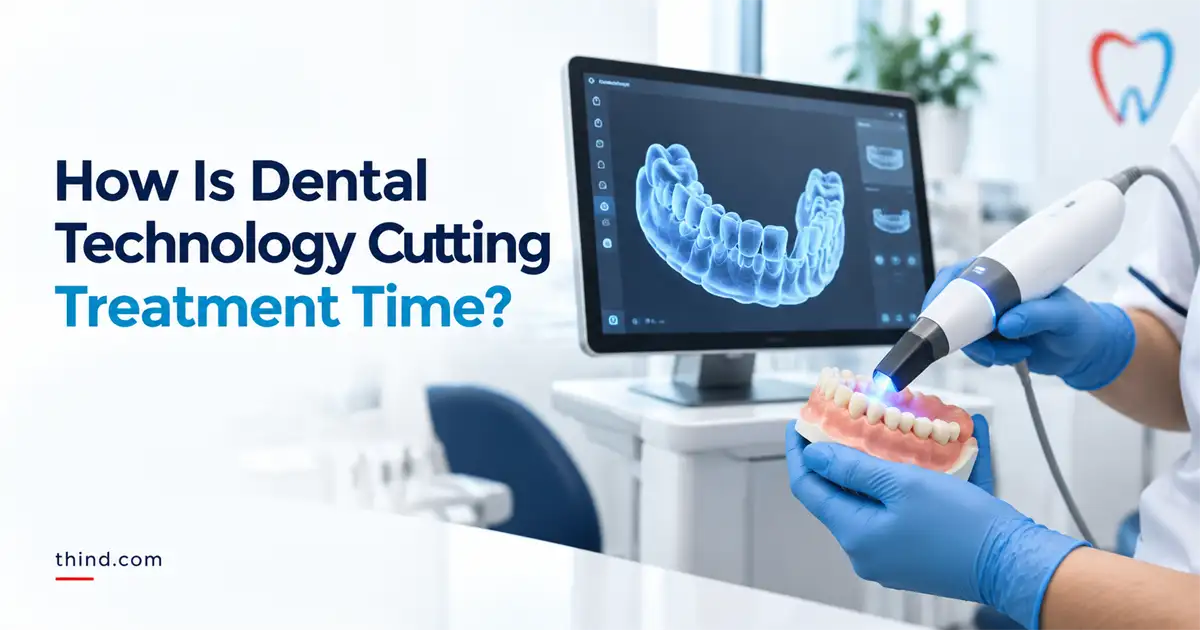
Digital dentistry is the use of computer-based technology, rather than manual tools and lab work, to plan, diagnose, and carry out dental treatment. It covers three main tools patients are most likely to encounter: intraoral scanners that replace putty impressions, CAD/CAM systems that design and mill restorations on site, and digital X-rays or AI-assisted imaging that help a dentist see problems more clearly.
None of this is science fiction. It is already standard equipment in a large share of dental practices, as of 2026.
How Much Time Does Old-Style Dental Treatment Actually Cost You?
Old-style, impression-and-lab treatment costs patients real time, and the gap between clinics that have modernised and clinics that have not is wider than most people assume. According to a 2021 American Dental Association ACE Panel report, only 53 percent of dentists surveyed used intraoral scanners at all, meaning close to half of practices were still relying on traditional putty impressions for procedures like crowns.
The same ADA report found that 66 percent of non-adopting dentists cited the cost of the equipment, not any clinical drawback, as their main reason for sticking with older methods. In other words, many patients are still waiting through multi-visit, lab-dependent treatment not because it works better, but because the clinic has not yet invested in the alternative. Among dentists who had adopted scanning, 70 percent said their main motivation was improved clinical efficiency, a telling sign of where the gap actually lies.
Why Do So Many Dental Visits Still Take Multiple Appointments?
Multiple appointments are usually a symptom of the workflow, not the treatment itself. A traditional crown has to leave the clinic: an impression is sent to an outside lab, the lab manufactures the restoration over days or weeks, and the patient returns wearing a temporary crown in between. Every extra handoff between clinic, courier, and lab adds days, and every day adds a small risk of a temporary crown loosening, breaking, or trapping food before the final piece is ready.
This is exactly the gap that chairside CAD/CAM dentistry was built to close. Dr. Jacob G. Park, D.D.S., a member of the ADA Council on Scientific Affairs and chair of the ADA Standards Committee on Dental Products’ Subcommittee 9 on CAD/CAM in Dentistry, described the shift plainly: "Today, I can complete a whole procedure, a single ceramic inlay, onlay or crown, in 50 to 90 minutes using a full chairside CAD/CAM system."
He added that more than 95 percent of his fixed restorations are now designed and fabricated in-house rather than sent out.
What Is Actually Changing Inside Dental Clinics Right Now?
Three specific technologies explain almost all of the time and comfort gains patients are starting to notice. Each one replaces a slower, less predictable manual step with a faster, more measurable digital one.
The first is the intraoral scanner, a wand-sized camera that builds a 3D digital model of the teeth in minutes, with no tray, no putty, and no gag reflex. Dr. Awab Abdulmajeed, D.D.S., M.S., Assistant Professor and Digital Dentistry Clinic Director at Virginia Commonwealth University’s School of Dentistry, put it directly: "The biggest benefit for patients is comfort, more efficient dental appointments, and faster turnaround times."
He added: "This ultimately reduces anxiety, time in the chair, and reduces the number of visits required."
The second is laser dentistry, which uses a focused beam of light instead of a drill for many cavity and soft-tissue procedures. According to a 2022 clinical study published in the journal Applied Sciences, 93 percent of laser procedures in the study were completed without any anaesthetic injection at all, and 98 percent of patients said they preferred laser treatment to conventional therapy.
Reported discomfort in that same study stayed below 3 on a 10 point pain scale across the group treated.
The third is AI-assisted diagnostic imaging, which cross-checks a dentist’s reading of an X-ray against a trained model. A 2025 study published in the journal Scientific Reports found that an AI platform detecting features such as fillings, missing teeth, and past root canal treatment on panoramic X-rays reached an accuracy range of 94.9 to 99.9 percent across the categories tested.
The technology is not meant to replace a dentist’s judgment as of 2026. It is meant to catch what a single glance might miss.
How Should You Actually Judge Whether a Clinic Is Up to Date?
The honest test of a modern clinic is not how new the waiting room looks. It comes down to five practical questions any patient can ask before booking treatment.
-
Does the clinic scan instead of scoop? A clinic that still relies only on putty impressions for routine crowns has not made the single biggest comfort upgrade available today.
-
Can restorations be finished on site? Chairside CAD/CAM removes the lab-and-temporary-crown cycle entirely for many cases.
-
Is laser treatment offered where appropriate? Not every procedure suits a laser, but its availability signals genuine investment in patient comfort.
-
Is diagnosis shown, not just described? Being shown your own scan or X-ray on a screen is a very different experience from being told what is wrong.
-
Does the clinic meet a recognised hygiene standard? Sterilisation protocols matter more than décor, and a nationally recognised accreditation is a more reliable signal than a clinic’s own claims.
Traditional Treatment vs. Digital-First Treatment
|
Step in Treatment |
Traditional Approach |
Digital-First Approach |
|---|---|---|
|
Taking an impression |
Putty tray impression, sometimes redone if inaccurate |
Intraoral scanner builds a 3D digital model in minutes |
|
Making a crown |
Sent to an outside lab; temporary crown worn for 1 to 3 weeks |
Designed and milled chairside, often within the same visit |
|
Diagnosing a problem |
Verbal explanation based on a static X-ray |
Patient views their own scan or digital X-ray on screen |
|
Treating a small cavity |
Local anaesthetic injection followed by a drill |
Laser-based treatment, often without an injection, for suitable cases |
What Should You Look for Before Booking Your Next Dental Appointment?
Use this as a practical checklist rather than a wish list. A clinic that checks most of these boxes has invested in the technology this article has been describing, not just the marketing around it.
-
Look for a clinic that shows you your own scan or X-ray on screen before recommending any treatment, rather than simply describing what it sees.
-
Look for a clinic that offers laser dentistry as an alternative to the traditional drill for cavities and minor soft-tissue procedures.
-
Look for hygiene and sterilisation protocols that are certified against a recognised national standard, not just described as "clean" on a website.
-
Look for a practice with more than one location, so a scheduling conflict at one site does not force you to start over somewhere new.
-
Look for a clinical team with years of experience working together, rather than a rotating roster of visiting dentists who do not know your history.
-
Look for treatment plans that are explained and priced clearly before you commit, with realistic timelines stated up front.
So What Does This Mean If You Are Choosing a Dentist in Ludhiana Right Now?
Everything covered above, digital scanning instead of putty, chairside CAD/CAM instead of lab delays, laser treatment instead of routine injections, and visible diagnosis instead of a verbal guess, is exactly what Thind Dental Clinic has built its NABH-approved practice around, across three locations in Ludhiana.
The clinic is run by Dr. Rajanbir Singh Thind and Dr. Gurinder Kaur Thind, whose combined experience runs through everything from routine scaling to full smile makeovers, implants, and clear aligner therapy.
If you have been putting off a dental visit because you associate it with long waits, guesswork, or an uncomfortable injection, that is precisely the experience this kind of technology was built to remove. You can see how the clinic’s laser and digital treatment options work before deciding on anything.
Your Next Step
The easiest way to find out where you actually stand is a proper look, not a guess based on symptoms alone. Thind Dental Clinic offers a free smile assessment and consultation that includes a digital scan, so you can see exactly what is happening in your mouth on screen before any treatment is proposed. There is no pressure to commit to anything during that visit, only a clear picture and a straightforward set of options explained in plain language.
If any part of what you read above sounds like the upgrade you have been waiting for, you can book your free consultation with Thind Dental Clinic at a time that works around your schedule.
Frequently Asked Questions
How does modern technology shorten dental treatment time?
Digital tools such as intraoral scanners and CAD/CAM systems remove several manual steps that traditional treatment requires, including lab turnaround and a second adjustment visit. A crown that once took two visits over two to three weeks can often be designed and completed chairside in about an hour, according to the American Dental Association. Laser dentistry adds further time savings for many cavity treatments by removing the need for a separate anaesthetic injection.
Are digital dental scans safer than traditional X-rays?
A digital intraoral scan itself uses no radiation, since it is an optical 3D scan rather than an X-ray. Digital X-rays, when used alongside scanning, generally use less radiation than older film-based X-rays. It is reasonable to ask your dentist about your specific imaging plan if radiation exposure is a concern.
How accurate are intraoral scans compared to traditional impressions?
Intraoral scanners are widely used for procedures such as single-tooth crowns, and most dentists who use them report being satisfied with the clinical results. Because the scan appears on screen immediately, a dentist can spot a gap or error and rescan on the spot, rather than send an impression away and find out weeks later. That immediate feedback is a major reason adoption has grown steadily among dentists.
Do digital impressions completely replace traditional putty molds?
For many procedures, including single crowns, digital scanning has replaced the traditional putty tray impression at clinics that have adopted the technology. Some complex, full-mouth cases may still combine both methods depending on a dentist’s judgment. The right approach depends on what is being treated, not on technology for its own sake.
Can digital scans and laser treatment actually make a dental visit more comfortable?
Yes. Patients generally find scanning far more comfortable than a traditional putty impression, which can trigger gagging and takes longer to set. Separately, laser-based treatment has let most patients in published studies skip the anaesthetic injection for suitable procedures, removing one of the more anxiety-inducing parts of a typical visit.