Published: September 7, 2026 | Last updated: September 7, 2026
Dr. Rajanbir Singh Thind, Thind Dental Clinic
India’s clear aligner market is on track to grow nearly tenfold in less than a decade, and the people driving that growth are not teenagers. As of 2026, adults already account for the large majority of aligner spending in the country, a shift that has quietly rewritten what "getting your teeth straightened" is supposed to feel like.
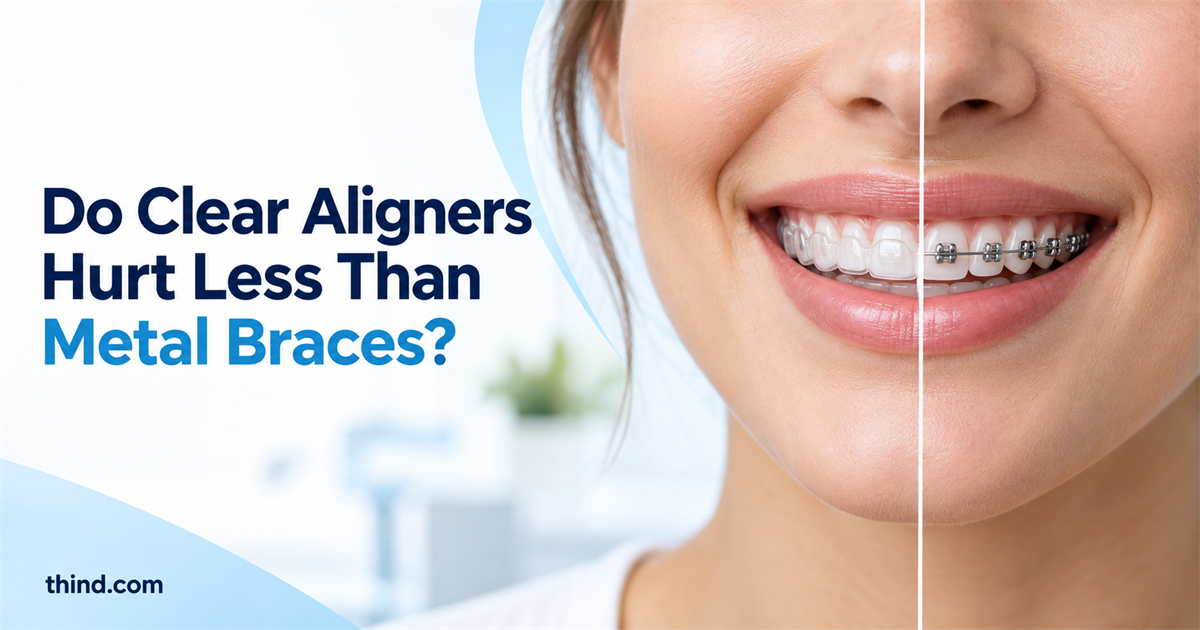
Quick answer: Clear aligners are generally less painful than traditional metal braces, according to a 2026 review pooling 32 clinical studies. The difference is largest in the first week after starting treatment or switching to a new aligner tray, when metal braces tend to cause noticeably sharper discomfort from wire tension and bracket friction. Aligners also scored better for gum health in the same review.
Comfort is not the only factor, though. Indian survey data shows most orthodontists still prefer fixed braces for severe misalignment, so the "less painful" option is not automatically the right one for every case. The honest answer depends on how crooked the teeth actually are, not just which option sounds gentler.
Clear aligners are a series of custom-fitted, removable plastic trays that gradually move teeth into position, replacing the need for fixed wires. Metal braces (or "traditional braces") are fixed brackets bonded to each tooth and connected by a wire that an orthodontist tightens over time. Both fall under orthodontics, the branch of dentistry focused on correcting bite and alignment problems, known clinically as malocclusion.
Why Do So Many Adults With Crooked Teeth Never Get Them Fixed?
Most adults with noticeable misalignment simply live with it, often for decades, because they assume straightening means years of visible metal and recurring pain. That assumption keeps a very large population untreated despite malocclusion being common, not rare.
The prevalence of malocclusion in India has been observed to range from 20% to 43% of the population, depending on the region studied, according to a review published in the Journal of Dental Health, Oral Disorders and Therapy in 2015. That range has held up as a rough benchmark for years because the underlying behavior, avoidance driven by fear of treatment, has not changed as fast as the technology has.
Meanwhile, despite that scale of need, India accounted for only about 2.7% of the global clear aligners market in 2025, according to Grand View Research’s 2025 India Clear Aligners Market Outlook. A large number of people who could benefit from a more comfortable option simply do not know it exists, or assume it costs far more than it realistically might for their case.
What Is Actually Changing in How Adults Straighten Their Teeth?
What is changing is scale, not just sentiment. Adults are now the single biggest group buying clear aligners in India, and the market behind that shift is expanding fast.
India’s clear aligner market was valued at roughly USD 223.6 million in 2025 and is projected to reach about USD 2,059.2 million by 2033, a compound annual growth rate of 31.7%, according to the same Grand View Research 2025 outlook. Adults already represented 77.15% of that market’s revenue in 2025, the largest segment by a wide margin, ahead of teens.
That growth is being driven partly by comfort data that simply did not exist in this form a few years ago. As of September 2026, a 2026 systematic review and meta-analysis published in BDJ Open, pooling 32 studies including 17 randomized controlled trials, found that patients using clear aligners reported significantly lower pain intensity than patients in fixed braces, with the gap widest one week into treatment. The same review found aligner patients also scored better on plaque and gum health measures across the studies analyzed.
Do Clear Aligners Really Hurt Less Than Metal Braces for Everyone?
No. Clear aligners tend to hurt less for typical mild-to-moderate cases, but Indian orthodontists themselves say aligners are not comfortable or reliable for severe misalignment. Case selection matters as much as the material used.
In a 2025 survey of 300 Indian orthodontists published in the International Journal of Applied Dental Sciences, 98% reported discomfort managing severe malocclusion cases with aligners, and 63% said they still preferred traditional fixed appliances overall. The same survey found 70.7% of respondents treat only 0 to 30 aligner cases per year, suggesting aligners are used selectively rather than as a default replacement for braces.
That nuance is the real takeaway: aligners are the more comfortable choice for the cases they suit well, not a universal upgrade. A clinic that recommends the same option for every case, aligners or braces, is skipping a step the evidence says matters.
|
Factor |
Clear Aligners |
Metal Braces |
|---|---|---|
|
Typical pain profile |
Lower overall pain intensity; mild pressure for 2 to 3 days after a new tray |
Higher pain intensity, especially after tightening visits |
|
Visibility |
Nearly invisible, removable for eating and photos |
Visible metal brackets and wire, fixed in place |
|
Best suited for |
Mild to moderate crowding, spacing, and alignment issues |
Severe malocclusion and complex bite corrections |
|
Daily discipline needed |
High; trays must be worn 20 to 22 hours a day to work as planned |
Low; no removal decisions once fitted |
|
Typical price band in India (2026 est.) |
Roughly ₹40,000 to ₹2,50,000 depending on brand and complexity |
Roughly ₹25,000 to ₹50,000 for standard metal braces |
Price bands are approximate and based on a 2026 industry cost guide published by FMS Dental; actual quotes vary by case complexity, clinic, and location.
What Should You Actually Look For When Choosing Between Aligners and Braces?
A smart patient chooses based on how a clinic evaluates their specific case, not on which option happens to be trending. These are the criteria the evidence above actually supports.
-
Digital case assessment before any recommendation. A clinic should use intra-oral scans or digital imaging to judge whether a case is mild, moderate, or severe before suggesting aligners or braces, not guess from a quick visual glance.
-
Recognized hygiene and safety accreditation. Since both options involve months of daily contact with dental hardware, a nationally recognized hygiene standard matters more than how clean a clinic looks on a given day.
-
Continuity of the same treating dentist. Aligner treatment usually involves a new tray every one to two weeks, so a dentist who has tracked the case from the start catches problems a rotating provider might miss.
-
Willingness to recommend braces when needed. A trustworthy provider should be comfortable suggesting the less comfortable option when the case calls for it, not the option that is easier to sell.
-
Transparent, written cost comparison. Because aligners and braces sit in very different price bands, a written breakdown before starting protects against surprise costs later.
"Movement of teeth with respect to jaws and joints is an extremely sensitive procedure and care should be taken to ensure the best possible results with minimal damage to enamel, roots, gums, bones and joints," said Dr. Rajaganesh Gautam, Executive Committee Member of the Indian Orthodontic Society.
That caution is worth taking seriously. It is also the strongest argument for professional supervision over any do-it-yourself aligner kit, regardless of how comfortable aligners are shown to be in properly supervised care.
What Should a Trustworthy Orthodontic Checklist Include?
Before starting either treatment, a short checklist protects against the two most common regrets: choosing the wrong option for the case, and choosing a provider without proper oversight.
-
Ask whether the clinic is NABH-accredited or holds an equivalent recognized hygiene and safety standard.
-
Ask to see a digital scan or X-ray of your own case before any treatment is recommended.
-
Ask how many aligner cases versus braces cases the clinic actually treats each year.
-
Ask who will see you at each visit, and whether it is the same dentist throughout treatment.
-
Ask for a written, itemized cost comparison between both options in rupees, including GST and any EMI or phased payment options.
-
Ask what happens if your case turns out to need braces after starting on aligners, or the reverse.
Where Does Thind Dental Clinic Fit Into This?
Thind Dental Clinic in Ludhiana is built around exactly this evidence-based, case-by-case approach rather than a one-size-fits-all sales pitch. As an NABH-approved clinic across three locations, run by the husband-wife dentist team of Dr. Rajanbir Singh Thind and Dr. Gurinder Kaur Thind, it uses digital scanning and laser dentistry to assess each case before recommending clear aligners, traditional braces, or another path entirely. Patients weighing clear aligner and metal braces treatment options at Thind Dental Clinic get a written, case-specific recommendation rather than a default answer.
For anyone who has been putting off straightening their teeth because they assumed every option meant years of visible discomfort, the most useful next step is simply finding out where their own case actually falls. Booking a free smile assessment and consultation with Thind Dental Clinic’s orthodontic team includes a digital scan and a clear, written comparison of what clear aligners and metal braces would each realistically involve, with no obligation to commit to either on the spot.
Frequently Asked Questions
Are invisible aligners painful to wear?
Most people feel mild pressure or soreness for two to three days after starting a new tray, which is a normal sign the teeth are moving. Research pooling 32 studies found this discomfort is generally less intense than the pain reported after metal braces are tightened.
Are aligners better than metal braces?
Aligners tend to be more comfortable and less visible for mild to moderate misalignment, but Indian orthodontist surveys show fixed braces are still preferred for severe cases. Which one is "better" depends on the specific case, not a fixed rule.
Will people notice I am wearing aligners?
Clear aligners are designed to be difficult to notice in everyday conversation or photos, especially compared with visible metal brackets and wires. Most people only notice on close inspection or when told directly.
How long does aligner treatment usually take?
Treatment length depends on how much correction is needed, but mild to moderate cases commonly take several months to around a year, while more complex cases can take longer. A same-day digital scan appointment at Thind Dental Clinic gives a realistic, case-specific timeline rather than a generic estimate.
Are aligners worth the cost compared to braces?
Aligners generally cost more than traditional metal braces in India, so the value comparison depends on how much an individual weighs comfort, appearance, and convenience against the price difference. Reviewing both options side by side during a consultation at Thind Dental Clinic makes the actual cost difference and expected outcome clear before deciding.
Sources
-
"India Clear Aligners Market Size and Outlook, 2026-2033." Grand View Research, 2025.
-
"Indian Orthodontic Society campaigns against at-home aligner treatment." Dental Tribune, 2022.
-
"Braces Cost in India: A Complete Guide to Orthodontic Treatments." FMS Dental, 2026.
-
"Cost of Invisalign and Other Clear Aligners in India." FMS Dental, 2026.