Published: September 6, 2026
Last updated: September 6, 2026
Dr. Rajanbir Singh Thind, Thind Dental Clinic
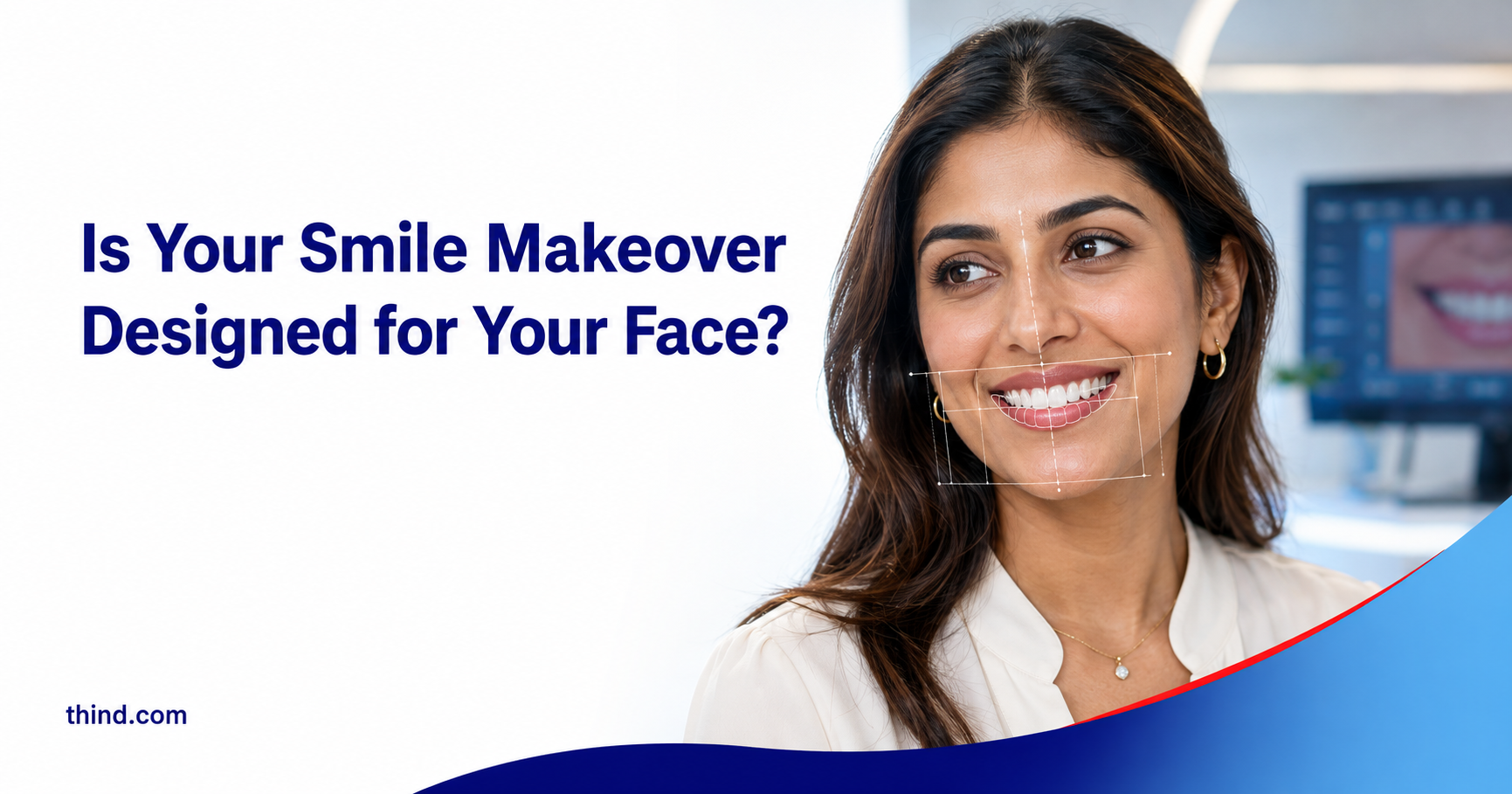
A face-matched smile makeover is a treatment plan built around your own facial proportions, lip line, and skin tone, not a size or shade copied from a photo or a celebrity. As of September 2026, most smile makeover disappointment traces back to one thing: a design chosen from a trend rather than measured against the patient’s actual face. Below are five signs your plan is doing this correctly, why the science of proportion matters more than whiteness, and how a personalized process actually works before you commit to any procedure.
How Much Is Cosmetic Dentistry Actually Growing in 2026?
India’s cosmetic dentistry market is projected to nearly triple in less than a decade, and most of that spending is happening without a face-matched design process. According to a 2026 update from Grand View Research, the segment is expected to grow from USD 1,523.1 million in 2022 to USD 4,406.9 million by 2030, a compound annual growth rate of 14.2 percent. Worldwide, the picture is similar in scale: cosmetic dentistry is expected to cross USD 31.31 billion in 2026 and keep expanding at 8.55 percent a year through 2034, based on 2025 market data compiled by URBN Dental, citing Precedence Research.
That much growth, this fast, means more people than ever are choosing a smile design in a short window of time, often before a single consultation. The market is not slowing down to let planning catch up.
Is Social Media Quietly Making Your Smile Decisions for You?
Yes, for a large share of patients, and the number is higher than most people expect. A 2024 study of 504 dental patients in Spain, published in Scientific Reports, found that 29.37 percent said social media had directly shaped their decision to get aesthetic dental treatment, more influence than they credited to a friend, a family member, or even their own dentist.
That matters because a trending photo shows one face, one jaw width, one lip line, and one lighting setup. It was never designed to fit yours. Choosing a smile because it looked good on someone else’s face is the single most common starting point for a makeover that ends up looking obviously done.
There is a second, measurable cost to skipping a personalized process. A 2024 systematic review in Cureus pooling 344 patients across ten separate studies found that three-dimensional smile simulations scored close to 9.0 out of 10 on patient satisfaction, compared with roughly 7.1 out of 10 for flat two-dimensional mockups, the simplified kind of preview many patients rely on when they simply pick a smile off a photo rather than seeing it modeled on their own face first.
Why Do Some Smile Designs Look Natural While Others Look Obviously “Done”?
Cosmetic dentistry is the branch of dentistry focused on improving the appearance of teeth, gums, and bite, and it succeeds or fails almost entirely on proportion. Dentists have long used a concept called the golden ratio, a mathematical proportion also used in art and architecture, as a starting reference point for how front teeth should relate to each other in width. The key word is “starting point”: real faces vary in width, symmetry, and lip mobility, so a proportion that looks perfect on a diagram can look wrong once it is placed on an actual person’s face.
This is exactly why the dental industry itself is shifting away from uniform, trend-driven results. Britain’s private dentistry sector reached GBP 12.16 billion in 2023-24, nearly 70 percent of the country’s total dental market, with cosmetic and elective treatment identified as the main growth driver, according to a March 2026 Forbes feature on the industry. In that same article, Sophia Bow, CEO of The Temple Practice in Yorkshire, described what separates a good outcome from an artificial-looking one: “The best outcomes are those where the dentistry disappears. Patients should feel like themselves again, not like they’re wearing something artificial.”
Two forces are driving this shift. First, dental veneers, thin shells bonded to the front of teeth, became widely accessible faster than public understanding of how to use them correctly, so uniform “one shade, one size” results became common. Second, digital planning tools now let a dentist preview a design mapped onto a patient’s real photograph before any tooth is touched, which the Cureus data above shows produces measurably higher satisfaction than guessing from a reference photo.
What Should You Actually Look for Before Choosing a Smile Design Plan?
A smart patient should judge a smile design plan by its process, not its price list. Five criteria consistently separate a face-matched plan from a copy-paste one.
- Facial and smile analysis technology. A plan built from digital scans and photographs of your own face fits better than one built from a catalog photo of someone else’s smile.
- More than one clinical opinion. A second qualified dentist reviewing the design catches proportion problems a single set of eyes can miss.
- Multiple treatment paths under one roof. Whitening, veneers, clear aligners, bonding, and implants each solve a different problem. A plan that reaches for the same solution for every patient is a trend response, not a diagnosis.
- Verified hygiene and sterilization standards. Cosmetic work often involves multiple visits and, at times, minor procedures, so infection-control standards matter as much as aesthetics.
- A transparent, written estimate in rupees. Costs should be itemized and inclusive of applicable GST before you agree to anything, not adjusted case by case without explanation.
What Are the 5 Signs a Smile Makeover Plan Is Actually Designed for Your Face?
The clearest sign is a digital, face-mapped preview shown to you before any treatment begins. Here are all five signs to check for during a consultation.
- You see a computer-generated preview of your new smile mapped onto your own face, not a stock photo or a generic size chart, before any tooth is touched.
- The dentist explains why whitening, veneers, aligners, bonding, or a combination is being recommended, instead of defaulting to the same veneer shape for every patient who walks in.
- The clinic can describe its sterilization and hygiene protocol clearly and openly when you ask, ideally backed by a recognized accreditation such as NABH.
- More than one dentist is involved in reviewing your case, especially for a full smile makeover rather than a single-tooth fix.
- You receive a written, itemized cost estimate in INR before starting, with GST and any follow-up visits accounted for, not a verbal number that changes later.
Teeth Whitening, Veneers, Aligners, or a Full Smile Makeover: Which Fits Your Goal?
The right option depends on what is actually wrong: color, shape, spacing, or alignment. The table below compares the four most common paths.
| Option | Best For | Typical Timeline | Indicative Cost Range (INR)\* | Reversible? |
|---|---|---|---|---|
| Professional teeth whitening | Surface staining, dullness, no shape or alignment issues | 1 to 2 visits | Rs 6,000 to Rs 15,000 | Not permanent; needs periodic touch-up |
| Porcelain or composite veneers | Chipped, worn, uneven, or gapped front teeth | 2 to 3 visits | Rs 8,000 to Rs 25,000 per tooth | Usually irreversible (enamel is trimmed) |
| Clear aligners | Crooked or crowded teeth, minor bite correction | 4 to 18 months | Rs 60,000 to Rs 2,50,000 (full course) | Fully reversible before treatment; result is permanent once complete |
| Full smile makeover (combination plan) | Multiple issues together: color, shape, spacing, missing teeth | 2 weeks to several months, case dependent | Rs 80,000 to Rs 3,50,000+ | Depends on the specific procedures combined |
\*Indicative ranges reported by Indian cosmetic dental clinics in 2026, inclusive of applicable GST. Actual cost depends on case complexity, materials chosen, and number of teeth treated. Always request a written estimate at consultation.
Where Can You Get a Face-Matched Smile Design in Ludhiana?
Everything above points to the same conclusion: a smile makeover works when it is planned around your face, verified by more than one qualified opinion, and backed by clean, transparent processes. That is the exact approach followed by the husband-wife dentist team at Thind Dental Clinic, an NABH-approved practice across three locations in Ludhiana offering digital smile design, laser dentistry, cosmetic dentistry, orthodontics, and implant care under one roof. Instead of starting from a trending photo, the team at Thind Dental Clinic’s smile design consultation starts with a scan of your own face and teeth.
If you have been putting off a smile makeover because you are not sure whether the result will actually suit you, that uncertainty is worth addressing before, not after, any treatment begins. A short, no-pressure conversation with a dentist who can show you a preview mapped to your own face answers that question directly. You can book a free smile assessment and consultation to see what a face-matched design would actually look like on you, with a clear, written estimate in rupees and no obligation to proceed on the same visit.
Frequently Asked Questions
Do smile makeovers look fake in real life?
Only when the design ignores facial proportion, using a uniform shade or shape regardless of the patient’s face. A design based on your own facial scan and skin tone, checked by more than one dentist, is built specifically to avoid this.
How do dentists design a natural-looking smile?
They start with digital photographs and scans of your face, measure tooth width against your lip line and facial midline, and often reference proportion guides such as the golden ratio as a starting point before adjusting for your individual features.
What is the difference between teeth whitening and a smile makeover?
Teeth whitening only changes color and works on otherwise healthy, well-shaped teeth. A smile makeover is a combination plan, whitening, veneers, aligners, or bonding together, used when shape, spacing, or alignment need correcting as well as color.
Can a smile makeover fix uneven gums too?
Yes. Gum contouring is commonly combined with veneers or bonding in a full smile makeover plan when uneven gum height is affecting how symmetrical the smile looks, alongside the tooth-level changes.
How much does a smile makeover usually cost in India?
It depends entirely on which procedures are combined and how many teeth are involved, typically ranging from roughly Rs 80,000 for a limited combination plan to Rs 3,50,000 or more for an extensive one, inclusive of GST. You can schedule a personalized cost estimate once a treatment plan has been mapped to your face.
Sources
- Grand View Research: India Cosmetic Dentistry Market Outlook (2026 update)
- URBN Dental: Cosmetic Dentistry Statistics 2026 (citing Precedence Research)
- Scientific Reports (Nature, 2024): Social media impact on students’ decision-making regarding aesthetic dental treatments
- PMC / Cureus (2024): The Recent Use, Patient Satisfaction, and Advancement in Digital Smile Designing, a Systematic Review
- Forbes (March 2026): How Cosmetic Dentistry Is Moving Toward Natural Smiles And Individual Character