Published: August 30, 2026. Last updated: August 30, 2026.
Dr. Rajanbir Singh Thind, Thind Dental Clinic
Only 25 percent of research studies on dentist-patient trust actually bother to define what trust means, according to a 2023 scoping review in the British Dental Journal. That gap matters more than it sounds: most patients are not lacking a competent dentist, only a clear, plain-language reason to believe the treatment plan sitting in front of them.
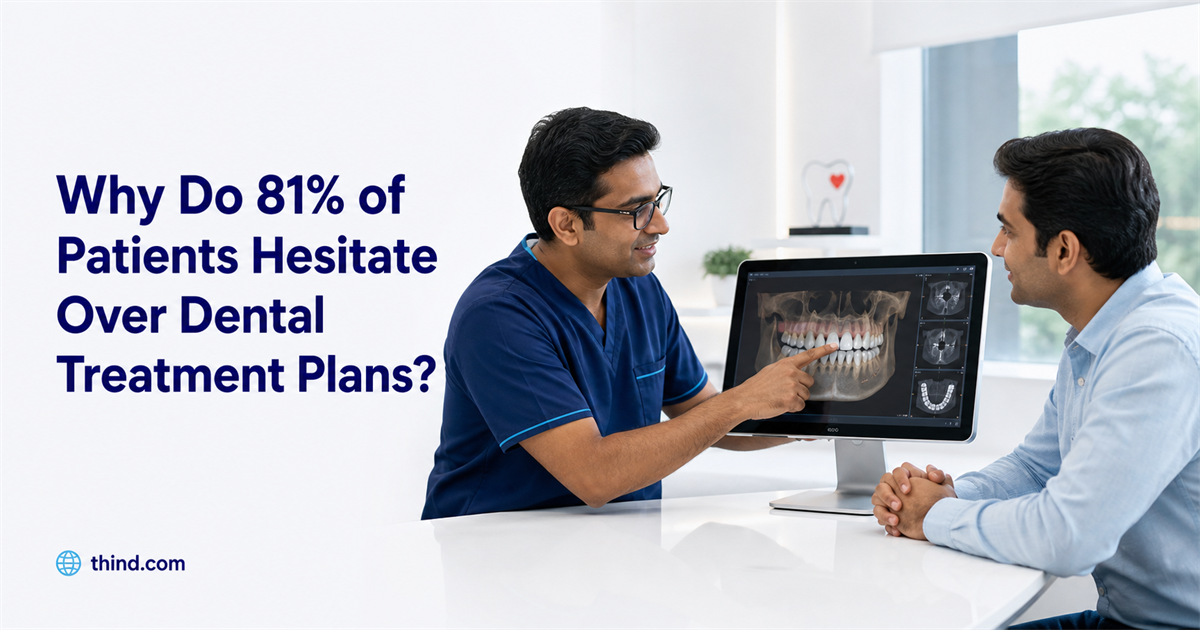
Patients hesitate before accepting dental treatment for one main reason: they are rarely shown, in plain language, why a specific procedure is necessary right now. A 2023 consumer survey found that 81 percent of Americans have questioned or hesitated over a dentist's treatment recommendation, even though 94 percent already agree that untreated dental problems affect overall health. The fix is not more willpower or less fear, but dental care built around clear explanation, visual evidence, and a long-term relationship with a consistent team, rather than a rushed diagnosis from an unfamiliar dentist every visit.
Why Do So Many Patients Doubt Their Dentist's Treatment Plan?
Most hesitation comes down to a trust gap, not a treatment quality gap. Independent research keeps finding the same pattern: patients believe dental problems are serious, yet stall the moment they are asked to act on a specific recommendation.
- 81% of Americans surveyed have questioned or hesitated to commit to a treatment their dentist suggested, and 31% avoid dental care entirely until the pain becomes severe, according to a December 2023 Directions Research consumer survey of over 1,000 U.S. adults.
- Only 25% of academic studies on dentist-patient trust actually define the term they are measuring, per a 2023 British Dental Journal scoping review led by researchers at the University of Dundee.
Neither statistic is really about fear of pain. Both point to the same missing ingredient: a clear, checkable reason to say yes.
Why Is Trust Breaking Down Between Patients and Their Dentists?
Trust breaks down mainly because most patients see a different dentist almost every visit, and are told what to do far more often than they are shown why. Health literacy is a person's ability to obtain, understand, and act on basic health information, and it plays a much bigger role in dental hesitation than most people assume.
Dental researchers generally treat patient trust as the confidence that a provider will act in the patient's best interest, even when the patient cannot fully verify the recommendation alone. That confidence is fragile when the "provider" changes every visit and the explanation is rushed.
Meanwhile, the number of choices keeps growing, which paradoxically makes trust harder to build, not easier. India now has 376,721 registered dentists, roughly one for every 3,846 people, already well past the World Health Organization's benchmark of one per 7,500, and growing more than three times faster than the population, according to a November 2025 analysis by the Observer Research Foundation.
At the same time, a May 2025 Nexdigm market report projects India's dental tourism sector will draw more than 1 million patients a year by 2030, with the restorative dentistry segment alone growing from roughly USD 619.5 million in 2024 toward USD 1.02 billion by 2030. More clinics and more options are opening up every year. But more options do not automatically create more trust, and as of mid-2026, patient hesitation has not gone away with the growth.
What actually rebuilds trust is simpler than technology or marketing. As of a March 2026 report from Tufts University School of Dental Medicine, which found that 72% of American adults carry some fear of the dentist and 27% call it severe, Christina Pastan, assistant clinical professor in the Department of Endodontics and director of mind-body wellness at Tufts University School of Dental Medicine, put it this way: "I think that the dentist-patient relationship is all about trust, communication, and connection."
What Does a "Trust-First" Dental Visit Look Like Compared to a Typical One?
A trust-first visit looks different at almost every step, not just at the moment treatment is proposed. The table below lays out the contrast plainly.
| Step in the Visit | Typical Dental Visit | Trust-First Dental Visit |
|---|---|---|
| Diagnosis | Explained verbally, often quickly | Shown on a digital X-ray or intra-oral scan before any treatment talk |
| Explanation | Assumes the patient already understands why | Explains the "why" in plain language and takes questions first |
| Continuity | A different dentist most visits, limited history | The same small team across years, with family history on record |
| Hygiene evidence | A clean-looking waiting room is the only signal | A sterilization protocol and accreditation the patient can ask about directly |
| Cost and timeline | Discussed mid-treatment or after | Discussed clearly, in writing, before the patient commits |
What New Criteria Should Guide How You Choose a Dentist in 2026?
Choosing a dentist on convenience or a single ad is no longer enough given how crowded the market has become. A smarter standard looks at how a clinic operates over years, not just how it looks on one visit.
- Explanation before recommendation. A trustworthy clinic walks through the diagnosis, in plain language, before proposing a treatment plan, not after.
- Visual proof, not just verbal opinion. Digital X-rays and intra-oral scans let a patient see the same evidence the dentist is looking at, whether the discussion is about a routine filling or a root canal treatment.
- Continuity of care. A small, consistent team that treats the same patients and families across years builds a history no single visit can replace.
- Verifiable hygiene standards. Sterilization protocols and third-party accreditation should be something a clinic can show, not just claim.
- Comfort-focused technology. Modern, lower-pain approaches, including laser-based treatment for common procedures, directly address the fear that keeps a third of patients away.
What Should You Actually Look For in a Long-Term Family Dentist?
Look for a clinic that behaves less like a single transaction and more like an ongoing relationship. The following checklist covers the practical signals worth checking before committing to a long-term dental home.
- Look for a clinic that shows you the diagnosis on a screen (an X-ray or scan image), rather than only describing it out loud.
- Look for a clinic where the same dentist, or a small and consistent team, treats you and your family visit after visit, year after year.
- Look for a clinic that can describe its sterilization protocol in specific terms and holds a recognized, third-party hygiene accreditation.
- Look for a clinic offering modern, lower-discomfort technology, such as laser dentistry, for routine procedures like cavity treatment.
- Look for a clinic that puts cost and timeline in writing before treatment starts, not partway through.
- Look for a clinic close enough, and with enough locations or hours, that your family will realistically keep returning to it rather than defaulting to whichever dentist is nearest when pain strikes.
Where This Standard Already Exists in Ludhiana
This is essentially the standard Thind Dental Clinic was built around. Its three clinics across Ludhiana carry NABH accreditation, and Dr. Rajanbir Singh Thind and Dr. Gurinder Kaur Thind's husband-wife dentist team has treated many of the same families for years, using digital scans, laser dentistry, and plain-language explanation instead of a rushed diagnosis.
Cosmetic dentistry, dental implants, root canal treatment, orthodontics, and teeth whitening are all handled by a team patients can actually get to know, not a rotating roster of unfamiliar faces.
None of this requires an immediate commitment to treatment. The lowest-friction next step is a free smile assessment and consultation, where a dentist explains what they see, in plain language, with visual evidence, before recommending anything at all. If trust has been the missing piece in dental care so far, that single visit at Thind Dental Clinic is where it can start to change.
Frequently Asked Questions
What qualities should I look for in a family dentist?
Look for clear, plain-language explanation before treatment, along with visual evidence such as digital scans. Verifiable hygiene standards and a team that will realistically see your family across multiple years, not just a single visit, matter just as much.
How do trusted family dentists build long-term relationships?
Trusted family dentists keep a consistent record of each family member's history and explain findings before recommending treatment. They also stay accessible enough, through multiple locations or flexible hours, that patients keep returning instead of switching providers.
Why does trust matter in long-term family dentistry?
Research shows patients with positive, ongoing communication with their dental provider report improved trust, more regular attendance, and reduced dental anxiety, according to the 2023 British Dental Journal scoping review cited above. Trust is what turns occasional visits into consistent preventive care.
Should children and parents use the same dentist?
Many families do, since it simplifies scheduling and lets one team track hereditary patterns and habits across generations. The more important factor is whether that team explains things clearly and keeps consistent records, whichever dentist a child sees.
Can a family dentist reduce treatment confusion?
Yes. A dentist who already knows a patient's history can explain new findings in context, rather than starting from zero, which is a large part of why continuity reduces the hesitation described earlier in this article.
Sources
- Directions Research consumer survey via Business Wire (December 2023)
- Yuan et al., "A scoping review to explore patient trust in dentistry," British Dental Journal (2023)
- Observer Research Foundation, "Dentistry in India: Oversupply and Gender Bias Shaping Oral Health Workforce" (November 2025)
- Nexdigm, India Dental Services Industry Research Report (May 2025)
- Tufts University School of Dental Medicine, "Uneasy at the Dentist? You're Not Alone," via Newswise (March 2026)