Published: August 29, 2026 | Last updated: August 29, 2026
By Dr. Rajanbir Singh Thind, Thind Dental Clinic
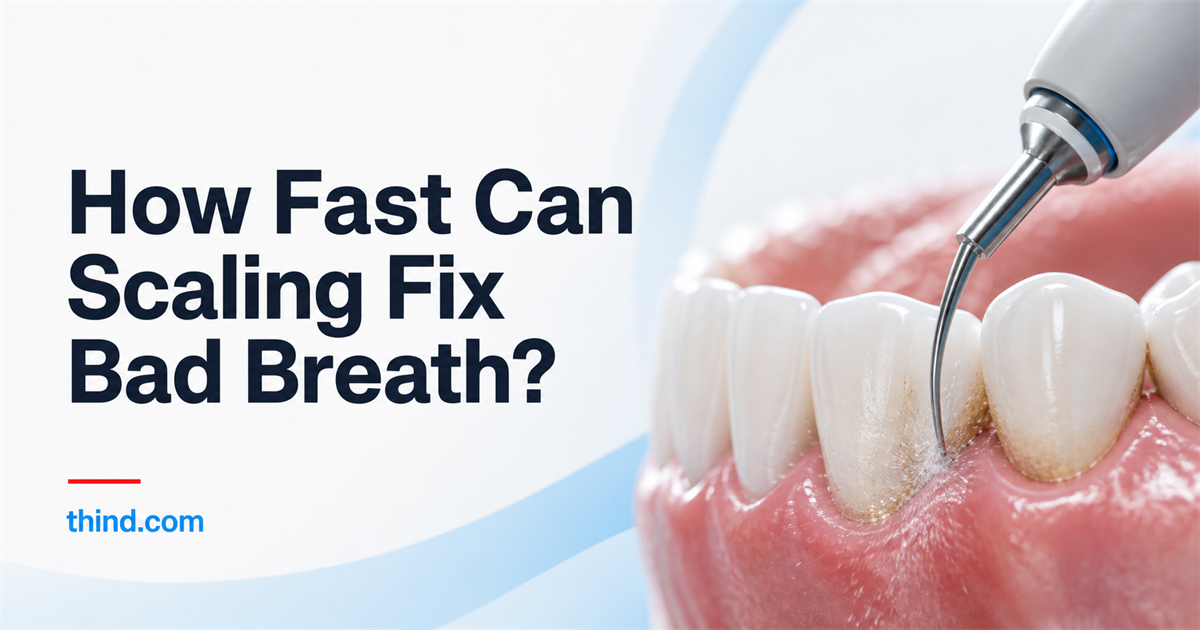
Quick answer: Professional dental scaling typically improves breath within a few days, because it removes the hardened plaque and tartar below the gumline where odor-causing bacteria live, something a toothbrush cannot reach. Chronic bad breath is far more common than most people realize, and most cases start in the mouth rather than the stomach. Brushing and mouthwash only mask the smell temporarily, while scaling addresses the bacterial source directly. Noticeable improvement usually begins almost immediately after treatment, with full gum healing continuing over the following one to two weeks.
What Is Halitosis, and Why Does Brushing Alone Often Fail to Fix It?
Brushing alone often fails because it only cleans the visible tooth surface, while the bacteria that actually cause bad breath live below the gumline where a toothbrush cannot reach. Halitosis is the medical term for this chronic, noticeable bad breath, caused by volatile sulfur compounds released by oral bacteria.
It is far more common than most people assume. A 2018 meta-regression analysis published in Clinical Oral Investigations estimated that roughly 31.8% of the global population experiences halitosis, with wide variation depending on age, diet, and oral hygiene habits. Brushing cannot fix this because dental plaque hardens into tartar (calculus) below the gumline, and that hardened layer becomes a permanent home for odor-causing bacteria that mouthwash and mints never actually reach.
What Is the Real Cost of Ignoring Bad Breath and Skipping Cleanings in India Today?
The cost is larger than most people expect, and it grows the longer treatment is delayed. As of August 2026, oral disease remains one of India's most under-treated health issues despite being highly preventable.
According to a 2025 economic analysis published in Frontiers in Dental Medicine, untreated oral disease costs India an estimated ₹613.2 billion every year in lost productivity and treatment expenses, and only 44.7% of study participants brushed their teeth twice a day.
Routine checkup attendance also drops sharply with age. The same review found that 51.5% of patients aged 18 to 24 had regular oral health checkups, compared with only 22.2% of patients over 75, with the steepest decline starting between ages 35 and 44, precisely the range where working professionals tend to postpone dental visits the longest.
Why Does Bad Breath Keep Coming Back No Matter How Much You Brush?
Bad breath returns because the bacteria causing it live in places daily brushing cannot reach: below the gumline, inside periodontal pockets, and on the back of the tongue. Removing them requires professional instruments, not just a toothbrush.
A 2018 systematic review in the International Journal of Dental Hygiene examined eight controlled clinical trials and found that professional tooth cleaning and scaling and root planing reduced the volatile sulfur compounds responsible for oral malodor in every trial studied, and the improvement held true independent of tongue cleaning or mouth rinse use. In plain terms, the cleaning itself was doing the work, not the extra habits patients added around it.
"A majority of halitosis is caused by bacteria in the mouth, but it could also be an indicator to other health issues that may need to be addressed," says Dr. Nicolaas Geurs, DDS, Dean of the University of Alabama at Birmingham School of Dentistry.
This is also why bad breath is often one of the earliest visible signs of gum disease, appearing well before pain, bleeding, or looseness of the teeth become noticeable.
How Should a Smart Patient Choose Where to Get Bad Breath Treated?
The right choice depends on how the clinic actually diagnoses and treats the bacterial source, not just how the waiting room looks. A few buying criteria separate a genuinely effective clinic from one that simply repeats a quick polish.
- Diagnostic accuracy first. A clinic that uses full-mouth digital scans and X-rays before treatment can see hidden plaque, decay, and gum pockets that a visual check alone will miss.
- Technology that reaches below the gumline. Ultrasonic and laser-assisted scaling remove tartar more precisely and comfortably than manual tools, which matters for patients who avoid the dentist out of fear of pain.
- Verified sterilization standards. Instruments should be sealed and sterilized to a recognized hygiene standard for every single patient, not just "cleaned between visits."
- Continuity of care. A consistent dentist who tracks a patient's gum health over years catches recurring plaque buildup earlier than a rotating roster of providers.
- Convenient, low-friction access. A clinic with multiple locations and flexible scheduling removes the "I don't have time" excuse that keeps many working professionals from ever booking a cleaning.
What Should You Look for Before Booking a Professional Scaling Appointment?
Look for a clinic that treats scaling as a diagnostic and preventive procedure, not a five-minute add-on. Before booking, check for the following:
- Look for a clinic that is NABH-approved or holds an equivalent recognized hygiene and safety accreditation, rather than one that only advertises "sterilized equipment" without proof.
- Look for a clinic that offers laser or ultrasonic scaling options, since these reach subgingival tartar with less discomfort than manual scraping alone.
- Look for a clinic that explains treatment costs and payment options clearly in rupees before you start, including whether GST and follow-up visits are included in the quoted price.
- Look for a clinic that gives you a written or digital treatment plan after assessment, rather than a verbal estimate you have to remember.
- Look for a clinic with experienced dentists who have treated gum disease long-term, since chronic bad breath often needs a provider who can track improvement across multiple visits.
- Look for a clinic that reinforces good daily oral hygiene habits alongside in-clinic treatment, rather than treating scaling as a one-time fix disconnected from home care.
| Approach | What It Actually Removes | Best For | Typical Comfort Level |
|---|---|---|---|
| Brushing and mouthwash at home | Surface food particles and loose bacteria above the gumline | Daily maintenance between professional visits | No discomfort |
| Basic ultrasonic scaling | Hardened tartar and plaque at and slightly below the gumline | Routine six-month cleaning and early bad breath control | Mild sensitivity, generally well tolerated |
| Laser-assisted or advanced scaling | Deeper subgingival tartar and bacterial biofilm in periodontal pockets | Persistent bad breath, early gum disease, or fear-averse patients | Minimal discomfort, often described as more comfortable than manual tools |
Notice what home care cannot do in that table: it never reaches the layer where most chronic bad breath actually originates. That is precisely the gap a properly equipped clinic is built to close.
This is exactly the standard Thind Dental Clinic was built around. Across three NABH-approved locations in Ludhiana, Dr. Rajanbir Singh Thind and Dr. Gurinder Kaur Thind combine digital diagnostics with non-contact laser treatment options so that scaling addresses the bacterial source of bad breath rather than just masking it for a few hours.
If chronic bad breath, bleeding gums, or a delayed checkup have been sitting on your to-do list, the lowest-friction next step is a proper assessment rather than another bottle of mouthwash. You can book a free smile assessment and consultation to find out exactly what is causing the problem before deciding on any treatment, and the same visit is a natural time to ask about scaling, laser dentistry, or a broader smile evaluation if other concerns come up. It takes one visit to know what you are actually dealing with, and there is no obligation attached to finding out.
Frequently Asked Questions
Why does my breath smell even after brushing twice a day?
Brushing only cleans the visible tooth surface, while most odor-causing bacteria live below the gumline and on the back of the tongue. Those areas need professional scaling and, in many cases, gentle tongue cleaning to be fully addressed.
Can stomach problems cause bad breath?
Stomach issues are a much less common cause of bad breath than most people assume; the large majority of cases originate from bacteria in the mouth. A dentist can usually identify an oral source within a single examination before any digestive testing is needed.
Can scaling permanently fix bad breath?
Scaling removes the existing bacterial buildup and typically improves breath within days, but it is not a one-time permanent fix on its own. Maintaining results depends on consistent daily brushing and returning for cleanings roughly every six months.
How often should professional scaling be done?
Most dental guidance points to a professional cleaning approximately every six months for people with average gum health, and more frequently for those with a history of gum disease or heavy tartar buildup. A dentist can confirm the right interval after examining your gums directly.
Does tongue cleaning really matter for bad breath?
Yes, the back of the tongue harbors a large share of the bacteria responsible for oral odor, so gentle tongue cleaning alongside brushing meaningfully improves freshness. It works best as a daily habit alongside, not instead of, professional scaling.
Sources
- Silva MF et al., "Estimated prevalence of halitosis: a systematic review and meta-regression analysis," Clinical Oral Investigations, 2018
- Deutscher H et al., "The effect of professional tooth cleaning or non-surgical periodontal therapy on oral halitosis," International Journal of Dental Hygiene, 2018
- "India's oral health outlook: challenges, economic impact and need for preventative strategies," Frontiers in Dental Medicine, 2025
- Dr. Nicolaas Geurs, DDS, quoted in "The stinky truth: What science says about bad breath," UAB News, August 15, 2025