Published: October 23, 2026
Last updated: October 23, 2026
Dr. Rajanbir Singh Thind, Thind Dental Clinic
In a 2019 survey of 1,000 US adults, Cigna's Behind the Smile study found that 58% said their smile could be improved. More than 21% also felt less confident in job interviews because of their smile or oral health.
Most people who want a better smile do not want a different one. They want their own smile, only calmer, straighter and more even, and that is a design problem before it is a treatment problem.
Quick answer: how do dentists design a natural-looking smile?
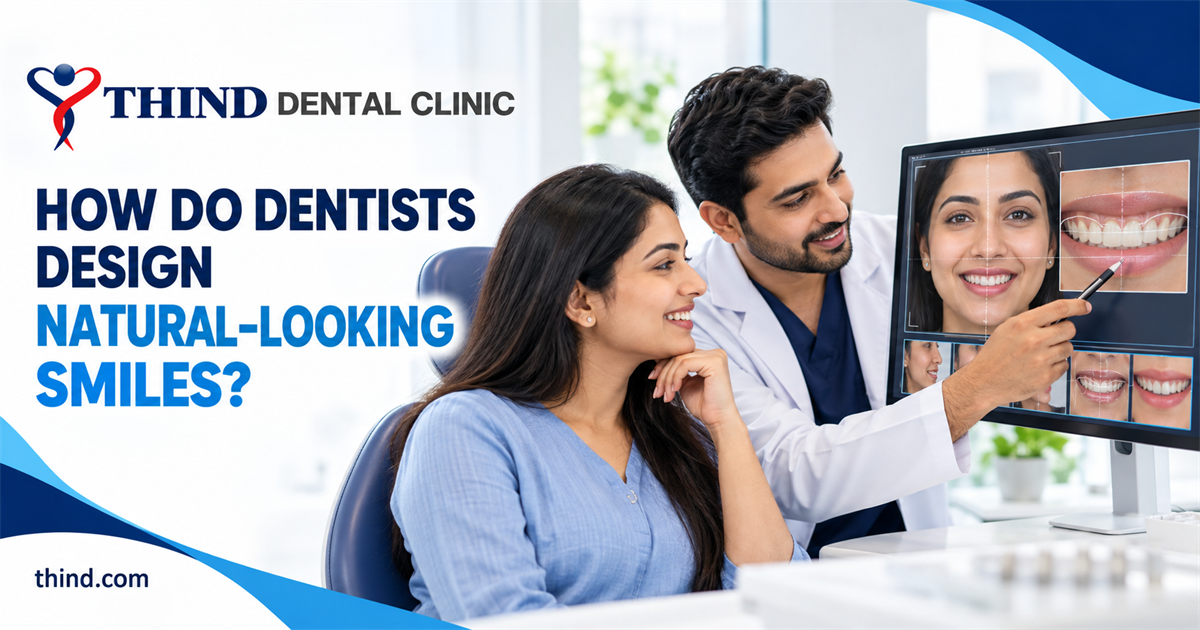
Dentists design a natural-looking smile by working from your face outward, not from a catalogue of teeth. They photograph and scan your smile, measure how your teeth, gums and lips relate, and agree on your goals with you. They then preview the plan as a digital design or a trial smile before any tooth is changed. As of October 2026, research shows professionals and laypeople judge smiles differently, so a preview you approve matters. Ask for photos, a preview, and an itemised plan.
What is smile design?
Smile design is the planning stage of cosmetic dentistry in which tooth size, shape, colour, position and gum line are matched to your face and lips before treatment starts. It is a plan, not a procedure.
The plan may then use whitening, bonding, dental veneers, gum reshaping or clear aligners. Complex plans can involve prosthodontics, the dental specialty that rebuilds and replaces teeth.
Why does a smile need to be designed at all?
Because people are unhappy with their smiles in large numbers, and unhappiness shows up in daily confidence. In the same 2019 Cigna survey, 93% of people completely satisfied with their smile rated their self-confidence as excellent or very good, against only 30% of those not at all satisfied.
The survey is American and self-reported, so treat it as a pattern, not an Indian benchmark. It still shows why a rushed or generic fix can disappoint: the smile is tied to how you feel in meetings, photos and conversations.
Do dentists and everyday people see a smile the same way?
No, and a good design plan accounts for that gap. In a 2017 study in the Journal of Clinical and Diagnostic Research, Saha and colleagues asked 10 specialists, 10 general dentists and 10 laypersons to judge 50 smile photographs. Specialists found 40.96% of smiles agreeable, general dentists 48.40% and laypersons 56.80%.
The same study found that all three groups rated more smiles as agreeable when they saw the whole face, not the smile alone (53.68%, 62.32% and 71.04%). Context changes judgement, which is why a smile is designed on the face and not on a model of teeth.
How do dentists plan the design step by step?
A careful design follows a fixed order, from records to preview to approval. The table shows what each step does and what you should be able to see or ask for.
| Step | What the dentist does | What you should see or ask |
|---|---|---|
| Listening and goals | Asks what bothers you and what you want to keep | Your own words reflected back in the plan |
| Examination | Checks teeth, gums, bite and jaw health first | Any gum or decay treatment listed before cosmetic work |
| Photographs and scans | Records your smile at rest, in speech and at full smile | Photos from several angles, not one pose |
| Facial analysis | Relates tooth length, width and midline to lips and face | An explanation of why each proportion was chosen |
| Digital design and trial smile | Previews the planned result on screen or on your own teeth | A preview you can approve or change |
| Itemised plan | Writes down options, order of treatment and upkeep | Simpler alternatives and what is reversible |
Does previewing the design actually help?
Yes, the early evidence points that way, though it is still limited. A 2024 systematic review in Cureus by Jain and colleagues screened 12,760 articles and included 10 studies with 344 participants. Its authors concluded that digital smile design improves communication, reduces working time, minimises errors and raises patient satisfaction.
One included study of 11 patients compared a 3D simulation with a 2D design. Satisfaction scored 9.0 out of 10 for 3D against 7.1 for 2D, but the review notes small samples and varied follow-up, so treat this as encouraging, not settled.
Can a better-designed smile change how others see you?
In experiments it can, but real-life proof is still missing. A 2020 scoping review in the British Dental Journal by Moore and Keat identified 16 relevant articles, ten of them experimental simulations. It found that visible dental problems can lower how people are rated on employment-related traits, while noting that demonstration of real-life impact on employment is lacking.
That honesty is useful. Design a smile for how it makes you feel and function, and treat any career benefit as a possible bonus.
What makes a design look natural instead of artificial?
A natural result respects your face, keeps small imperfections that belong to you, and avoids the extremes of shade and symmetry. Gum shape matters too, because a high or uneven gum line changes how the whole smile reads (see gummy smile).
- Tooth shade that suits your skin tone and the whites of your eyes.
- Tooth length and width that follow your lip line and face shape.
- Gentle variation between teeth, not a perfectly uniform row.
- A gum line that frames the teeth evenly.
How should you choose who designs your smile?
Choose a team that designs before it treats and can prove its safety standards. Five criteria separate a considered plan from a quick cosmetic fix.
- Verified hygiene: recognised accreditation such as NABH approval shows sterilisation and safety systems are audited.
- Digital planning: scans, photographs and a preview of the result before any tooth is touched.
- Gentle, modern technology: tools such as laser dentistry that reduce discomfort where suitable.
- Conservative thinking: a willingness to offer the simplest option that works, including whitening or bonding alone.
- Continuity: more than one location and an experienced team, so follow-up is easy to keep.
What should be on your checklist before you agree to a design?
Use this checklist at your consultation. A clear answer to each item is a good sign.
- Did the dentist examine your gums and bite before talking about looks?
- Were you shown a preview, digital or on your own teeth, that you could change?
- Is the plan itemised, with options, order and upkeep written down?
- Were reversible and irreversible steps explained separately?
- Does the clinic hold a recognised hygiene accreditation?
Where can you get a smile design that follows this approach in Ludhiana?
Thind Dental Clinic is an NABH-approved practice at three locations in Ludhiana, Punjab, led by Dr. Rajanbir Singh Thind and Dr. Gurinder Kaur Thind. The team plans smile makeovers around your face, with digital planning, laser dentistry and clear aligners where they suit the case.
Every plan starts with an examination and a preview, and the simplest effective option is always discussed first.
How can you start?
If you would like to see what a designed smile could look like on your own face, you can book a free smile assessment and consultation at thind.com. You will leave with a clear, written explanation of your options, whether or not you decide to go ahead.
Frequently asked questions
Is smile design the same as a smile makeover?
No. Smile design is the planning stage, and a smile makeover is the set of treatments that follows from it. Good design often shows that a smaller treatment is enough.
Can I see my new smile before treatment starts?
Often yes, through a digital preview or a trial smile placed on your own teeth. A 2024 review of 10 studies found digital smile design improved communication and patient satisfaction. Ask to approve and change the preview before any tooth is altered.
Will a designed smile look fake?
It should not, if the design follows your face and keeps natural variation. Shade, tooth proportions and gum line all matter. A preview lets you judge this before you commit.
Do dentists and patients agree on what looks good?
Not always. A 2017 study found that specialists, general dentists and laypersons rated 40.96%, 48.40% and 56.80% of smile photographs as agreeable. Tell your dentist what bothers you, and ask them to show you what they see.
How long does smile design take?
The design stage is usually completed in one or two visits, since it involves examination, photographs, scans and a preview. Treatment time then depends on the plan you choose. Your dentist can give you a written timeline.
Sources
- Cigna, Behind the Smile: Oral Health and Self-Esteem (survey of 1,000 US adults, 2019)
- Saha MK and colleagues. Perception of Acceptable Range of Smiles by Specialists, General Dentists and Lay Persons and Evaluation of Different Aesthetic Paradigms. Journal of Clinical and Diagnostic Research, 2017
- Jain A and colleagues. The Recent Use, Patient Satisfaction, and Advancement in Digital Smile Designing: A Systematic Review. Cureus, 2024
- Moore D and Keat R. Does dental appearance impact on employability in adults? A scoping review. British Dental Journal, 2020
- Wikipedia: Cosmetic dentistry