Dr. Rajanbir Singh Thind, Thind Dental Clinic
Published: October 17, 2026
Last updated: October 17, 2026
Quick answer
Aligners can correct many crowded and crooked smiles, but severe cases are harder and less predictable. A 2023 systematic review of six studies and 283 patients found that aligners and fixed braces both worked in complex extraction cases, although fixed appliances did better on tooth inclination and bite contacts. Whether aligners suit you depends on how much movement is needed, which teeth must rotate, and how closely the plan is monitored. A proper assessment with digital records, not the word "severe," decides the answer.
How common are crooked teeth, and what makes a case "severe"?
Crooked teeth are very common: a 2021 meta-analysis of 54 studies and 97,959 Indian children aged 8 to 15 found a pooled malocclusion prevalence of 35.40%, as reported by Balachandran and Janakiram in the Journal of Oral Biology and Craniofacial Research. Malocclusion is the term for teeth that do not line up or meet correctly.
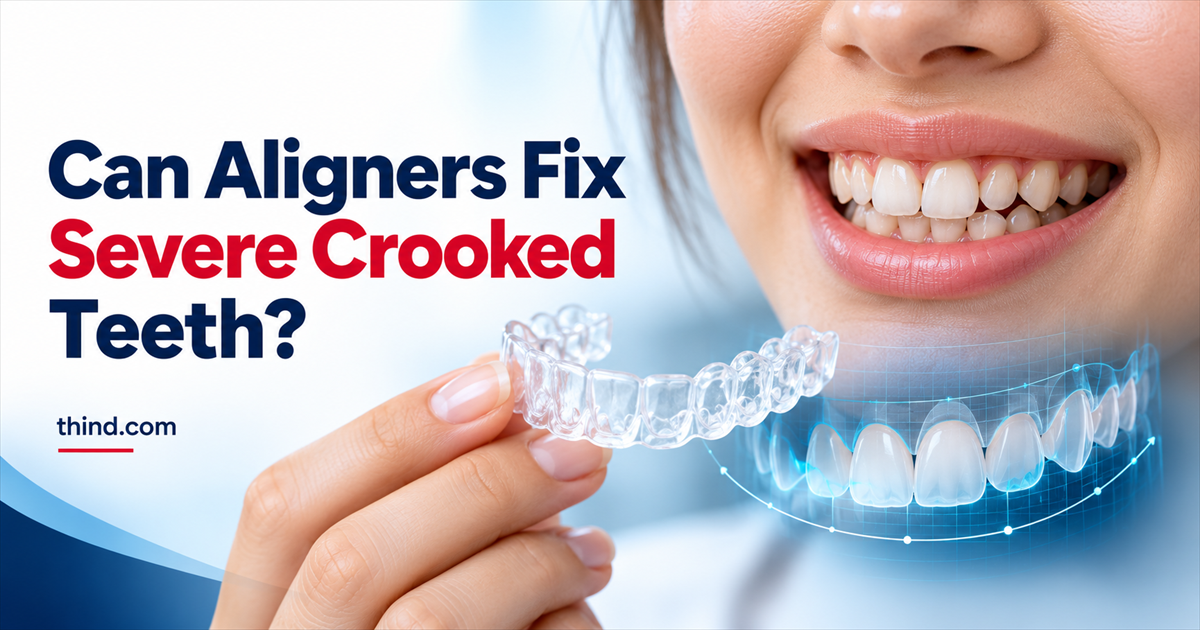
A case is usually called severe when many teeth are badly overlapped, rotated, or far from their ideal position. Clear aligners are a series of removable, custom-made plastic trays that move teeth in small steps, and each extra tooth that must travel far adds difficulty to the plan.
Do aligners move every tooth as planned?
No. Aligners move teeth less exactly than the computer plan suggests, and the gap grows with harder movements. In a 2009 prospective study of 401 anterior teeth, DrBicuspid reported in its coverage of the American Journal of Orthodontics and Dentofacial Orthopedics paper that teeth achieved a mean of 41.1% of the predicted movement, with canine rotation near 33%.
Those figures come from an earlier generation of aligners, so they show the direction of the problem rather than today's exact performance. They also measure how much of the planned movement happened, not whether treatment succeeded overall.
Which tooth movements are hardest for aligners in 2026?
Rotating canines and premolars remains the weakest area. A 2025 systematic review of 12 studies by Benedetti and colleagues in Dentistry Journal reported rotation accuracy from 36% to 85%, averaging about 65%, and found that only 15 of 53 canines achieved more than 50% of the planned correction.
The same review found incisors and molars more predictable, and rated the certainty of evidence as low to moderate. That is why severe crowding, where many teeth rotate at once, needs careful planning and follow-up adjustments.
How do aligners compare with fixed braces in complicated cases?
In the best available review, both options worked, with small differences. A 2023 systematic review in Cureus by Jaber, Hajeer and Sultan covered six studies and 283 patients with complicated or severe malocclusion. In one randomised trial it included, great improvement occurred in 88.9% of aligner patients and 91.7% of fixed-appliance patients.
| Measure | Clear aligners | Fixed braces |
|---|---|---|
| Premolar extraction cases | Effective | Effective |
| Great PAR improvement (one trial, 36 patients) | 88.9% | 91.7% |
| Tooth inclination and bite contacts | Less favourable in the review | Better in the review |
| Planned versus achieved movement | May differ from the plan | Adjusted at each visit |
The authors still called for more high-quality studies, so these results are encouraging rather than final. Learn more about dental braces and orthodontics if you want the wider background.
Why do severe cases need more than a standard aligner plan?
Severe cases need more space and more movement, and both raise the chance of the result drifting from the plan. Dentists may create room by widening the arch, polishing small amounts between teeth, or removing teeth, and the review above included premolar extraction cases for this reason.
Because aligners can fall behind the plan, good clinics rescan during treatment and order refinement trays when needed. Treatment also depends on you wearing the trays for the hours advised.
How should you choose who treats severe crooked teeth?
Choose a team that treats your case as a medical plan first and a product second. Four criteria matter most:
- Verified hygiene standards: a clinic with recognised accreditation, such as NABH, shows its sterilisation processes are audited.
- Digital planning: an intraoral scanner and 3D simulation let you see the planned movement before you start.
- Experience across treatment types: a team that offers both aligners and other options will recommend what fits, not what they sell.
- Easy access: several locations and clear follow-up schedules make refinements and check-ins realistic for a working week.
What should you check before starting aligners for severe crowding?
Ask for answers to these points before you commit:
- Will a full examination, photographs and digital scan be done before any plan is shown?
- Does the dentist explain which teeth are expected to be hardest to move?
- Is there a stated plan for refinements if teeth lag behind?
- Are fixed braces or a combined approach explained as honest alternatives?
- Do you understand the daily wear time and retainer plan afterwards?
- Is the clinic open about its hygiene and sterilisation standards?
Where can you get an honest opinion in Ludhiana?
Thind Dental Clinic is a NABH-approved dental clinic in Ludhiana with three locations, led by Dr. Rajanbir Singh Thind and Dr. Gurinder Kaur Thind. The team offers clear aligners and orthodontic care alongside laser dentistry and smile design, using digital planning so you can understand your options before deciding.
If your case is on the complex side, you will be told plainly whether aligners, braces or a combination suit you best.
What is the next step?
If you have been hiding crooked teeth for years, a short assessment can turn uncertainty into a clear plan. You can book a free smile assessment and consultation at thind.com, and the team will review your teeth, explain what is realistic, and answer your questions without pressure. You can also explore smile design and aligner options at Thind Dental Clinic before you visit.
Frequently asked questions
Can aligners fix severely crowded teeth?
Sometimes. Reviews show aligners can treat complicated cases, including premolar extraction cases, but results are less predictable than in mild crowding. A dentist needs to examine your teeth and scan them before saying whether aligners are suitable.
Are fixed braces better than aligners for severe cases?
Not always, but fixed braces showed advantages in inclination and bite contacts in a 2023 systematic review. Both approaches reduced malocclusion scores in a similar way in the trial discussed above. The best choice depends on your teeth and your priorities.
Which teeth are hardest for aligners to straighten?
Canines and premolars that must rotate are the hardest. A 2025 review found only 15 of 53 canines achieved more than 50% of the planned rotation. Incisors and molars were more predictable.
Do severe cases take longer with aligners?
They can, because more movement and refinement trays are often needed. Reviews report mixed results on duration, so it is safest to ask your dentist for an estimate based on your own scan. Wearing the trays as advised helps avoid delays.
Will I need extractions if I have severe crowding?
Not necessarily. Space can also be made by widening the arch or polishing small amounts between teeth, depending on your case. Your dentist should explain why any option is recommended before you agree.
Sources
- Balachandran P, Janakiram C. Prevalence of malocclusion among 8 to 15 years old children, India: a systematic review and meta-analysis. Journal of Oral Biology and Craniofacial Research. 2021.
- Jaber ST, Hajeer MY, Sultan K. Treatment effectiveness of clear aligners in correcting complicated and severe malocclusion cases compared to fixed orthodontic appliances: a systematic review. Cureus. 2023.
- Benedetti G, et al. Evaluating the clinical success of clear aligners for rotational tooth movements in adult patients: a systematic review. Dentistry Journal. 2025.
- DrBicuspid. Study finds Invisalign only 41% effective (reporting Kravitz N, et al., American Journal of Orthodontics and Dentofacial Orthopedics, 2009).