Published: October 8, 2026
Last updated: October 8, 2026
By Dr. Rajanbir Singh Thind, Thind Dental Clinic
India's clear aligner market was worth USD 124.24 million in 2023 and is forecast to reach USD 967.19 million by 2030, according to Grand View Research. That is a growth rate of 34.07% a year. Yet most people who are curious about aligners still cannot explain what a plastic tray actually does to a tooth.
Quick answer: Invisible aligners move teeth in small, planned steps. A dentist scans your teeth, software maps the path each tooth should travel, and a series of custom clear trays presses on the teeth gently, one set after another. Small tooth-coloured bumps called attachments help the trays grip. Results depend on the type of movement: a 2025 systematic review found rotation accuracy ranging from 36% to 85%. As of October 2026, aligners work best for mild to moderate cases that are planned carefully.
What is an invisible aligner, exactly?
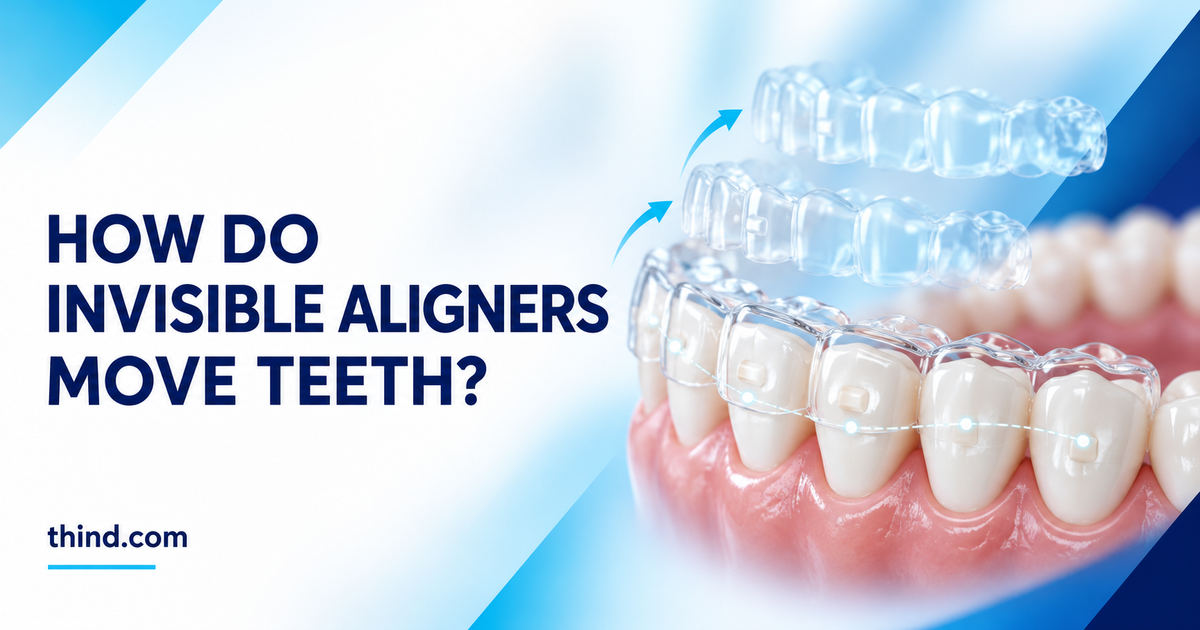
An invisible aligner is a custom-made, transparent plastic tray that fits closely over your teeth and moves them gradually. Clear aligners are worn in a numbered series, and each tray is shaped slightly differently from the last.
The first widely used system came from Align Technology, but many brands and clinic-designed systems exist today. They all rely on the same principle: controlled, repeated pressure over time.
Why can a tooth move at all?
A tooth moves because steady pressure makes the bone around its root reshape slowly. The tooth is not fixed in the jaw like a nail in wood. It sits in a living socket that can remodel when a gentle, consistent force is applied.
That is why aligners ask for patience. The tray cannot force a tooth to move quickly, because the bone needs time to adapt at every step.
How does a series of trays move teeth step by step?
Each tray is made slightly ahead of where your teeth are today, so wearing it applies a small push toward the next planned position. After a set period, you switch to the next tray, which repeats the process.
- A digital scan or impression records your starting bite.
- Planning software designs the full path from the starting position to the target smile.
- The path is split into many small stages, one tray per stage.
- You change trays on the schedule your dentist sets and attend check-ups to confirm the teeth are tracking the plan.
What do attachments do on aligner treatment?
Attachments are small tooth-coloured bumps bonded to certain teeth so the tray has something to push against. A smooth tooth is hard for plastic to grip, especially for rotations and certain vertical movements.
They are removed at the end of treatment, and the tooth surface is polished. Not every tooth needs one, and your dentist decides where they go from the plan.
How accurate are aligners at moving teeth?
Accuracy varies a lot by the type of movement, which is why a good plan matters more than the tray brand. Three recent peer-reviewed reviews show the range.
- A 2025 systematic review in Dentistry Journal by Benedetti and colleagues reviewed 12 studies on rotations in adults. Reported accuracy ranged from 36% to 85%, averaging around 65%, with a mean absolute error of about 2.3 degrees.
- A 2025 systematic review in The Angle Orthodontist by García-Marín, Otero-Pregigueiro and Iglesias-Linares screened 919 articles and included 6 on molar movement. Upper molar predictability was 61.1% (plus or minus 9.1%), while mesial molar movement had a median predictability of 85.6%.
- A 2026 review in the Archive of Orofacial Data Science by Rumana Masum selected 15 of 58 articles on adults and reported that rotations over 15 degrees significantly reduced the correction accuracy of upper canines.
The lesson is not that aligners are unreliable. It is that some movements are easier for plastic than others, and the best plans expect refinements.
What can and cannot aligners move well?
Aligners handle gaps, mild crowding and moderate tilting well, and are less predictable for large rotations and complex bite changes. Here is how the main movement types compare.
| Type of movement | How aligners handle it | What helps |
|---|---|---|
| Closing small gaps | Generally straightforward | Consistent daily wear |
| Mild crowding | Usually manageable | Careful planning of space |
| Large rotations (round teeth) | Less predictable, per the reviews above | Attachments and refinements |
| Moving molars backward or forward | Varies by direction and distance | Staged planning and monitoring |
| Severe bite problems | Often needs another approach | Specialist assessment, sometimes braces |
For a comparison with fixed appliances, see the general overview of dental braces.
Why does wearing the trays consistently matter so much?
Trays only move teeth while they are in your mouth, so the plan assumes you wear them as prescribed. If they sit in a case for long periods, the teeth stop tracking the plan and later trays no longer fit well.
This is the most common reason a case needs extra trays or a restart, and it is entirely within the patient's control.
How should you choose who plans your aligner treatment?
Choose the planner, not just the product. Because accuracy depends on the type of movement, the dentist's judgment about what to attempt, when to add attachments and when to refine is what protects your result. Several criteria separate a careful provider from a rushed one:
- Digital scanning and a visual simulation of the planned result before you commit.
- Hygiene standards backed by formal accreditation, not just a tidy waiting room.
- Dentists experienced in both general and cosmetic work, so staining, chipped teeth or gum concerns are handled in one plan.
- Convenient locations, since aligner treatment needs regular check-ins over months.
What should you check before starting aligners?
- Look for a provider who explains which of your teeth need rotations, and how those are handled.
- Look for a written plan that states the number of trays, the expected duration and what happens if teeth lag behind.
- Look for a clinic that tells you honestly when braces or another approach would suit your bite better.
- Look for scheduled progress reviews rather than a "mail the trays" model with no clinical oversight.
- Look for clear answers about retainers, since teeth need holding in place after movement.
Thind Dental Clinic is an NABH-approved practice with three locations in Ludhiana, run by Dr. Rajanbir Singh Thind and Dr. Gurinder Kaur Thind. Our team plans clear aligner and orthodontic treatment from a digital assessment, alongside cosmetic dentistry and smile makeovers. Every plan is checked against the movement types described above, so you know what to expect.
If you would like to see how your own teeth would move before deciding anything, you can book a free smile assessment and consultation at thind.com. You will leave with a clear picture of whether aligners, braces or a combined approach fits your bite, and you can also learn more about our dental technology and hygiene standards first.
Frequently asked questions
How do invisible aligners move teeth without wires?
Each tray is shaped slightly ahead of your current tooth positions, so it applies gentle pressure toward the next planned position. Attachments on some teeth give the plastic something to push against. Over many trays, the teeth shift to the final plan.
Are aligners as accurate as the computer plan shows?
Not always. A 2025 systematic review found rotation accuracy between 36% and 85%, averaging around 65%. That is why dentists plan for check-ins and sometimes order refinement trays.
Do all teeth need attachments?
No. Attachments are placed only where the tray needs extra grip, often for rotations. Your dentist decides this from the digital plan.
What happens if I do not wear my trays enough?
The teeth can fall behind the plan, and new trays may stop fitting properly. Your dentist may then need to reassess and order new trays. Consistent wear is the simplest way to avoid delays.
Are aligners suitable for every bite problem?
No. They work best for mild to moderate crowding and spacing. Severe bite problems may need braces or a specialist approach, which an assessment will identify.
Sources
- Grand View Research, India Clear Aligners Market Report (market size 2023 and forecast to 2030)
- Benedetti G, et al. "Evaluating the Clinical Success of Clear Aligners for Rotational Tooth Movements in Adult Patients: A Systematic Review." Dentistry Journal, 2025 (DOI 10.3390/dj13100440)
- García-Marín C, Otero-Pregigueiro A, Iglesias-Linares A. "Predictability of mesiodistal movement of upper and lower molars with clear aligners: a systematic review." The Angle Orthodontist, 2025;95(5):563-571
- Masum R. "Efficacy of Clear Aligners in Controlling Tooth Movement." Archive of Orofacial Data Science, 2026 (DOI 10.17879/aods-2026-9172)