Published: September 20, 2026
Last updated: September 20, 2026
Byline: Dr. Rajanbir Singh Thind, Thind Dental Clinic
A 2025 laboratory study published in Scientific Reports tested several popular whitening formulas side by side on real tooth enamel. One product left enamel hardness almost unchanged. Another reduced it by nearly 98 percent compared to untreated enamel.
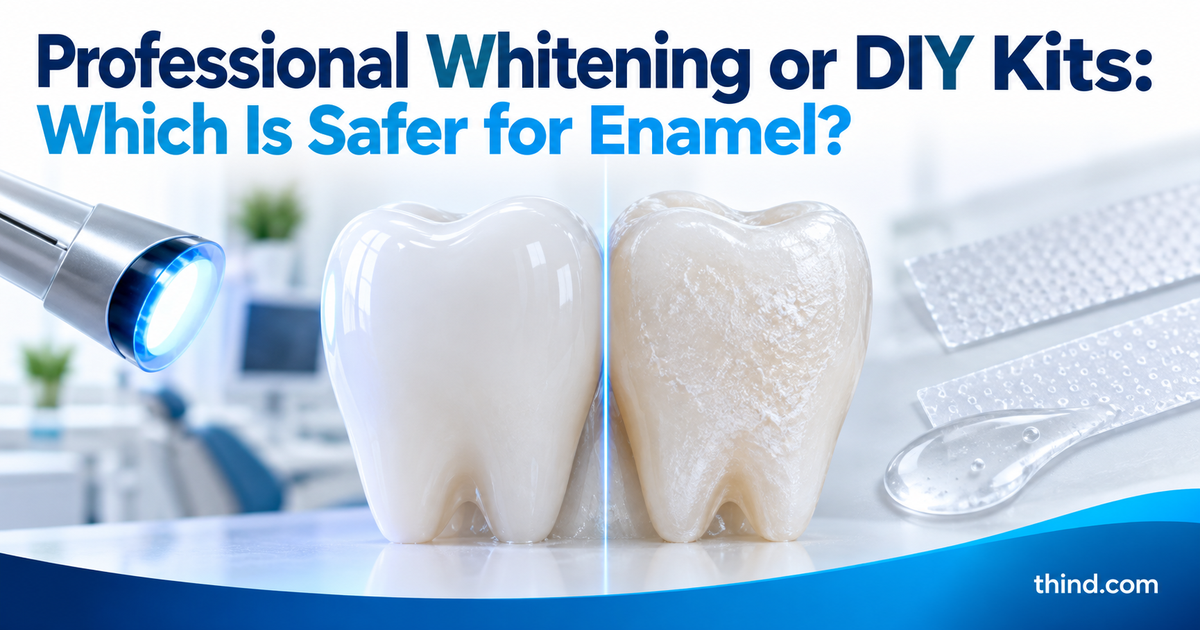
Teeth whitening, also known as tooth bleaching, is a cosmetic dental process that lightens the visible color of teeth using an active bleaching agent. Not every whitening method carries the same risk to your enamel or gums. The difference usually comes down to three things: the active ingredient and its concentration, the acidity of the formula, and whether a dentist is supervising the process. Professional and dentist-supervised options are generally formulated and monitored to protect enamel, while unsupervised do-it-yourself methods vary widely, and some carry a meaningfully higher risk of damage.
What Is Teeth Whitening, and Why Has It Become a Do-It-Yourself Trend?
Teeth whitening is now one of the most requested procedures in cosmetic dentistry, and most of that demand is shifting toward home use. The global teeth whitening market was valued at roughly USD 8.01 billion in 2026 and is projected to reach USD 9.61 billion by 2031, according to a 2026 industry report by Mordor Intelligence.
The same report found that at-home products already account for about 68.67 percent of end-user revenue as of 2025, with Asia-Pacific, including India, growing faster than any other region. Convenience and cost are the obvious draw. What most people never see is the laboratory data on what these products actually do to enamel.
How Much Damage Can At-Home Whitening Really Do to Tooth Enamel?
Tooth enamel is the hard, protective outer layer of a tooth, and it does not regenerate once it is worn away. According to a 2025 study in Scientific Reports, one widely used at-home bleaching gel reduced enamel hardness to just 0.1 GPa from a control value of 4.75 GPa, a drop of nearly 98 percent, while three other formulas showed only minor changes.
The researchers traced the difference to formula chemistry rather than bleach strength alone. Products with a more acidic pH, in the 5.5 range, caused far more damage than those kept closer to a neutral pH of 6 to 7. In other words, two products with similar hydrogen peroxide or carbamide peroxide content can behave completely differently once they touch enamel.
Why Do So Many People Try DIY Fixes Instead of Seeing a Dentist First?
Most people do not choose DIY whitening because they distrust dentists. They choose it because visiting one feels expensive, slow, or unnecessary until something hurts. In India, out-of-pocket payments account for about 62.6 percent of all healthcare spending, according to an April 2025 analysis in Frontiers in Dental Medicine, a share several times higher than in countries with stronger insurance coverage.
The same analysis found that routine dental checkups drop sharply with age and busy schedules, from 51.5 percent among 18 to 24 year olds to just 22.2 percent among adults over 75. Cosmetic concerns like yellow teeth rarely feel urgent enough to justify a clinic visit, so a home kit or a kitchen remedy becomes the default choice.
What Is Changing in How Dentists Approach Whitening Safety in 2026?
Dentists are shifting away from a one-size-fits-all view of whitening and toward formulas and protocols matched to each patient's enamel and sensitivity level. Tooth sensitivity remains the most common side effect. A 2022 systematic review cited by the American Dental Association found that mild to moderate sensitivity affects up to two-thirds of users in the early stages of bleaching.
"Sensitivity isn't necessarily a bad sign, it often means the product is working," explains Dr. Shereen S. Azer, BDS, MSc, MS, FACP, Associate Professor and Chair of the Division of Restorative and Prosthetic Dentistry at Ohio State University College of Dentistry. In the same interview, cosmetic dentist Dr. Joyce Kahng, DDS, notes that custom-fitted trays remain one of the more predictable ways to whiten because the dose and fit are controlled from the start.
As of September 2026, this personalized, dentist-guided approach, rather than a single fixed product or price point, is what most clinical guidance is converging on.
How Should You Actually Compare Your Whitening Options?
The most useful comparison is not price alone. It is enamel safety, supervision, and how the ingredients are formulated. The table below summarizes the three broad categories.
| Whitening Method | Where It Happens | Typical Active Ingredient | Enamel Safety Signal (2025 Research) | Sensitivity Risk | Dentist Supervision |
|---|---|---|---|---|---|
| Unsupervised DIY (kitchen remedies, uncontrolled strips) | At home, no assessment | Variable, often undisclosed or acidic | Not tested or inconsistent | Variable, hard to predict | None |
| Dentist-supervised take-home trays | At home, dentist-fitted | 10 percent to 38 percent carbamide peroxide | Favorable when pH-balanced formulas are used | Common but usually transient | Full |
| In-office professional whitening | Dental clinic | Concentrated hydrogen peroxide gel | Monitored in real time | Managed during the visit | Full |
What New Criteria Should Guide a Smarter Whitening Decision?
Once you look past the marketing, a handful of criteria actually predict whether a whitening experience will be safe and satisfying. These are worth checking before you commit to any method.
- Formal hygiene accreditation for the clinic or provider, not just a clean-looking waiting room.
- Digital shade assessment or scanning technology, rather than guesswork on the final result.
- A dentist who personalizes the formula and duration to your enamel and sensitivity, instead of a single generic protocol.
- Convenient access to the same trusted provider for follow-up, rather than a one-time transaction.
- A provider team with years of combined clinical experience across both preventive and cosmetic dentistry.
What Should You Look for Before Booking a Whitening Treatment?
Use this as a practical checklist before you book anything, whether it is a home kit or an in-clinic appointment.
- Look for a clinic that holds recognized hygiene accreditation, such as NABH standards used in India.
- Look for a clinic that explains the exact active ingredient and concentration before you start.
- Look for a clinic that offers enamel-friendly, pH-balanced formulations rather than the strongest option by default.
- Look for a clinic that supervises your first session in person, even if later touch-ups are at home.
- Look for a clinic with more than one convenient location so follow-up visits are not a hassle.
- Look for a clinic that gives you a written aftercare plan for sensitivity and diet.
Where Can You Get NABH-Approved, Dentist-Supervised Whitening in Ludhiana?
This is exactly the gap Thind Dental Clinic was built to close. As an NABH-approved practice with three locations across Ludhiana, Thind Dental Clinic is run by Dr. Rajanbir Singh Thind and Dr. Gurinder Kaur Thind, who personalize whitening protocols using digital scanning and laser dentistry rather than a single fixed formula.
Because the team also handles everything from root canal treatment to clear aligners and full smile makeovers, whitening decisions are made with your whole mouth's health in view, not in isolation. You can explore the full range of cosmetic and general dentistry services at thind.com before deciding what is right for you.
If you have been putting off whitening because you are unsure which option is actually safe for your teeth, the simplest next step is a conversation, not a purchase. You can book a free smile assessment and consultation to get a professional read on your enamel and sensitivity before choosing any product or procedure.
Frequently Asked Questions About Teeth Whitening
Is professional whitening better than home kits?
For most people, yes, because professional and dentist-supervised whitening is monitored, personalized, and based on formulas tested for enamel safety. Unsupervised home kits and kitchen remedies vary widely in acidity and ingredient quality, which the 2025 Scientific Reports study linked directly to enamel damage.
Can teeth whitening damage enamel?
Yes, some formulations can, particularly acidic or unregulated ones used without guidance. Research shows the risk depends more on a product's pH and formulation than on peroxide concentration alone, so not all whitening products carry the same risk.
How long do whitening results usually last?
Results typically last from several months to around a year, depending on diet, smoking, and oral hygiene habits. Staining foods and drinks such as tea, coffee, and tobacco tend to shorten how long whitening results stay visible.
Do whitening toothpastes actually work?
Whitening toothpastes can remove surface stains through mild abrasion, but they cannot change the natural color of the tooth the way a peroxide-based bleaching agent can. They work best as maintenance after a proper whitening treatment, not as a replacement for one.
Who should avoid teeth whitening or get a dentist's opinion first?
People with untreated cavities, exposed roots, gum disease, or existing tooth sensitivity should get a dental check first, since whitening can worsen these issues. A dentist can also advise pregnant women and anyone with dental restorations like crowns or veneers, which do not respond to bleaching the same way natural enamel does.
Sources
- Mordor Intelligence, Teeth Whitening Market Size and Share Report, 2026
- Scientific Reports (Nature), Ex vivo comparative study of at home bleaching products on whitening efficacy and enamel integrity, 2025
- American Dental Association, Whitening, Oral Health Topics
- Frontiers in Dental Medicine, India's oral health outlook: challenges, economic impact and need for preventative strategies, April 2025
- The Healthy, Teeth Whitening: Dental Experts Share Options, Costs, and Long-Term Maintenance