Published: August 2, 2026
Last updated: August 2, 2026
Dr. Rajanbir Singh Thind, Thind Dental Clinic
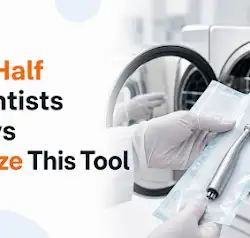
When a 2025 survey asked practicing dentists in Bhopal whether they always sterilized their handpiece, the single most reused tool in a dental chair, between patients, only 50.6% said yes. The rest admitted they sometimes skipped it. Most patients never think to ask, because they assume sterilization is automatic every time, everywhere.
Quick answer: dental infection control is the set of protocols, sterilization steps, and hygiene standards a clinic follows to stop bacteria, viruses, and other pathogens from passing between patients and staff. As of August 2026, following these protocols is still not automatic everywhere: a 2025 survey found real gaps in Indian dental practices, from inconsistent tool sterilization to low awareness of cross-infection risk. Third-party accreditation, such as NABH, is currently the clearest way for a patient to verify that a clinic’s hygiene claims are audited rather than simply stated. Asking direct questions about sterilization before booking is one of the simplest things a patient can do to protect themselves.
How Big Is the Real Risk of Infection From Dental Treatment?
The risk is real, measurable, and larger than most patients assume. It is not evenly distributed either: it depends heavily on which clinic, and which habits, a patient happens to walk into.
Research on oral surgical procedures found surgical site infection rates ranging from 2.15% to 30.8%, depending on the type of procedure, according to an August 2024 study published in the World Journal of Surgery and Surgical Research. That is a wide range, and the difference between the low end and the high end often comes down to how strictly infection control protocols were actually followed in that specific clinic.
The same pattern shows up on the provider side of the equation. A 2025 study of 312 dentists in Bhopal, published in the International Journal of Medical and Pharmaceutical Research, found that 92.3% of respondents expressed concern about the risk of cross-infection to themselves and their staff, yet 31.4% admitted a lack of awareness of cross-infection protocols. Concern and correct practice, in other words, are not the same thing.
Why Does a Gap Exist Between Dental Protocols and Daily Practice?
The gap exists because infection control depends on daily discipline that is invisible to the patient sitting in the chair, and largely unenforced unless an outside body is checking. Dentistry has long had a reputation for taking this seriously.
“The profession of dentistry was always the leader in regard to great infection control protocols,” said Duc “Duke” M. Ho, D.D.S., who chaired the American Dental Association’s Council on Dental Practice, in comments reported by ADA News in April 2025. That reputation is largely earned, but reputation is not the same as a guarantee at every single clinic, every single day.
The vigilance has to be maintained deliberately, not assumed. “Five years after the height of the COVID-19 pandemic, infection control remains a top priority in our practice,” said Cyrus Lee, D.M.D., CEO and Executive Dental Director of Permanente Dental Associates, in ADA News coverage from February 2025. That framing, an active daily priority rather than a box checked once, is exactly what separates clinics that stay consistent from clinics that drift.
What changes that gap is external verification. A systematic review of Indian tertiary care hospitals, published in Frontiers in Health Services in August 2025 by Deepika Kanyal and Babaji Ghewade of Datta Meghe Institute of Medical Sciences, found that infection control compliance improved by 40% after facilities went through NABH accreditation, and patient satisfaction scores rose by 25% in the same period. Accreditation, in other words, is not paperwork. It measurably changes what actually happens in the treatment room.
Cost pressure is part of why gaps persist without that outside check. Autoclave servicing, sealed single-use pouches, and disposable instruments all cost more than reusing tools loosely. Clinics that are not independently audited have less built-in reason to keep spending on that margin, especially in a competitive, price-sensitive market.
What Should a Smart Patient Look for Before Choosing a Dentist in 2026?
A smart patient should judge a clinic on verified systems, not on how clean the waiting room looks. A tidy reception area says nothing about how instruments are handled in the next room.
Third-party accreditation, not self-declared hygiene. A clinic that has passed an external audit, such as NABH, has had its sterilization and safety protocols independently checked, not just claimed on a wall certificate.
Transparency about the sterilization process. A clinic confident in its protocols will explain them without hesitation and will not treat the question as unusual or intrusive.
Modern, lower-contact technology. Digital X-rays, intraoral scanners, and laser-based tools reduce the number of reusable instruments and physical contact points compared to older manual methods.
Consistency across visits and locations. A clinic that maintains the same standard across multiple branches, not just one well-kept room, signals a documented system rather than a lucky day.
An experienced, stable clinical team. Long-tenured dentists and staff tend to follow protocol more consistently than a rotating cast of unfamiliar faces.
What Is the Actual Difference Between NABH-Accredited and Non-Accredited Dental Care?
The core difference is verification: NABH-accredited care has been independently audited against a fixed set of standards, while non-accredited care relies on the clinic’s own word. The table below compares what each typically means in practice.
Aspect
Non-Accredited or Informal Setup
NABH-Accredited Dental Care
Hygiene claims
Self-declared, not independently checked
Verified through an external NABH audit against fixed standards
Instrument sterilization
Varies by staff member and day, per 2025 Bhopal survey data above
Documented protocol, checked as part of accreditation review
Infection control compliance
No external benchmark to measure against
Improved by roughly 40% after accreditation, per the 2025 Frontiers in Health Services review
Patient satisfaction outcomes
Not systematically tracked
Rose by roughly 25% after accreditation, per the same review
Record keeping
Informal or inconsistent
Structured documentation required for re-accreditation
What Should You Actually Check Before Your First Appointment?
Before booking, a few direct checks tell you more than any brochure. None of these require dental training, only a willingness to ask.
Ask whether the clinic holds NABH accreditation or an equivalent independently audited certification.
Ask whether instruments are autoclave-sterilized in sealed pouches opened in front of you, not pre-opened trays sitting out.
Ask how often sterilization equipment itself is tested and serviced, not just used.
Notice whether staff can explain their protocol clearly, or seem uncertain when asked.
Check whether the clinic uses digital or laser-based tools that reduce reliance on repeatedly reprocessed instruments.
Look for consistency: the same standard should hold true across every visit, not just the first one.
Thind Dental Clinic was built around exactly this standard of verified, audited hygiene. As an NABH-approved practice across three locations in Ludhiana, it combines digital and laser dentistry with documented sterilization protocols overseen by Dr. Rajanbir Singh Thind and Dr. Gurinder Kaur Thind, so patients are not asked to simply take hygiene claims on faith.
If you have been putting off a dental visit while wondering whether a clinic’s hygiene claims would actually hold up to scrutiny, the next step does not need to be a full treatment decision. You can book a free smile assessment and consultation to see the sterilization process, ask the questions listed above in person, and get a clear, judgment-free picture of your own oral health before deciding anything further.
Frequently Asked Questions
How do I know if a dental clinic is truly hygienic?
Ask for proof of independent accreditation such as NABH, watch whether instruments come from sealed sterilization pouches opened in front of you, and notice whether staff explain their process without hesitation. A genuinely hygienic clinic will not treat these questions as unusual.
Do dentists really sterilize tools after every patient?
They are supposed to, but practice varies by clinic. A 2025 survey of dentists in Bhopal found only 50.6% always used an autoclave to sterilize handpieces between patients, so it is reasonable to ask directly rather than assume.
Why are NABH standards important for patients?
NABH accreditation requires a clinic to pass an external, structured audit of its sterilization, documentation, and safety protocols instead of simply stating that it is clean. That outside check is what separates a verified standard from a claimed one.
Can poor sterilization actually cause infections?
Yes. Research on oral surgical procedures found surgical site infection rates ranging from 2.15% to 30.8% depending on the type of procedure, which shows the outcome depends heavily on how strictly protocols are followed at that specific clinic.
What red flags suggest a clinic lacks proper hygiene standards?
Watch for pre-opened instrument trays, staff who seem unsure or defensive when asked about sterilization, no visible or mentioned accreditation, and inconsistent standards between visits. Any of these is worth a direct follow-up question before you proceed.
Is Thind Dental Clinic NABH accredited?
Yes, Thind Dental Clinic is an NABH-approved dental practice with locations across Ludhiana, offering digital and laser dentistry alongside documented sterilization protocols. A free smile assessment and consultation is available for patients who want to see the process firsthand.
Sources
Infection Control Today, “Elevating Infection Prevention in Dental Clinics: Addressing Surgical Site Infection Risks,” November 2025
Nahar S, Jain S, Sharva V, et al., “Awareness of cross-infection control among dentists in their workplace in Bhopal city,” International Journal of Medical and Pharmaceutical Research, 2025
Kanyal D, Ghewade B, “Evaluating quality improvement in tertiary care hospital before and after NABH accreditation: a systematic review,” Frontiers in Health Services, August 2025
ADA News, “Five years later: Staffing shortages, infection control since the COVID-19 pandemic,” February 2025
ADA News, “Pandemic infection control procedures still in place,” April 2025