Published: November 11, 2026
Last updated: November 11, 2026
Dr. Rajanbir Singh Thind, Thind Dental Clinic
In a 2024 study of 181 young Indian adults, Priyanka and colleagues, writing in Cureus, found that 98.3% showed some psychological impact linked to how their teeth look. Almost everyone notices their smile. Very few know what the first step to changing it actually involves.
That first step is the consultation. Knowing what happens inside it removes most of the fear and most of the guesswork.
Quick answer: what happens during a smile makeover consultation?
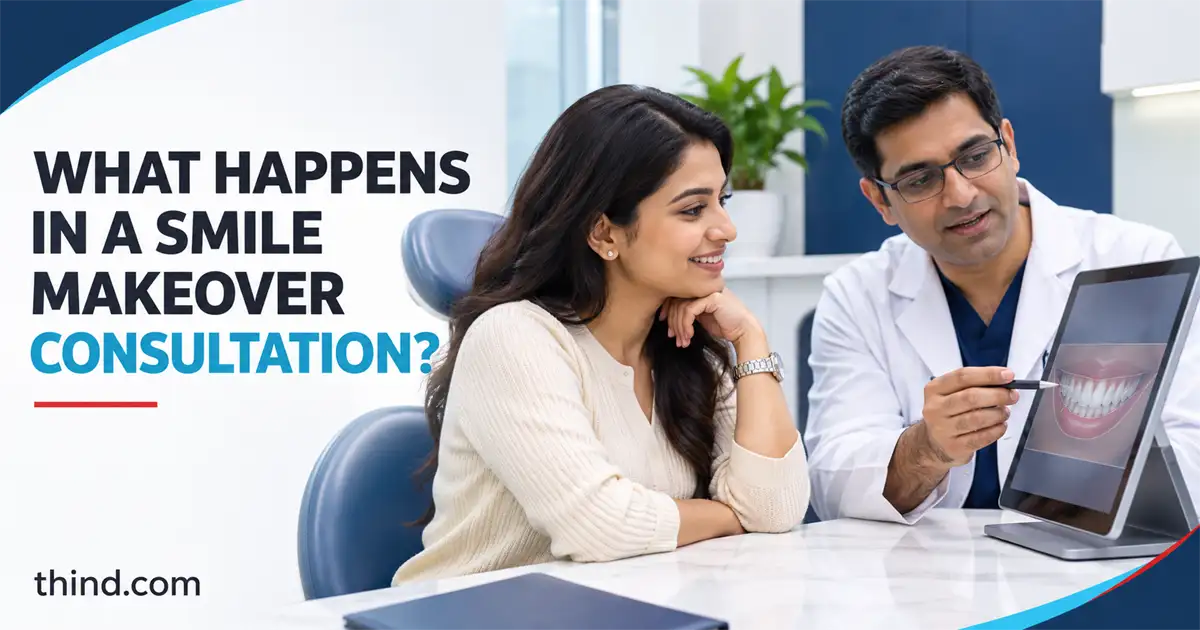
A smile makeover consultation is a planning visit, not a treatment visit. The dentist listens to what bothers you, examines your teeth, gums and bite, and records photos and often a digital scan. Many clinics then build a digital preview or a temporary mock-up so you can see the proposed smile before any tooth is changed. You should leave with a written plan that lists your options, including the least invasive one, with costs in ₹, timelines and maintenance needs. As of November 2026, research shows previews and scans make this visit clearer and more comfortable than older methods, so expect a conversation, not a sales pitch.
What is a smile makeover consultation?
A smile makeover consultation is the first appointment in which a dentist studies your face, teeth and gums and plans how to improve your smile. A smile makeover itself is a combined plan that may include whitening, bonding, veneers, gum reshaping or clear aligners.
No drilling, reshaping or whitening happens at this stage. The goal is diagnosis, discussion and a plan you understand before you agree to anything.
Why do so many people delay this first visit?
Most people delay because they fear the chair, the cost or being pushed into treatment they do not need. Dental fear is common, and for many adults it attaches to the very first appointment.
The cost of waiting is real. The same 2024 Cureus study found that the psychological effect of dental appearance was close to universal in its sample, which means many people carry that weight for years before anyone explains their options.
- Delay keeps you guessing about what is possible and what it costs.
- Guessing often leads people to judge treatment by social media photos instead of a proper examination.
- Without a plan, small concerns that need simple care can be mistaken for problems that need major work.
What happens at each step of the consultation?
A well-run consultation follows a clear sequence: listen, examine, record, preview and plan. The table below shows what each step involves and what you should take away from it.
| Step | What the dentist does | Why it matters to you | What you should take away |
|---|---|---|---|
| 1. Your goals | Asks what bothers you and how you want your smile to look | Treatment should start from your concern, not a menu | Your priorities written into the plan |
| 2. Clinical examination | Checks teeth, gums, bite, old fillings and jaw comfort | Gum or bite problems must be handled before cosmetic work | A plain-language explanation of your oral health |
| 3. Records | Takes facial and smile photos, X-rays if needed, and often a digital scan | Accurate records allow precise planning | A clear view of what the dentist sees |
| 4. Smile analysis and preview | Studies proportions, gum line and face shape, then shows a digital preview or mock-up | You judge the look before any tooth is changed | A preview, with its limits explained |
| 5. Options and plan | Presents two or more routes, from least to most invasive | You choose with full information | A written plan with costs in ₹, timeline and maintenance |
Does the dentist examine more than your front teeth?
Yes, a proper consultation looks at your whole mouth and face, not only the teeth you show in photos. Healthy gums and a stable bite are the foundation that every cosmetic result sits on.
If gum inflammation, decay or bite strain is found, a good plan treats it first. Skipping this step is one of the main reasons cosmetic work fails early.
Will you get a digital scan instead of messy impressions?
Often yes, and most patients prefer it. An intraoral scanner is a handheld camera that builds a 3D model of your teeth without impression putty.
A systematic review and meta-analysis of 13 studies by de Paris Matos and colleagues in the Journal of Prosthetic Dentistry (2023) found that patients preferred intraoral scanning over conventional impressions. The authors concluded that scanning promotes less discomfort, especially for people sensitive to taste, nausea and breathing difficulty.
Can you preview your new smile before treatment starts?
In many cases yes, through a digital design on screen, a temporary mock-up worn over your own teeth, or both. These tools are part of digital dentistry, which uses photos and scans to plan treatment.
A 2025 systematic review of seven studies by Alwabel and colleagues in Cureus reported on how patients respond to these previews. In one included study, 64.3% of patients rated the digital preview "very effective" and 85.7% said the same of the physical mock-up.
The same review describes a randomised trial of 150 patients in which those planned with digital smile design scored 87.2 out of 100 for satisfaction, against 81.5 for conventional planning. The review notes that study sizes were small, so treat a preview as a strong guide rather than a guarantee.
Why might you and your dentist notice different things?
Because trained eyes pick up smaller details than untrained ones, so the consultation must cover both views. What bothers you most should lead the plan, while the dentist explains anything that affects health or long-term results.
A 2016 study by Al Taki and colleagues in the International Journal of Dentistry compared 28 orthodontists, 35 general dentists and 47 laypersons. Orthodontists noticed a lateral incisor that was 2 mm narrower, while laypersons noticed the change only at 4 mm.
The same study found that orthodontists rated up to 2 mm of visible gum as attractive, while laypersons accepted up to 4 mm. This is why a good consultation asks what you see before suggesting what to change.
How should you judge whether a consultation is worth your time?
Judge it by the quality of planning and safety, not by the size of the discount. Four criteria separate a careful consultation from a rushed one:
- Independently verified hygiene: national accreditation shows that sterilisation and patient-safety systems are audited by an outside body.
- Digital and laser technology: scans, digital previews and comfort-focused laser options make planning precise and treatment gentler.
- An experienced team with more than one perspective: two senior dentists reviewing a plan catch what one might miss.
- Convenient access: more than one clinic location makes follow-ups easier to fit around work and family.
What should you check before you leave the consultation?
Before you leave, make sure you have everything you need to decide calmly at home. Use this checklist:
- The dentist examined your teeth, gums and bite, not only your front teeth.
- You saw a digital preview or mock-up and understood its limits.
- You were offered at least two options, including the least invasive one.
- You received a written plan with costs in ₹ (inclusive of GST where applicable) and a timeline.
- Maintenance, follow-ups and retainers, if needed, were explained up front.
- The clinic could show its hygiene accreditation.
Where can you have a smile makeover consultation in Ludhiana?
Thind Dental Clinic offers smile design and cosmetic dentistry in Ludhiana, with planning built around digital records, previews and your own goals. The clinic is NABH-approved and is led by Dr. Rajanbir Singh Thind and Dr. Gurinder Kaur Thind, a husband and wife dentist team, across its Ludhiana clinic locations.
Plans can combine whitening, invisible aligners and orthodontics, and laser dentistry where each one genuinely fits your case.
If you would like to see what your own consultation would show, you can book a free smile assessment and consultation at thind.com. You leave with a clear explanation of your options and no obligation to start treatment.
Frequently asked questions
Will dentists show before-after smile simulations?
Many clinics now show a digital simulation, a physical mock-up, or both. Research reviewed in 2025 found that patients rated these previews highly, with physical mock-ups rated "very effective" more often than screen designs. Always ask how closely the final result is expected to match the preview.
How long does smile planning usually take?
The consultation itself is usually a single visit, though complex cases may need a second appointment to review the preview. Planning takes longer when gum or bite problems must be treated first. Your dentist should give you a timeline for each stage in writing.
Should patients discuss budget during consultations?
Yes, and the earlier the better. Sharing your budget helps the dentist show options at different levels, including simpler treatments that may meet your goal. A good plan lists every cost in ₹ so there are no surprises later.
Can consultations help reduce fear before treatment?
Yes, because fear often comes from not knowing what will happen. A consultation involves no drilling or reshaping, and seeing a preview of your result makes the process concrete. Many people find that a calm first visit makes later appointments much easier.
Will dentists explain all available treatment options?
A careful dentist should present more than one route, from the least invasive to the most complete. If you are offered only one expensive option, it is reasonable to ask why. You should understand which steps are reversible and which are permanent before you decide.
Sources
- Priyanka JSY, Bhavya P, Srinivas B, et al. An Assessment of the Subjective Psychological and Social Effects of Malocclusion-Related Dental Aesthetics and Its Influence on Body Self-Image and Oral Health-Related Quality of Life in Young Adults. Cureus, 2024;16(5):e60120. DOI: 10.7759/cureus.60120
- de Paris Matos T, Wambier LM, Favoreto MW, et al. Patient-related outcomes of conventional impression making versus intraoral scanning for prosthetic rehabilitation: a systematic review and meta-analysis. Journal of Prosthetic Dentistry, 2023;130(1):19-27. DOI: 10.1016/j.prosdent.2021.08.022
- Richards D. Intraoral scanning v conventional impressions: patient related outcomes. The Dental Elf, National Elf Service, 2023
- Alwabel LK, Alabduljabar WM, Alawfi LK, et al. Digital Smile Design and Patient-Centered Outcomes in Esthetic Restorative Dentistry: A Systematic Review. Cureus, 2025;17(11):e98084. DOI: 10.7759/cureus.98084 (PMID: 41473620)
- Al Taki A, Khalesi M, Shagmani M, Yahia I, Al Kaddah F. Perceptions of Altered Smile Esthetics: A Comparative Evaluation in Orthodontists, Dentists, and Laypersons. International Journal of Dentistry, 2016;2016:7815274. DOI: 10.1155/2016/7815274