Published: October 21, 2026
Last updated: October 21, 2026
Dr. Rajanbir Singh Thind, Thind Dental Clinic
In a 2019 survey of 1,000 US adults, Cigna's Behind the Smile study found that 58% said their smile could be improved. Yet only 7% of those with lower self-confidence named better oral health as a way to lift it.
Wanting a better smile is common. Knowing what to ask before you commit is rare, and that gap is where most disappointment starts.
Quick answer: what should you ask before a smile makeover?
Ask six things: what exactly is wrong and why, what the smallest treatment is that would fix it, what is reversible and what is not, whether you can preview the result, what the full cost and timeline are, and how the result is maintained. A good plan is written, itemised and based on a proper examination of your teeth, gums and bite, and it should offer more than one option. As of October 2026, research shows cosmetic marketing can outpace clear explanation, so questions protect you.
What is a smile makeover?
A smile makeover is a personalised plan that combines treatments to change the colour, shape, alignment and gum framing of your visible teeth. It draws on cosmetic dentistry, which includes whitening, dental veneers and clear aligners.
It is a plan, not a single procedure. That is why the questions you ask at the start matter more than the treatment you choose first.
Why is asking questions more important now than before?
Because cosmetic dentistry is increasingly shaped by social media and before-and-after photos. A 2025 systematic review in BMC Medical Ethics by Rostamzadeh and Rahimi examined marketing practices and overtreatment in cosmetic dentistry. It reports that 48.6% of practitioners in one included study used before-and-after photos to attract patients, and 90.7% in another reported rising demand for aesthetic procedures because of social media.
The same review notes that 37% of university students in one study said social media influenced their decision to have aesthetic treatment. Photos can inspire you, but they do not tell you what was done, what was removed, or how long it lasted.
How safe and long-lasting are the treatments in a makeover?
Well-planned treatments can last many years, but you should ask for the evidence behind each one. A commentary in Evidence-Based Dentistry by Watt and Conway (2013) summarised a systematic review of feldspathic porcelain veneers. It estimated cumulative survival of 95.7% at five years and 95.6% at ten years in a post hoc analysis, though individual ten-year studies ranged from 64% to 95%.
That range is the reason to ask. Survival depends on the dentist's skill, the material, your bite and your habits, so ask how long results usually last in your own case.
Can you see the result before treatment starts?
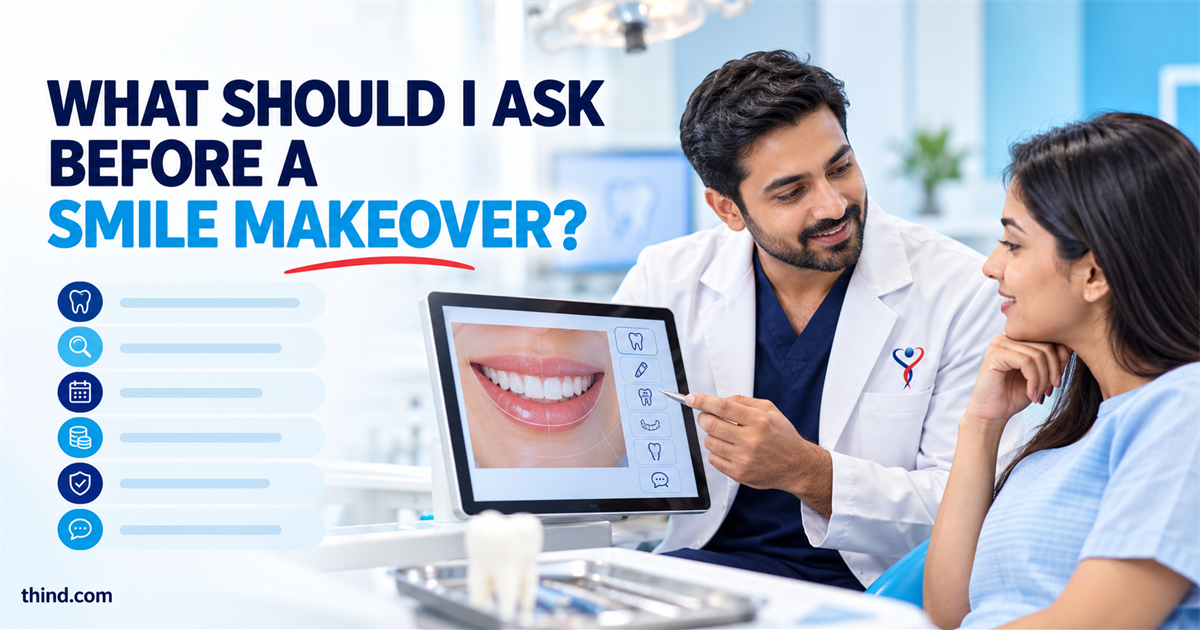
Often yes, and you should ask. Digital smile design is a planning method that uses photographs and scans to preview a proposed smile before any tooth is changed. It is part of wider digital dentistry.
The evidence is encouraging but still young. A 2025 systematic review and meta-analysis in Digital Health by Saini and colleagues pooled studies of AI-based digital smile design and found a pooled satisfaction prevalence of 58%, with a wide confidence interval (30% to 86%). Treat previews as a helpful guide, not a guarantee.
Will you and your dentist see your smile the same way?
Not always, so say clearly what bothers you. A 2026 study in Scientific Reports by Guner and colleagues compared 86 dental professionals with 86 laypersons. Professionals placed more emphasis on gum appearance, while laypersons more often named the teeth themselves as their main criterion.
Your dentist may notice gum levels or proportions you never considered. Ask them to show you what they see, and tell them what you see.
Which questions should you ask, and what should a good answer sound like?
Use the table below as a checklist at your consultation. A clear, specific answer to each question is a good sign.
| Question to ask | Why it matters | A good answer sounds like |
|---|---|---|
| What exactly is the problem, and what causes it? | Treatment should start from a diagnosis, not a catalogue. | An examination of teeth, gums and bite, explained in plain words. |
| What is the simplest option that would work? | Some concerns need whitening or bonding, not a full makeover. | Two or three options, starting with the least invasive. |
| What is reversible and what is permanent? | Reshaping enamel cannot be undone. | A clear split between reversible and permanent steps. |
| Can I preview the result? | It lets you judge the look before committing. | A digital or physical preview, with its limits explained. |
| What are the total cost and timeline? | Surprise costs make people stop halfway. | A written, itemised plan with a timeline for each step. |
| How do I maintain the result? | Retainers, polishing and habits protect your investment. | Follow-up visits and home care explained up front. |
How should you choose who plans your smile makeover?
Choose a team that plans before it treats and fits around a working week. Five criteria matter most:
- Verified hygiene: recognised accreditation such as NABH shows that sterilisation and safety systems are independently audited.
- Digital planning: scans and a preview of your result before treatment starts.
- Comfort-focused technology, such as laser-assisted methods where suitable.
- Experienced dentists who offer several options, including the smallest one that works.
- Convenient locations, so check-ups and adjustments fit around meetings.
What should you check before you say yes?
Check these before you sign anything, because they separate a considered plan from a rushed one:
- The dentist examines your teeth, gums and bite before recommending treatment.
- You receive a written, itemised plan with costs in ₹ and a timeline.
- You can see a preview, and the dentist explains how closely the final result may match it.
- Alternatives are offered, including doing less.
- The clinic can show its hygiene accreditation.
- Maintenance and follow-up visits are explained before treatment begins.
Where can you get a clear smile makeover plan in Ludhiana?
Thind Dental Clinic offers smile makeover and cosmetic dentistry in Ludhiana, Punjab, across three clinic locations. The clinic is NABH-approved and led by Dr. Rajanbir Singh Thind and Dr. Gurinder Kaur Thind, a husband and wife dentist team.
Treatments include whitening, clear aligners and orthodontics, laser dentistry and complete smile design, planned around your face and your goals.
If you would like to put these questions to a dentist, you can book a free smile assessment and consultation at thind.com. There is no obligation to proceed, and you leave with a clear picture of your options.
Frequently asked questions
How many questions should I ask at a smile makeover consultation?
Six core questions cover most needs: the diagnosis, the simplest option, what is permanent, the preview, the total cost and the maintenance. Write them down before you go. A good dentist will welcome them.
Is it rude to ask for a simpler, cheaper option?
No. A considered plan should show you more than one route, including the least invasive one. If every option on offer is the biggest one, ask why.
Can I see how my smile will look before treatment?
In many cases you can, through digital previews or temporary mock-ups. These show the planned shape and shade, but they are a guide and not a promise. Ask how closely the final result is likely to match.
How long does a smile makeover last?
It depends on the treatments used, your bite and your habits. Research on porcelain veneers shows high survival rates over five to ten years, with wide variation between studies. Your dentist should explain what maintenance your plan needs.
Do I need a full makeover, or can I start small?
You can often start small. Stained teeth or a small chip may need only one simple treatment. A full makeover makes sense when several features bother you at once.
Sources
- Cigna, Behind the Smile: Oral Health and Self-Esteem (2019 survey of 1,000 US adults)
- Rostamzadeh M, Rahimi F. Aesthetic dentistry and ethics: a systematic review of marketing practices and overtreatment in cosmetic dental procedures. BMC Medical Ethics, 2025. DOI: 10.1186/s12910-025-01169-6
- Watt E, Conway DI. Review suggests high survival rates for veneers at five and ten years. Evidence-Based Dentistry, 2013. DOI: 10.1038/sj.ebd.6400914
- Saini RS and colleagues. Impact of artificial intelligence-based digital smile design on patient and clinician satisfaction and facial esthetic outcomes: a systematic review and meta-analysis. Digital Health, 2025. DOI: 10.1177/20552076251388392
- Guner ZD and colleagues. A comparison of dental professionals' and patients' perceptions in assessing smile esthetics. Scientific Reports, 2026. DOI: 10.1038/s41598-026-48105-1