Published: October 12, 2026
Last updated: October 12, 2026
Dr. Rajanbir Singh Thind, Thind Dental Clinic
The American Association of Orthodontists estimated in its 2014 survey that 27 percent of all orthodontic patients in the United States and Canada were adults, a record 1,441,000 people aged 18 and older. Adults are no longer the exception in the orthodontic chair.
That shift is why the old question has become a practical one: should you choose clear aligners or metal braces?
Quick answer: are aligners better than metal braces?
Aligners are better for comfort, appearance and, in pooled studies, treatment time, but braces still lead for some bite problems. A 2019 meta-analysis of 8 studies found aligners finished significantly faster, while braces did better at occlusal contacts, torque control and retention. A 2023 meta-analysis of 12 studies found less pain with aligners at days 3 and 4. As of October 2026, the better choice is the one matched to your bite, so ask for a diagnosis before choosing a look.
What are clear aligners and metal braces?
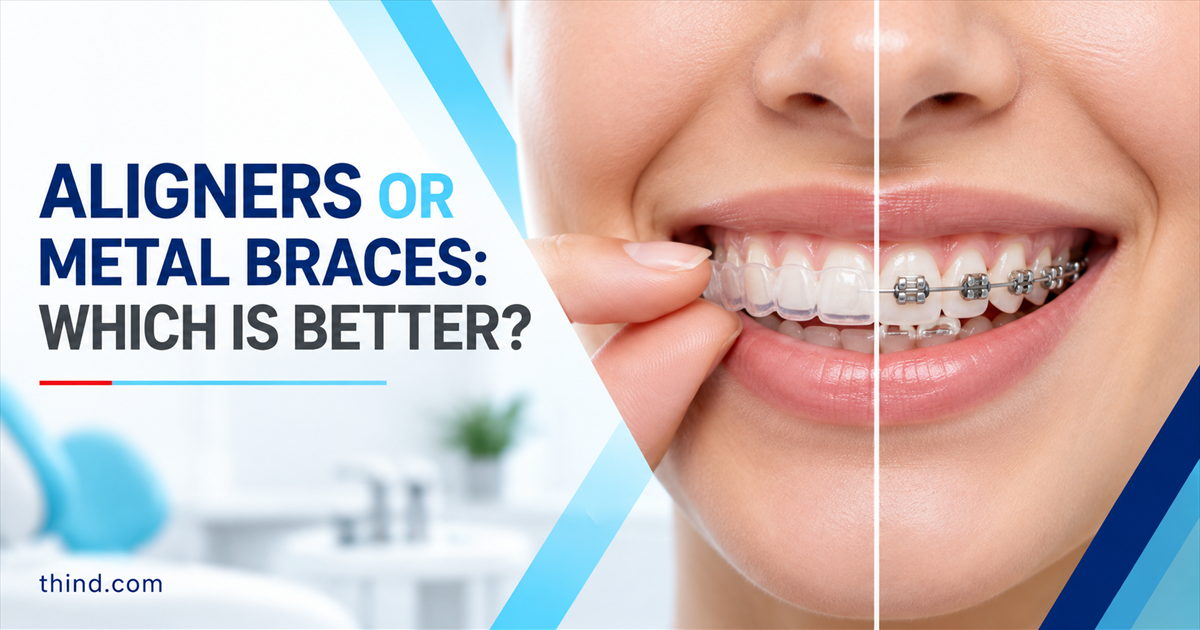
Clear aligners are removable, transparent plastic trays worn in a numbered series, each one moving the teeth a little further. Dental braces are brackets and wires fixed to the teeth, adjusted by the dentist at regular visits.
Both belong to orthodontics, the branch of dentistry that corrects crowding, gaps and bite problems, together known as malocclusion.
Do aligners and braces get the same results?
For many cases, yes, but the details differ. In a 2019 meta-analysis in BMC Oral Health by Ke, Zhu and Zhu covering 8 studies (2 randomized trials and 6 cohort studies), the authors concluded that "both clear aligners and braces were effective in treating malocclusion."
The same review found aligners were not as effective as braces at producing adequate occlusal contacts, controlling tooth torque and retention. Overall grading scores showed no significant difference between the two.
The picture for harder cases is similar. A 2023 systematic review in Cureus by Jaber, Hajeer and Sultan of 6 studies and 283 patients with complicated or severe malocclusion found that 3 studies showed no difference on the PAR index or the ABO-OGS between aligners and braces. Two studies found gaps between planned and achieved tooth movement with aligners in premolar extraction cases.
Are aligners faster than braces?
On average in pooled research, yes. The Ke meta-analysis reported significantly shorter treatment time with aligners (weighted mean difference of −6.31, P < 0.001).
Faster does not mean right for everyone. Speed depends on how complex the movement is and how consistently the trays are worn, so your own timeline will come from your dentist's plan.
Are aligners more comfortable than braces?
Yes, especially in the first week. A 2023 meta-analysis in BMC Oral Health by Li, Du and Yang of 12 studies found lower pain scores with aligners on a 10-point scale at 3 days (mean difference −0.97) and 4 days (−0.59).
The same review found better oral health-related quality of life with aligners. On the OHIP-14 questionnaire (lower scores mean less impact), the difference was −10.88 at 1 week, −6.27 at 1 month and −4.19 at 6 months.
How do aligners and braces compare side by side?
The table below summarises what the research above shows and what is simply how the two systems work.
| Question | Clear aligners | Metal braces |
|---|---|---|
| Appearance | Transparent trays, hard to notice | Visible brackets and wires |
| Early pain | Lower at days 3 and 4 (Li and colleagues, 2023) | Higher at days 3 and 4 |
| Treatment time | Significantly shorter in pooled studies (Ke and colleagues, 2019) | Longer in pooled studies |
| Bite contacts, torque, retention | Less effective in pooled studies | More effective in pooled studies |
| Who controls wear | You, since trays are removable | The dentist, since brackets are fixed |
| Eating | Trays come out for meals | Food can catch around brackets |
What should you look for before choosing between them?
Choose the provider who diagnoses first and offers both options honestly, not the one who sells a single system. These criteria matter more than the brand of tray or bracket:
- A clinic that holds a recognised hygiene accreditation such as NABH approval, because treatment runs for many months and involves repeated visits.
- Digital scanning and a 3D preview of your planned result before you commit.
- Dentists who will tell you plainly if your bite is better suited to braces.
- Convenient locations, since check-ups and refinements are part of both pathways.
- A clear plan for retainers, because teeth can shift after any orthodontic treatment.
What is the quick checklist before you decide?
- Ask whether your case is mild, moderate or complex.
- Ask what happens if the teeth do not track the plan.
- Ask how many hours a day you must wear the trays, and whether you can realistically do it.
- Ask to see a digital preview of the final position.
- Ask about retainers and follow-up visits after treatment ends.
Where can you get an honest aligner or braces assessment in Ludhiana?
Thind Dental Clinic is an NABH-approved practice with three locations in Ludhiana, run by the husband-and-wife team of Dr. Rajanbir Singh Thind and Dr. Gurinder Kaur Thind. The team offers clear aligner and orthodontic treatment alongside digital planning, so the recommendation starts from your bite and not from a product.
You can read more about the clinic's cosmetic dentistry and smile design services on the website.
If you are weighing aligners against braces, book a free smile assessment and consultation at thind.com. You will leave with a clear view of which option suits your teeth and what to expect.
Frequently asked questions
Which option is less noticeable socially?
Clear aligners, because the trays are transparent and there is no metal. They are not invisible up close, and small tooth-coloured attachments may be bonded to some teeth.
Are braces better for severe alignment cases?
Sometimes. Pooled research shows braces perform better for bite contacts, torque control and retention. A 2023 review of complicated cases found no difference in index scores in 3 of 6 studies, so the answer depends on your specific bite.
Are aligners worth the higher cost?
That depends on what you value. Aligners offer less early pain, a less visible appearance and, in pooled studies, shorter treatment time. If your bite needs the control that braces give, the cheaper-looking option may be the better value.
Can adults start braces or aligners later in life?
Yes. Adults made up 27 percent of orthodontic patients in the 2014 American Association of Orthodontists survey. Your dentist will first check that your gums and teeth are healthy enough for movement.
What happens if aligners are not worn consistently?
Teeth move less than planned, treatment takes longer and refinements may be needed. Because aligners are removable, results depend on you wearing them for the hours your dentist prescribes.
Sources
- Ke Y, Zhu Y, Zhu M. A comparison of treatment effectiveness between clear aligner and fixed appliance therapies. BMC Oral Health, 2019.
- Li Q, Du Y, Yang K. Comparison of pain intensity and impacts on oral health-related quality of life between orthodontic patients treated with clear aligners and fixed appliances: a systematic review and meta-analysis. BMC Oral Health, 2023.
- Jaber ST, Hajeer MY, Sultan K. Treatment effectiveness of clear aligners in correcting complicated and severe malocclusion cases compared to fixed orthodontic appliances: a systematic review. Cureus, 2023.
- Dental Tribune, reporting the American Association of Orthodontists Economics of Orthodontics survey, 2014 (published 2016).