Published: September 18, 2026
Last updated: September 18, 2026
Dr. Rajanbir Singh Thind, Thind Dental Clinic
A missing tooth is one of the most common dental problems in India, and one of the most delayed.
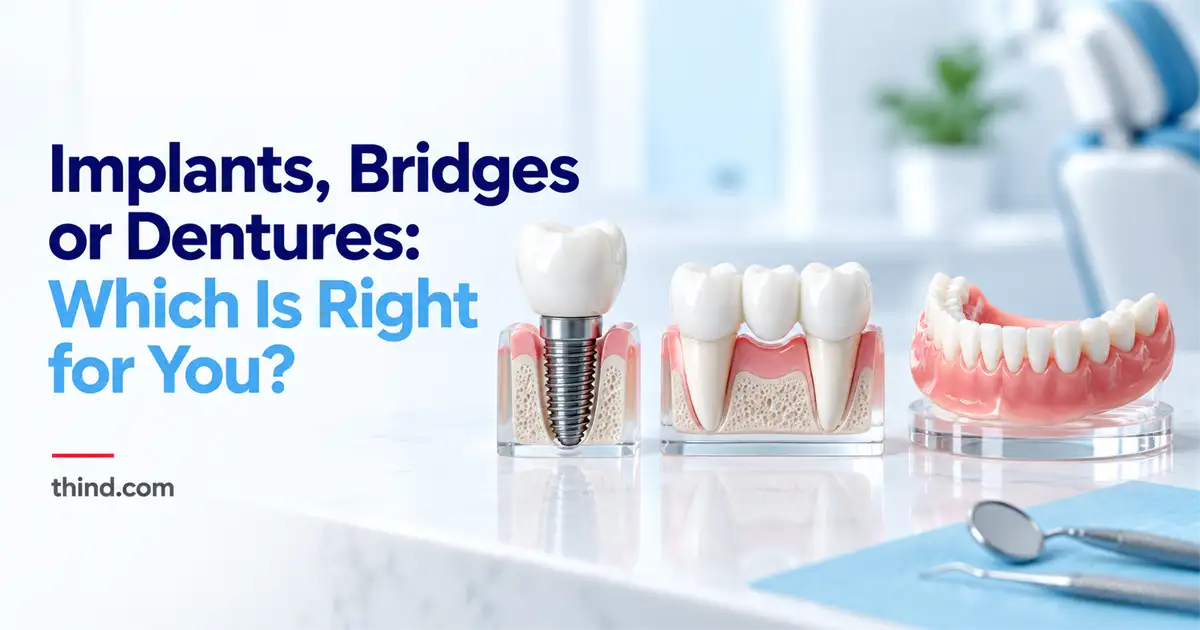
Choosing between a dental implant, a dental bridge, and a denture comes down to bone health, budget, and how many teeth need replacing, not which option is newest. A dental implant is a titanium post placed in the jawbone that supports a crown, and it is the only option that actively preserves bone. A dental bridge uses the teeth next to the gap to anchor a false tooth and typically lasts around a decade, while a denture is a removable appliance that costs less upfront but needs more adjustment over time. As of September 2026, the right choice depends mainly on how much bone support remains and how many teeth are missing.
Why Does Losing Just One Tooth Matter So Much?
Losing one tooth sets off changes that go far beyond the gap you can see. The jawbone under a missing tooth begins to change shape because it no longer receives the chewing pressure it needs to stay dense, and neighbouring teeth gradually drift into the empty space. This is why dentists rarely treat a missing tooth as a cosmetic issue alone.
Globally, severe periodontal disease, the leading cause of tooth loss, affects more than 1 billion people, according to the World Health Organization's oral health fact sheet updated on 17 March 2025. The same report states that edentulism (complete tooth loss) affects nearly 23 percent of people aged 60 and above worldwide. That is roughly one in four older adults living without any natural teeth at all, a figure most people find surprising the first time they hear it.
What Happens If You Wait to Replace a Missing Tooth?
Waiting rarely makes the decision easier. It usually makes it more expensive and more limited. A 2021 systematic review and meta-analysis of 16 studies covering 13,662 adults, published in Contemporary Clinical Dentistry by Venkat, Janakiram and Ramanarayanan, found that 58.8 percent of Indian adults have lost at least one tooth, and 10.7 percent have lost all of their natural teeth.
The same review found that partial tooth loss was nearly double among rural adults compared with urban adults, and slightly more common among women, while complete tooth loss was more common among men. These are not small, isolated numbers. They describe a majority of the adult population carrying at least one untreated gap.
- A missing back tooth (tooth loss) is often ignored simply because it does not show when you smile, yet it still changes how you chew and can shift your bite over months.
- The longer a gap is left untreated, the more the bone beneath it can change, which can make later treatment, including implants, more complex and sometimes more costly.
- Neighbouring teeth tilting into a gap can create new food-trap areas, raising the risk of decay and gum problems in teeth that were previously healthy.
Why Is Tooth Replacement Changing So Fast Right Now?
Tooth replacement in India is shifting quickly toward digital, implant-based solutions, and the pace is not just a clinic-level trend. According to a January 2026 market analysis by Astute Analytica, India's dental implant market is projected to roughly double in size between 2025 and 2035, growing at a compound annual rate of 6.99 percent. The same report notes that titanium implants achieved clinical success rates averaging 98.2 percent in 2025 studies, and that single-implant pricing in India typically ranges from ₹20,000 to ₹50,000.
Part of what is driving this shift is patient behaviour, not just technology. Working professionals in their late thirties to fifties are increasingly unwilling to accept a removable solution that limits what they can eat or how confidently they speak in meetings. Younger patients, meanwhile, are more likely to research options online before ever booking a consultation, which is why understanding the real differences between implants, bridges and dentures matters more now than it did a decade ago.
As Dr. Avinash Bidra, a prosthodontics faculty member at the University of Connecticut School of Dental Medicine, has explained: "When you lose even a single tooth, it will result in bone loss, change the bite, cause food impaction and result in adjacent teeth moving towards the missing space. The longer one waits to get it replaced, the more challenging the clinical situation is, yet if you fix it fast the cycle stops." Prosthodontists, he adds, are the specialists who "predominantly do one thing, replace missing teeth."
Dental Implants vs Bridges vs Dentures: How Do They Actually Compare?
Each option solves the same problem in a different way, and the right one depends on your specific mouth, not on which is newest. Here is how the three compare on the factors that matter most to patients.
| Factor | Dental Implant | Dental Bridge | Denture |
|---|---|---|---|
| Typical cost in India | Roughly ₹20,000 to ₹50,000 per single implant, and ₹2,00,000 to ₹6,00,000 for full-arch rehabilitation (Astute Analytica, 2026) | Generally lower than a single implant, varying with the material and number of units bridged | Usually the lowest upfront cost of the three, varying by material and number of teeth replaced |
| Bone health over time | Stimulates the jawbone through chewing pressure, helping preserve bone density | Does not stimulate the bone under the gap, which can continue to change shape | Does not stimulate the bone under the gap, and may need refitting as the jaw changes |
| Approximate longevity | Reported clinical success rates averaging 98.2 percent in 2025 studies, with many implants functioning for decades with proper care | Around 79 to 82 percent of fixed bridges are still functioning at the 10-year mark, per a March 2023 review | Typically neds relining, adjustment, or replacement every several years as gums and bone change shape |
| Treatment process | Multiple visits across a few months, including healing time before the crown is placed | Usually completed in two to three visits over a couple of weeks | Several fittings over one to two weeks, adjusted for comfort |
| Neighbouring teeth | No alteration needed to adjacent healthy teeth | Adjacent teeth are reshaped to support the bridge | No permanent alteration, though clasps may rest on nearby teeth in partial dentures |
The longevity row is worth pausing on. A March 2023 review published on the NCBI Bookshelf found that fixed dental bridges have a 10-year survival rate of approximately 79 to 82 percent, with an estimated average longevity of around 10 years with adequate care. That is a useful benchmark when weighing a lower upfront cost against the likelihood of needing a second treatment later.
What Should Actually Decide Between an Implant, a Bridge, and a Denture?
The smartest way to choose is not by price alone. It is by matching the option to your bone health, timeline, and how many teeth are involved. A handful of criteria consistently separate a good decision from a rushed one.
- Bone density and gum health. Enough bone volume needs to remain to support an implant, which is why a digital scan or intra-oral imaging before treatment matters more than a visual check alone.
- Number and location of missing teeth. A single back tooth, several teeth in a row, and a full arch each call for a different combination of solutions, sometimes even a mix of implants and a bridge.
- How the clinic explains the plan. A trustworthy recommendation comes with a visible reason, not just a price, ideally shown through your own scan or X-ray rather than a generic diagram.
- Hygiene and sterilization standards. Any surgical or semi-surgical procedure, including implant placement, carries more risk in a clinic that cannot clearly explain its sterilization protocol.
- Continuity of care. Implants, bridges, and dentures all need periodic review, so a clinic you can return to for years matters more than a one-time low price.
What Should You Look for Before Choosing Where to Get It Done?
Once you know which option fits your situation, the clinic you choose affects the outcome almost as much as the treatment itself. A short checklist can prevent most of the regret patients describe after a rushed decision.
- Look for a clinic that shows you your own digital scan or X-ray before recommending a treatment, rather than relying on a generic explanation.
- Look for NABH-approved hygiene standards and a clinic that is transparent about its sterilization process when asked.
- Look for a team experienced across implants, bridges, and dentures, not one that defaults to whichever procedure it performs most.
- Look for laser or digital treatment options where appropriate, since these can shorten recovery and reduce discomfort for procedures around the gum line.
- Look for a clinic with more than one location or flexible scheduling, since tooth replacement usually needs multiple visits over weeks or months.
- Look for a written, itemised treatment estimate before you begin, so cost does not become a mid-treatment surprise.
Every one of these points is really the same idea from a different angle: choose a clinic that shows its work, in the form of scans, sterilization protocols, written estimates, and a team you can see again next year.
Where Thind Dental Clinic Fits Into This Decision
This is exactly the standard we built Thind Dental Clinic around. Across our three NABH-approved clinics in Ludhiana, Dr. Rajanbir Singh Thind and Dr. Gurinder Kaur Thind use full-mouth digital X-rays and intra-oral scanning to show patients their own bone structure before recommending an implant, bridge, or denture.
Rather than defaulting to one solution for every patient, our teams also use laser dentistry, including non-contact laser cavity treatment, where it can make a procedure faster and more comfortable.
If you have been putting off replacing a missing tooth because you were not sure which option made sense for you, that uncertainty is usually the easiest part to resolve. You can book a free smile assessment and consultation to get a clear, scan-based answer instead of a guess.
Bring your questions about cost, timeline, or a past treatment that did not go well. A short conversation with the team at Thind Dental Clinic is usually enough to tell you whether an implant, a bridge, or a denture is the right starting point, and what it would actually involve for your specific mouth.
If it has been a while since your last dental visit and you are not sure where to start, the simplest next step is a free smile assessment and consultation at one of our Ludhiana clinics, with no pressure to commit to treatment the same day. Bringing a clear picture of your options, backed by your own scan, tends to make the eventual decision far less stressful than it feels right now. You can also review our full range of cosmetic and restorative dentistry services beforehand if you would like to come prepared with questions.
Frequently Asked Questions
How long do dental implants really last?
Clinical studies reported success rates averaging 98.2 percent in 2025, and many implants continue functioning well for decades when patients maintain good oral hygiene and attend regular reviews. Longevity depends heavily on bone health, gum care, and whether the implant was placed with adequate planning.
Is a dental bridge painful to get?
Placing a bridge usually involves reshaping the two teeth next to the gap, which is done under local anaesthesia and is not typically described as painful. Mild sensitivity for a few days afterward is common and usually settles on its own.
Can dentures look and feel natural?
Modern dentures are shaped and shaded to match your remaining teeth and facial structure, so they can look natural, though most wearers need a short adjustment period for speaking and eating. Fit tends to improve with small adjustments in the first few weeks.
Which option is cheapest for replacing a single missing tooth?
A denture is usually the lowest upfront cost, followed by a bridge, with a single implant typically ranging from about ₹20,000 to ₹50,000 in India as of 2026. The cheapest option upfront is not always the lowest cost over ten years once potential replacements are factored in.
Do I need to replace a back tooth even if no one can see it?
Yes, because a missing back tooth still affects chewing balance and can allow neighbouring and opposing teeth to shift over time. The consequences are functional, not just cosmetic, even when the gap is not visible when you smile.
Can I start with a denture and move to implants later?
In many cases yes, though earlier bone loss from a longer wait can make a later switch to implants more involved. A dentist can assess this directly from a scan rather than a general rule of thumb.
Sources
- World Health Organization, "Oral health" fact sheet, updated 17 March 2025
- Venkat M, Janakiram C, Ramanarayanan V, "Prevalence of Tooth Mortality among Adults in India: A Systematic Review and Meta-Analysis," Contemporary Clinical Dentistry, 2021 (PubMed)
- Astute Analytica, "India Dental Implant Market Projected to Reach US$ 300.71 Million by 2035," January 2026
- "Dental Bridges for Partial Tooth Loss," NCBI Bookshelf, InformedHealth.org, March 2023
- UConn Today, "Missing Teeth? More Common Than You Think," interview with Dr. Avinash Bidra, UConn School of Dental Medicine