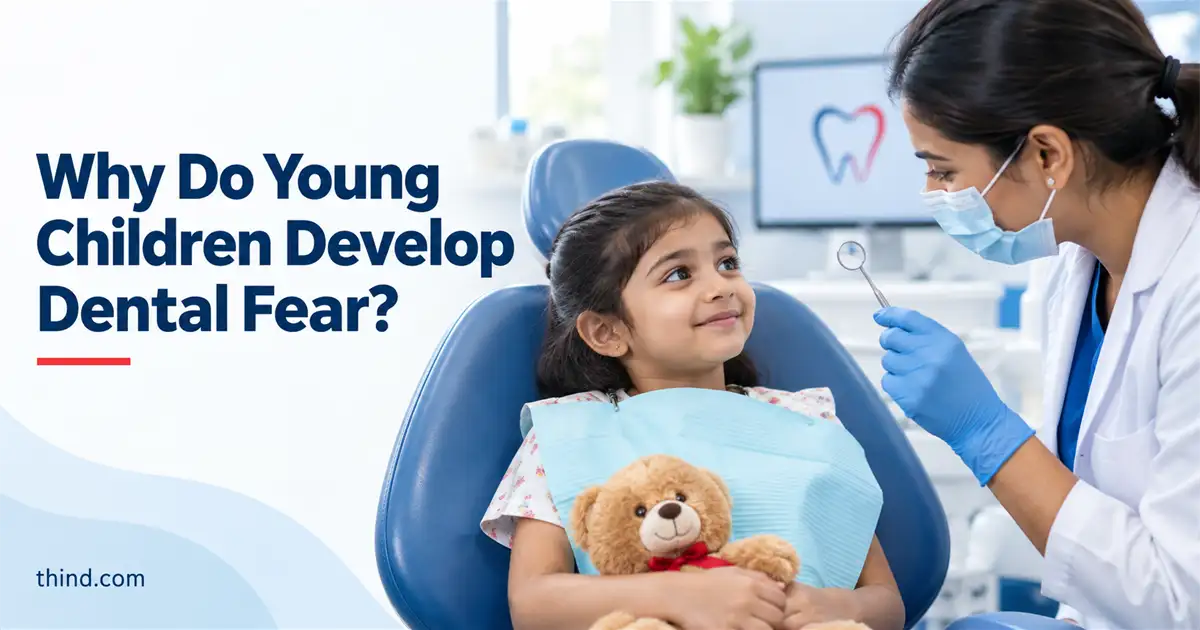
Most parents assume dental fear is something adults pick up after one bad experience in their twenties or thirties. The data tells a different story. A 2024 systematic review in the Journal of Dentistry found that nearly 30 percent of children between the ages of two and six already show measurable dental fear and anxiety, often years before their permanent teeth arrive.
Dental fear in young children is caused mainly by unfamiliar sensations, unclear explanations, and pain during early treatment, not by dentistry itself. What prevents it is a combination of an early first visit (ideally by age one), calm step by step explanations before any procedure, and technology that reduces noise, pressure, and needles. Children who have positive early experiences are far less likely to carry dental anxiety into adulthood, and parents who understand this can shape how their child responds to every future visit, long before a problem ever appears.
What Is Dental Fear, and How Common Is It in Young Children?
Dental fear is an anxious or fearful response to dental care that ranges from mild nervousness to a diagnosable phobia. As of September 2026, it remains one of the most under-discussed pediatric health issues, even though it is more common than most parents assume.
The 30 percent figure cited above comes from pooled data across dozens of studies worldwide, not one clinic’s observation. In an average classroom of 25 to 30 young children, that means roughly seven to nine may already be dealing with some degree of dental fear, whether or not their parents have noticed.
What Happens When a Child’s Dental Fear Goes Unaddressed?
Left unaddressed, dental fear does not stay still. It tends to compound, delay treatment, and get more expensive with every year that passes.
- A 2019 systematic review in the Indian Journal of Pediatrics found early childhood caries (tooth decay in very young children) affects an average of 49.6 percent of children across India, with no state falling below 40 percent.
- According to the American Academy of Pediatric Dentistry, a child’s odds of already having a cavity at their first dental visit more than double for every year that visit is delayed, and a five-year-old’s first visit shows roughly 20 times greater odds of existing decay than a one-year-old’s.
- A 2025 analysis in Frontiers in Dental Medicine put India’s total annual economic burden from oral disease at 613.2 billion rupees, with patients covering 62.6 percent of dental costs out of pocket, compared with 10 to 12 percent in the United States.
As of September 2026, none of these numbers describe rare, worst case scenarios. They describe what tends to happen, on average, when a fearful first experience turns into years of avoidance.
Why Do So Many Children Develop Fear of the Dentist in the First Place?
Most childhood dental fear traces back to one of three overlapping causes: an unpleasant early experience, a lack of clear guidance for parents about when to start visits, or fear inherited directly from an anxious parent.
A national poll from the University of Michigan’s C.S. Mott Children’s Hospital found that only 45 percent of parents said a doctor or dentist ever suggested an age to start their child’s dental visits, while 55 percent received no professional guidance at all. Sarah Clark, co-director of the University of Michigan’s C.S. Mott Children’s Hospital National Poll on Children’s Health, put it plainly:
“Visiting the dentist at an early age is an essential part of children’s health care.”
Fear also travels through families. Children of parents with high dental anxiety are consistently more likely to develop it themselves, which means the pattern can repeat for a generation unless something interrupts it early.
What Should Smart Parents Look for in Dental Care for an Anxious Child?
The right choice is not the clinic with the most toys in the waiting room. It is a clinic built around reducing the specific triggers that create fear in the first place.
- Early, unhurried first visits. A clinic that welcomes a child’s first visit around age one, rather than waiting for a problem, is following the same guidance pediatric dentistry researchers recommend worldwide.
- Visible hygiene and sterilization standards. Parents should be able to see, not just be told, that instruments and treatment rooms meet a recognized accreditation standard.
- Technology that reduces invasive sensations. Laser dentistry and digital scanning can treat many early cavities with less noise, less pressure, and in some cases no injection at all, which matters enormously for a child who already associates the dentist with pain.
- One consistent provider for the whole family. Continuity lets a dentist track a child’s development over years instead of starting from zero at every visit, and it helps when parents model calm behavior in the same clinic their child visits.
- Explanations before instruments. A dentist who narrates each step in plain language, before touching a child’s mouth, consistently produces calmer visits than one who does not.
How Does a Modern, Low-Anxiety Visit Compare to a Traditional One?
The biggest differences show up in three places: how pain is managed, how much a child understands what is happening, and how long a problem is allowed to sit before it gets treated.
| Element | Traditional Approach | Modern Low-Anxiety Approach |
|---|---|---|
| Cavity detection | Visual check, often after pain has started | Digital scans and X-rays that catch problems early, before pain |
| Pain management | Drilling and injections for most cavities | Laser treatment for many early cavities, often without an injection |
| Communication | Procedure explained briefly or not at all | Step by step explanation before any instrument is used |
| Visit frequency | Reactive, driven by pain or a visible problem | Preventive, scheduled every six months regardless of symptoms |
| Family continuity | A different dentist for each family member or visit | One trusted dentist tracking the whole family over time |
How Can You Tell If a Clinic Will Actually Make Visits Easier for Your Child?
Use this checklist before booking, not after a difficult visit has already happened.
- Look for a clinic that welcomes first visits at an early age instead of waiting for a complaint.
- Look for a clinic that can show you its sterilization and hygiene accreditation, not just describe it.
- Look for a clinic that offers digital scans or laser treatment as a standard option, not an upsell.
- Look for a clinic where the same dentist can see every member of the family over multiple years.
- Look for a clinic with more than one location, so a follow-up visit does not depend on rearranging an entire day.
- Look for a dentist who explains each step before starting treatment, every single time, not only on the first visit.
Where Ludhiana Families Are Already Finding This Kind of Care
Thind Dental Clinic was built around exactly this checklist. As an NABH-approved practice across three locations in Ludhiana, it is led by Dr. Rajanbir Singh Thind and Dr. Gurinder Kaur Thind, who combine laser dentistry, digital diagnostics, and unhurried, explanation-first treatment for patients of every age.
For a family trying to break the fear cycle described above, hygiene a parent can verify, technology that reduces pain, and one trusted team across every visit is simply the practical version of everything the research points to.
The easiest place to start is not a procedure, it is a conversation. A free smile assessment and consultation at Thind Dental Clinic gives a dentist the chance to meet a child, or an anxious adult, on neutral terms, explain what an exam actually involves, and start building the kind of trust that prevents fear before it ever takes hold.
Frequently Asked Questions
At what age should a child have their first dental visit?
Most pediatric dentistry guidelines recommend a first visit by age one, or within six months of the first tooth appearing. Clinics such as Thind Dental Clinic welcome first visits at exactly this age, since early visits let a dentist catch small issues before they become painful.
Why are so many children afraid of the dentist?
Most childhood dental fear comes from a combination of an unpleasant early experience, unclear guidance for parents on when to start visits, and fear inherited from an anxious parent. None of these causes are permanent, and all of them can be addressed with the right approach.
Does delaying a child’s first dental visit really increase the risk of cavities?
Yes. Research from the American Academy of Pediatric Dentistry shows the odds of a child already having a cavity at their first visit rise sharply with every year of delay, with a five-year-old’s first visit carrying roughly 20 times the odds of existing decay compared with a one-year-old’s first visit.
Can laser dentistry really make a child’s treatment painless?
For many early cavities, yes. Laser dentistry at Thind Dental Clinic can remove decay with less vibration, less noise, and often no injection at all, which matters most for a child who is already anxious about needles or drills. It is not appropriate for every case, which is why a proper assessment comes first.
How can parents help reduce a child’s dental anxiety before an appointment?
Simple, honest preparation helps more than surprises. Explaining what will happen in plain language, avoiding words like “shot” or “drill,” and choosing a dentist who talks directly to the child rather than only to the parent all reduce anxiety measurably.
Is childhood dental fear something kids usually grow out of on their own?
Not reliably. Studies tracking dental fear over time show it can persist into adolescence and adulthood if the underlying experience is never addressed, which is why early, positive visits matter more than waiting for a child to get used to it.
Published: September 16, 2026
Last updated: September 16, 2026
Dr. Rajanbir Singh Thind, Thind Dental Clinic
Sources
- Hutton, L. and Linden, J., “Tiny teeth in terrified tots: what is the global prevalence of paediatric dental fear and anxiety?”, Evidence-Based Dentistry, 2024
- Ganesh, A., Muthu, M.S., Mohan, A. and Kirubakaran, R., “Prevalence of Early Childhood Caries in India: A Systematic Review”, Indian Journal of Pediatrics, 2019
- “India’s oral health outlook: challenges, economic impact and need for preventative strategies”, Frontiers in Dental Medicine, 2025
- “The Importance of the Age One Dental Visit”, American Academy of Pediatric Dentistry
- “Lack of guidance may delay a child’s first trip to the dentist”, Michigan Medicine, University of Michigan