Published: September 9, 2026 | Last updated: September 9, 2026
Dr. Rajanbir Singh Thind, Thind Dental Clinic
Nearly half the people on Earth are living with a disease that rarely makes headlines. According to the World Health Organization’s 2022 Global Oral Health Status Report, oral disease affects an estimated 3.5 billion people worldwide, more than any other health condition the WHO tracks. Most of it is preventable, and most of it is only discovered after it starts to hurt.
Waiting for tooth pain before booking a dental visit forces decisions to be made under pressure, when discomfort, limited time and rising costs narrow the choices available. Early diagnosis, through routine checkups, digital X-rays and periodic scans, catches problems such as a small cavity or early gum inflammation while they are still simple to treat. A 2025 study in the Indian Journal of Dental Research found that over 80 percent of Indian patients already showed signs of periodontal disease, and 33.7 percent reported oral pain in the past 12 months. Catching a problem early keeps more treatment options open, keeps costs more predictable, and removes the panic that leads to rushed choices.
Preventive dental care is the practice of finding and treating minor problems, such as a small cavity or early gum inflammation, before they progress into pain, infection or tooth loss. It relies on routine checkups and diagnostic tools rather than waiting for symptoms to appear on their own.
How Common Is Dental Pain and Gum Disease in India Right Now?
Dental pain and gum disease are far more common in India than most people assume, and most of it goes undiagnosed until it becomes serious. As of September 2026, the most detailed look at how Indian patients actually experience dental care still comes from a 2025 study published in the Indian Journal of Dental Research.
Researchers examined 1,049 patients at private clinics across India and found that more than 80 percent already showed signs of periodontal disease, and 33.7 percent had experienced oral pain in the past year. Only 51.5 percent had visited a dentist in the previous 12 months, and 8.1 percent said they had never been to a dentist at all.
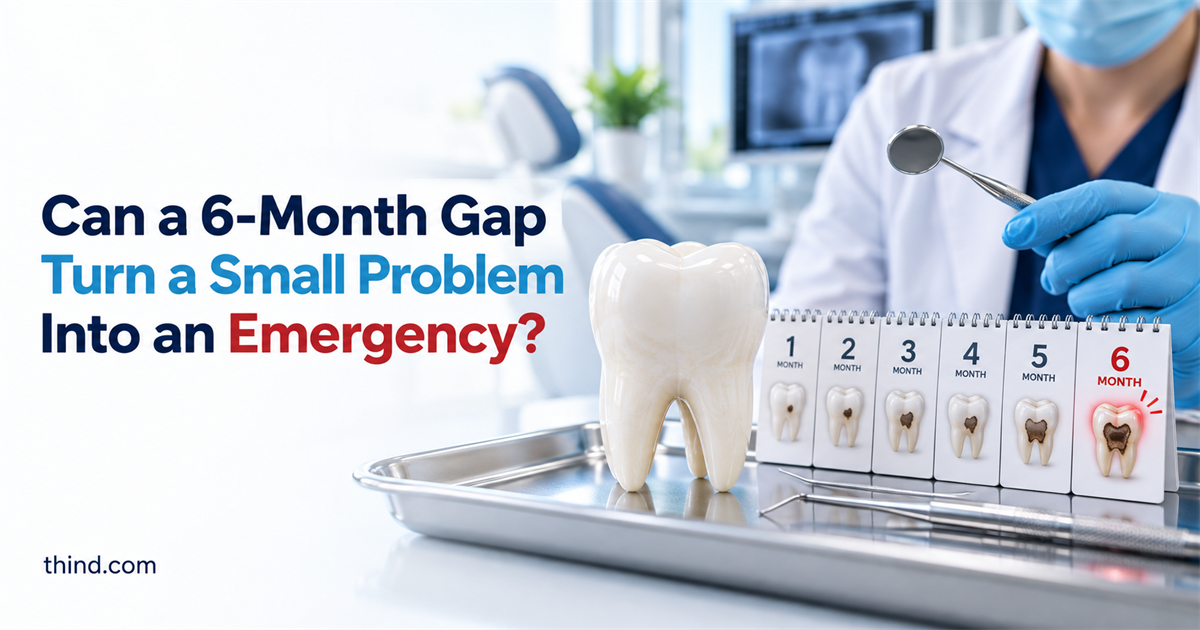
Left untreated, these problems rarely stay minor. Periodontal disease can progress silently for years before a tooth becomes loose, and tooth decay that begins as a small mark on the enamel can reach the nerve long before it causes constant pain.
Why Do Most People Only See a Dentist After the Pain Already Started?
Most people wait because early dental problems are usually invisible, and because dental care itself is still largely organized around treating problems rather than catching them early. That is a system pattern, not a personal failing.
The same 2025 Indian study found that dentists in private practice spend more than half their time on curative, restorative work, and less than 10 percent of their time on preventive care. That imbalance reflects patient behavior as much as clinic scheduling: most people book an appointment only once something already hurts.
"Oral health has long been neglected in global health, but many oral diseases can be prevented and treated with cost-effective measures," said Dr Tedros Adhanom Ghebreyesus, Director-General of the World Health Organization, in the same 2022 report cited above.
What is changing is the technology available to catch problems early. Digital dental radiography and intra-oral scanning let a dentist see decay, bone loss or an early cavity long before a patient feels anything. Preventive tools also have strong evidence behind them: a 2025 letter from American Dental Association leaders cites research showing fluoride varnish applied twice yearly reduces cavity rates by up to 43 percent in permanent teeth, and dental sealants prevent up to 80 percent of cavities in back teeth.
India’s dental services market is projected to grow at a compound annual rate of 7.6 percent between 2023 and 2030, according to Grand View Research, with cosmetic dentistry named as the fastest-growing segment. That shift suggests patients are increasingly choosing planned, technology-led care over purely reactive visits.
What Actually Changes Once a Small Problem Becomes an Emergency?
Once pain forces the decision, patients typically have fewer treatment options, less time to compare them, and a larger emotional and professional cost to absorb. The problem stops being about teeth and starts being about the rest of a person’s schedule and confidence too.
A 2024 report from Guardian’s 12th Annual Workplace Benefits Study found that 78 percent of working adults with fair or poor oral health reported a negative emotional impact, and 12 percent said they avoided speaking up in meetings because of how they felt about their smile. For working professionals, that cost shows up long before any dental bill does.
A dental emergency also rarely arrives at a convenient time. It usually means last-minute time away from work, an unplanned expense, and a treatment plan chosen quickly rather than compared calmly over a few days.
The table below compares what is typically available to a patient who catches a problem early against one who waits for it to become urgent.
|
What You’re Comparing |
Early Diagnosis Path |
Emergency or Delayed Path |
|---|---|---|
|
When the problem is usually found |
During a routine checkup or scan, often before symptoms appear |
After pain, swelling or a broken tooth forces an urgent visit |
|
Typical treatment options |
Several options, including a minor filling, cleaning or early gum therapy |
Often narrowed to root canal treatment, extraction or tooth replacement |
|
Visits generally needed |
Usually fewer, and planned in advance |
Often more, spread across an urgent visit and follow-ups |
|
Time to decide on treatment |
Days or weeks to ask questions and compare |
Hours, often while in pain |
|
Cost predictability |
Discussed and estimated in advance |
Less predictable, decided under time pressure |
What Should Guide How You Choose Dental Care From Now On?
The smartest shift a patient can make is choosing dental care built around early detection, not just treatment once something goes wrong. A few criteria consistently separate clinics that catch problems early from those that mostly react to them.
-
Digital X-rays and intra-oral scanning used as a standard part of every checkup, not offered only as an extra step.
-
Visible, clearly explained hygiene and sterilization standards, ideally benchmarked against a recognized accreditation framework.
-
More than one convenient location or flexible scheduling, so a preventive visit does not require a full day off work.
-
Continuity of care: the same dentist reviewing a patient’s case across multiple visits, rather than a different provider each time.
-
Clear, written treatment plans and cost estimates given before any procedure begins.
What Should You Look for When Choosing a Clinic for Preventive Care?
Beyond general criteria, a few concrete things are worth checking before committing to a clinic for ongoing preventive care.
-
Look for a clinic that includes a full digital or intra-oral scan as part of the first visit, not only a visual check.
-
Look for a clinic that can explain its sterilization and hygiene protocol clearly when asked, without hesitation.
-
Look for a clinic with more than one location or extended hours, so preventive visits fit around a working schedule.
-
Look for a clinic where you can expect to see the same dentist at your next visit, not a rotating roster of providers.
-
Look for a clinic that gives a written treatment plan and cost estimate before any procedure begins, not after.
-
Look for a clinic offering a low-commitment first visit, such as a free assessment, so starting the conversation does not feel like a financial decision.
Where Can You Find This Kind of Preventive-First Care in Ludhiana?
This is the model Thind Dental Clinic in Ludhiana has built its practice around. As an NABH-approved clinic operating across three locations, it combines digital diagnostics and laser dentistry with continuity of care from the same husband-and-wife dentist team, Dr. Rajanbir Singh Thind and Dr. Gurinder Kaur Thind, so problems are more likely to be caught during a routine visit than during an emergency.
Patients can also look into the clinic’s digital diagnostic and laser dentistry options before deciding on their first visit, which fits the same idea this article has been building toward: understanding a problem clearly before deciding how to treat it.
What’s a Low-Pressure Way to Start?
The easiest first step is not a treatment decision, it is a conversation. Book a free smile assessment and consultation at Thind Dental Clinic to get a clear picture of where things stand today, with no pressure to commit to treatment on the same visit. It is the kind of appointment this entire article has been building toward: a calm, early look, taken before pain makes the decision for you.
Frequently Asked Questions
How often should adults get a dental checkup?
Most dental guidance points to a checkup roughly every six months, though some adults with excellent home care and low risk can space visits further apart with their dentist’s guidance. Regular checkups are how hidden decay and early gum disease typically get caught before they need urgent treatment.
What happens if I delay treating a small cavity?
A small cavity usually affects only the outer enamel and is simple to fill. Left untreated, decay can spread toward the nerve, which is when a filling is no longer enough and a root canal treatment or extraction may become necessary instead.
Can regular checkups actually prevent expensive emergency treatment?
Yes, in most cases. Catching a cavity or gum problem at an early stage generally means simpler, shorter and more predictable treatment than waiting until it becomes painful or urgent, which is why preventive visits are consistently positioned as the lower-cost path over time.
Why do people ignore dental problems until the pain starts?
Early dental problems are often painless, so there is no obvious signal prompting a visit. Combined with busy schedules and the assumption that "nothing feels wrong," this leads many people to seek care only once a problem is already advanced.
Do dental checkups always include X-rays or scans?
Not always, but they should happen at reasonable intervals. Digital X-rays and intra-oral scans reveal decay between teeth, bone loss and other issues invisible to a visual exam alone, which is why clinics that include digital scanning as a standard part of checkups tend to catch more problems earlier.