Published: July 22, 2026 | Last updated: July 22, 2026
By Dr. Rajanbir Singh Thind, Thind Dental Clinic
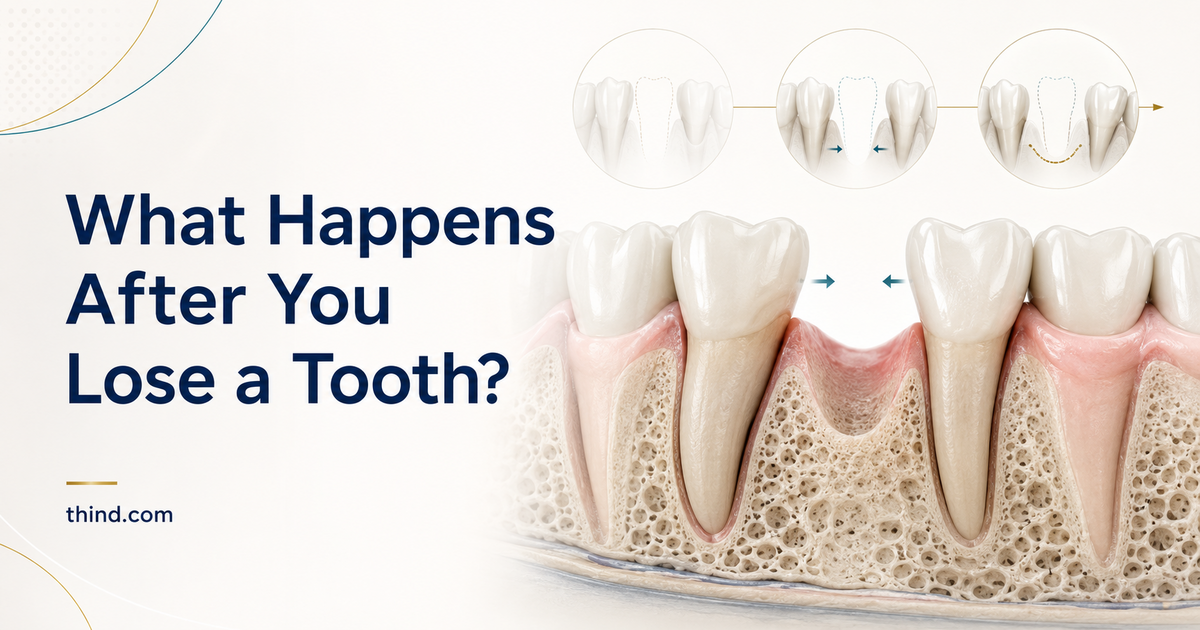
When a tooth is lost and not replaced, the jawbone beneath the gap begins to shrink within months because it no longer gets the chewing stimulation it needs, a process dentists call bone resorption. Nearby teeth can drift, your bite can shift, and chewing on that side gradually gets harder. None of this happens overnight. It is a slow decline that becomes more expensive and more complex to correct the longer it continues, which is why timing, not just the treatment itself, is the real decision that matters here.
What actually happens inside your jaw after you lose a tooth?
A tooth root does more than hold a tooth in place. It constantly signals the surrounding bone to stay dense, and once that signal disappears, the bone starts resorbing, or breaking down and shrinking, almost immediately. Over the following months, the ridge of bone that once supported the tooth narrows and flattens.
Tooth loss is the general term for this event, whether it happens from decay, gum disease, or injury. What most patients are never told is that the bone change starts long before it becomes visible from the outside, which is exactly why dentists recommend deciding on a replacement early rather than waiting.
How common is tooth loss among Indian adults right now?
It is far more common than most people assume. A systematic review and meta-analysis published in Contemporary Clinical Dentistry by Venkat, Janakiram, and Ramanarayanan pooled 16 Indian studies covering more than 13,000 adults and found that 58.8 percent had lost at least one permanent tooth, and 10.7 percent had lost all of their natural teeth.
The same review found the problem is worse in rural areas, where prevalence reached 61 percent, and rises sharply with age, approaching near-universal tooth loss by age 65 and above. In other words, this is not a rare misfortune. It is close to a default outcome for anyone who delays care long enough.
What is the real cost of waiting to replace a missing tooth?
The cost is mostly invisible at first, which is exactly what makes it dangerous. Left unaddressed, a single gap tends to widen into a bigger structural problem across several stages.
- First few months: the jawbone under the gap begins narrowing as it loses the stimulation a tooth root once provided.
- 6 to 12 months: neighboring teeth start tilting into the empty space, and the opposing tooth in the other jaw can start over-erupting.
- 1 to 2 years: chewing shifts to the opposite side, which can strain the jaw joint and alter bite alignment.
- Beyond 2 years: the narrowed, lower-volume bone can make later implant placement more complex and may require bone grafting first.
This is also playing out at a population level. As of July 2026, Grand View Research values India’s dental implant market at USD 216.9 million in 2025, projecting it to more than double to USD 514.3 million by 2033, growing at 11.5 percent a year. That kind of growth generally reflects a population catching up on years of delayed treatment, not a sudden trend.
Why is oral health neglect finally becoming impossible to ignore?
Because global health authorities are now treating it as a mainstream health issue, not a cosmetic afterthought. The World Health Organization’s Global Oral Health Status Report found that 45 percent of the world’s population, roughly 3.5 billion people, live with an oral disease, with the heaviest burden falling on low and middle income countries such as India.
“Placing people at the heart of oral health services is critical if we are to achieve the vision of universal health coverage for all individuals and communities by 2030,” said Dr Bente Mikkelsen, WHO Director for Noncommunicable Diseases.
The emotional side is just as well documented. A 2024 University of Sheffield study found that between 10 and 15 percent of the population wear removable dentures, and that tooth loss is frequently traumatic for the people going through that journey, not just an inconvenience.
“Tooth loss can be hugely traumatic and this study has uncovered just how challenging it is for people needing partial dentures,” said Professor Barry Gibson, Professor in Medical Sociology at the University of Sheffield.
Put together, the data and the lived experience point the same direction: this is a health issue with a clear window for early, less invasive treatment, and a much harder, more expensive path if it is ignored.
How do dental implants, bridges, and dentures actually compare?
Each option replaces the visible tooth, but only one is designed to also replace the root through osseointegration, fusing with the jawbone to keep stimulating it. The table below lays out how the three options typically differ in India as of 2026.
Feature
Dental implants

Dental bridges

Removable dentures

Replaces the tooth root

Yes, fuses directly with the jawbone

No

No

Effect on jawbone over time

Helps preserve bone density

Does not stimulate bone; resorption continues

Does not stimulate bone; resorption continues

Impact on neighboring teeth

None; stands independently

Adjacent teeth are shaved down for support

None structurally, but fit changes as bone shrinks

Typical lifespan

Often 15 to 20 plus years with care

10 to 15 years on average

5 to 8 years before refitting or replacement

Approximate cost band in India (per tooth or unit, GST inclusive)

Roughly ₹25,000 to ₹65,000

Roughly ₹15,000 to ₹40,000

Roughly ₹8,000 to ₹30,000 per arch

A 2024 meta-analysis in Clinical Oral Investigations by Schiegnitz and colleagues, described as the first study to systematically track implant survival over a full 20 years, found survival rates ranging from 78 percent under conservative assumptions to 92 percent in complete-case analysis, with retrospective data showing 88 percent survival over two decades. The authors were direct about the implication: long-term success depends on regular follow-up, not just the surgery itself.
What should actually change in how you evaluate a missing-tooth solution?
Most patients still shop for a missing-tooth fix the way they would shop for a quick repair: lowest price, fastest appointment, done. Given what the data above shows about bone loss and long-term outcomes, a smarter set of buying criteria looks different.
- Bone-first thinking, not just tooth-first. Ask how a treatment affects your jawbone over the next decade, not just how it looks next month.
- Verified hygiene standards, not just a clean-looking waiting room. Formal accreditation and documented sterilization protocols matter far more than décor.
- Digital diagnostics before any drilling. Full-mouth X-rays and intra-oral scans catch problems a visual exam misses.
- Comfort-focused technology. Modern laser dentistry can treat many cavities without the vibration and noise of a traditional drill.
- Continuity of care. A team that will still know your case in five years matters more than a one-time procedure.
What should you look for before choosing where to fix a missing tooth?
Use this as a working checklist during any consultation, regardless of which clinic you are considering.
- Look for a clinic that can show you its hygiene accreditation or sterilization protocol on request, not just describe it verbally.
- Look for a clinic that uses digital X-rays, intra-oral scanning, and offers laser treatment options for pain-sensitive procedures.
- Look for a clinic with more than one location, so follow-up visits fit around a busy work schedule rather than the other way around.
- Look for a clinic where the same experienced dentists see you across visits, rather than a rotating roster of unfamiliar staff.
- Look for a clinic that gives you a written treatment plan and cost estimate before any procedure begins, with no vague pricing.
- Look for a clinic willing to explain why it recommends one option (implant, bridge, or denture) over another for your specific case.
Where does this leave someone who has been putting off a missing tooth?
Everything above points to the same conclusion: earlier, evidence-based treatment is simpler, cheaper, and better for your jaw than waiting. This is exactly the standard Thind Dental Clinic was built around. As an NABH-approved practice across three locations in Ludhiana, it is run by the husband-and-wife team of Dr. Rajanbir Singh Thind and Dr. Gurinder Kaur Thind, using digital imaging, intra-oral scanning, and laser dentistry, including non-contact laser cavity treatment, so that decisions about implants, bridges, or dentures are made from a full picture of your bone and bite, not guesswork.
If you have been avoiding a gap in your smile because of fear, cost uncertainty, or a bad past experience, the more useful first step is not a treatment decision. It is simply an accurate picture of where things stand. You can book a free smile assessment and consultation to get full-mouth imaging and a clear, written explanation of your options before committing to anything. From there, whether the right path turns out to be a dental implant, a bridge, or a denture, you will at least be choosing with the same information your dentist is looking at, not without it.
There is no pressure and no obligation attached to that first visit. It exists specifically so the decision about your jaw, your bite, and your confidence is an informed one, made on your own timeline, with a full-mouth digital assessment in hand rather than a guess.
Frequently asked questions
How long do dental implants actually last?
Well-placed and properly maintained implants often last 15 to 20 years or longer, and many patients keep them for life. The Schiegnitz et al. (2024) 20-year meta-analysis in Clinical Oral Investigations found survival rates of 78 to 92 percent over two full decades, with regular follow-up visits playing a major role in long-term success.
Can dental implants fail, and why does that happen?
Yes, though failure is the exception rather than the rule. The most common causes are poor bone integration, uncontrolled gum disease around the implant, smoking, and skipping the follow-up visits needed to catch small problems early.
Are dental implants safe for older adults?
Generally yes. Age alone is rarely a barrier to getting an implant, since what matters more is bone quality, overall health, and whether existing conditions are well managed. A dentist will typically confirm this with imaging and a health review before recommending the procedure.
Can diabetics get dental implants safely?
In most cases, yes, provided blood sugar levels are well controlled at the time of surgery and during healing. Poorly controlled diabetes can slow healing and raise infection risk, which is why a proper pre-treatment health review matters more than the diagnosis itself.
What foods should be avoided right after getting an implant?
Hard, crunchy, and very sticky foods are best avoided for the first one to two weeks while the surgical site heals. Soft foods such as dals, khichdi, mashed vegetables, and yogurt are usually recommended until the dentist confirms the area has settled.
How many clinic visits does getting an implant usually take?
Most cases need an initial assessment visit, a surgical placement visit, a healing period of a few months for osseointegration, and a final visit to fit the crown. Straightforward, single-tooth cases with modern digital planning can sometimes be completed in fewer visits than patients expect.
Sources
- Grand View Research, India Dental Implants Market Size & Outlook, 2026-2033
- Venkat, Janakiram, and Ramanarayanan, Prevalence of Tooth Mortality among Adults in India: A Systematic Review and Meta-Analysis, Contemporary Clinical Dentistry (2021)
- Schiegnitz et al., How far can we go? A 20-year meta-analysis of dental implant survival rates, Clinical Oral Investigations (2024)
- World Health Organization, WHO highlights oral health neglect affecting nearly half of the world’s population (2022)
- University of Sheffield, Hidden challenges of tooth loss and dentures revealed in new study (2024)