A gag-inducing tray of blue putty used to be a routine part of almost any dental visit. In head-to-head comparisons, patients rated that old-style mold just 2.57 out of 10 for comfort, while a 3D digital scan of the exact same mouth scored 9.14 out of 10, according to a 2026 systematic review published in Frontiers in Oral Health. The most unpleasant part of getting a diagnosis, it turns out, was never actually necessary.
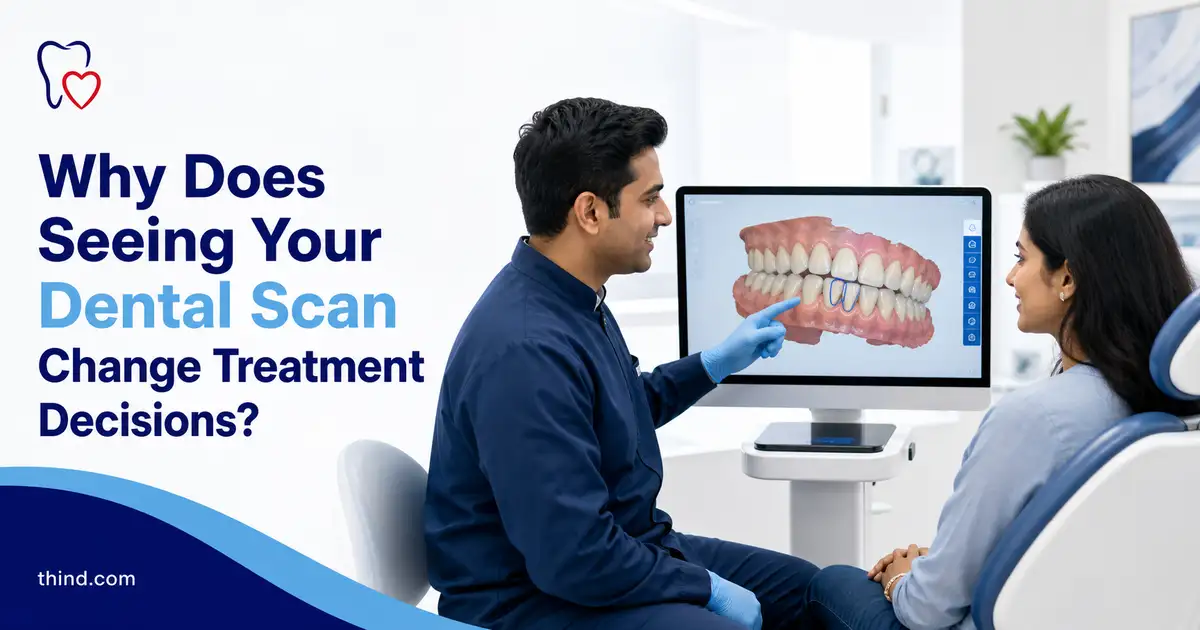
A digital dental scan changes a patient's decision because it replaces a dentist's spoken description with a live 3D image the patient can see and understand immediately. When someone can view the exact spot on a screen, whether it is a cracked filling, a receding gum line, or bone loss under a missing tooth, they stop having to take anyone's word for it. Research comparing digital scanning to older methods consistently links this visual clarity to higher comfort, fewer repeat visits, and treatment plans patients actually understand well enough to accept. As of August 2026, this shift is one of the biggest, and least talked about, changes happening in everyday dental care.
What Exactly Is a Digital Dental Scan?
A digital dental scan is a process where a small handheld wand captures thousands of images per second inside the mouth and stitches them into a 3D model on a screen, replacing the need for a physical mold. This device is formally known as an intraoral scanner, and it is increasingly paired with 3D X-ray systems known as cone beam computed tomography, which can show bone density and hidden root problems that a flat X-ray cannot.
Together, these tools let a dentist point at a screen and say "this is what I am seeing," instead of asking the patient to imagine it. That single change in how information is shared is what this article is really about.
What Is Skipping the Visual Proof Actually Costing Patients in 2026?
Skipping the visual proof costs patients accuracy, trust, and often money, mainly because the everyday neighborhood clinics most people actually walk into are still among the last parts of dentistry to adopt this technology. The numbers show a fast-moving industry with very uneven reach.
- In the single year between 2025 and 2026, the global market for intraoral scanners grew from an estimated USD 0.82 billion to USD 0.91 billion, on its way to USD 1.55 billion by 2031, according to Mordor Intelligence's 2026 industry report on intraoral scanners.
- That same report shows hospitals still hold 55 percent of the market as of 2025, while ordinary dental clinics, the setting where most patients are actually treated, are the fastest-growing segment at a 13.80 percent annual rate, meaning the everyday clinic is only now catching up.
- In India specifically, the intraoral scanner segment was worth just USD 16.99 million in 2024 and is growing at an 11.8 percent annual rate, according to a 2026 market report by Astute Analytica, a small base that suggests most Indian patients today have still never been shown a live scan of their own mouth.
- The same Astute Analytica report projects India's dental implant market to grow from USD 153.01 million in 2025 to USD 300.71 million by 2035. A meaningful share of that spending replaces teeth that were already lost, treatment that visual, early diagnosis is generally better placed to prevent than a guess-and-wait approach.
Why Is Dentistry Moving From "Trust Me" to "Look For Yourself"?
Dentistry is shifting toward visual proof because it measurably changes how patients feel about treatment, not just how they understand it. When patients can see their own images, confidence and comfort both rise, and that changes whether they say yes.
A 2024 review published in the journal Oral found that digital scanning shortens chairside procedure time by more than 30 percent on average compared to physical impressions for single-tooth work, and that showing patients their own scan images increased their confidence in the oral health plan being proposed to them. Dentists who use this technology daily describe the same shift from their side of the chair.
"We scan every patient when they come in for a consultation, and we can provide a visual aid to showcase the treatment we're proposing," says Dr. Manrina Rhode, founder of DRMR Clinic in London, in Dentistry.co.uk's 2025 guide to intraoral scanners."It's very, very cool to be able to show patients who are thinking about orthodontic work a visualisation of how their teeth will look in an image of their face," adds Dr. Monik Vasant, principal dentist at Fresh Dental London, in the same 2025 Dentistry.co.uk guide.
Three forces are driving this change at once: scanning hardware has become far cheaper and faster than it was even five years ago, patients who now video-call and shop online expect the same visual transparency from healthcare, and record-keeping expectations from accreditation bodies push clinics to document findings with images rather than notes alone.
Traditional Impressions vs. 3D Digital Scanning: What Actually Changes for the Patient?
The short answer is comfort, speed, and understanding all move in the patient's favor. The table below lays out the comparison directly.
| What Changes | Traditional Impression | 3D Digital Scan |
|---|---|---|
| Patient comfort (0 to 10 scale) | 2.57 out of 10 | 9.14 out of 10 |
| Typical chair time for single-tooth work | Baseline, often includes redo attempts | Over 30 percent faster on average |
| Can the patient see the finding right away | No, description only | Yes, live on a screen |
| Where it is most common in 2026 | Many everyday neighborhood clinics | Specialist, cosmetic, and implant-focused clinics, the fastest-growing setting at 13.80 percent a year |
How Should You Actually Choose Where to Get Treatment Now?
The smartest way to choose dental care today is to judge a clinic by how it proves things to you, not by how confidently it talks. A few shifts in thinking make this easier.
- Ask to see it, not just hear it. A clinic that routinely shows patients their own scans, rather than describing problems verbally, is signaling a more evidence-based, transparent approach to cosmetic dentistry and general treatment alike.
- Weigh documented hygiene over decor. Clean-looking waiting rooms say little about sterilization protocol. Ask what accreditation the clinic holds and how instruments are tracked between patients.
- Value convenience that does not compromise care. A group with more than one location, consistent equipment, and shared digital records across sites usually means less friction fitting appointments into a working professional's week.
- Look for continuity of care. A clinic where the same experienced clinicians see you across visits, rather than a rotating roster, tends to catch small problems earlier because they know your baseline.
- Ask about pain-management options upfront. Clinics investing in modern anesthesia and laser-based tools for procedures like cavity treatment are generally better equipped to reduce the fear that keeps people away in the first place.
What Should You Look For Before You Book Your Next Dental Visit?
Before booking, run through a short checklist rather than choosing on price or proximity alone. Each item below reflects what current research says separates a modern, trustworthy clinic from an outdated one.
- Does the clinic offer a digital scan or intraoral camera view as part of a first consultation, rather than only a mirror and a verbal note?
- Can staff clearly explain what accreditation or hygiene certification the clinic holds, and answer questions about sterilization without hesitation? Accredited clinics in India have become associated with materially better trust and reimbursement outcomes: NABH-accredited clinics can receive up to 15 percent higher reimbursements under government health schemes, according to an October 2025 report on NABH accreditation for Indian dental clinics.
- Does the clinic offer laser or digital options for routine issues like cavity treatment, rather than only the traditional drill?
- Is pricing explained clearly and in writing before treatment starts, with payment options discussed openly rather than only at checkout?
- Are both preventive care and corrective options, from a simple cleaning to dental implants or root canal treatment, available under one roof, so records and history travel with you instead of resetting at every referral?
- Does the team include more than one experienced clinician, so a second opinion is available without switching clinics entirely?
Where This Leaves You in Ludhiana
This is exactly the shift Thind Dental Clinic has built its NABH-approved clinics across Ludhiana around: digital scans and full-mouth imaging shown to patients before any treatment is agreed on, laser dentistry for pain-free cavity care, and an experienced husband-and-wife dentist team credentialed across implants, root canals, orthodontics, and cosmetic smile work. The goal, in line with everything above, is simple: you should be able to see what your dentist sees before you decide anything.
If you have been putting off a dental visit because you were never quite sure what was actually wrong or what it would involve, the lowest-friction next step is not a full treatment plan. It is a straightforward look. You can book a free smile assessment and consultation at Thind Dental Clinic, see your own digital scan on screen, and decide from there with real information instead of a guess.
Frequently Asked Questions
Can patients understand treatment better with 3D visuals?
Yes. Studies comparing patient comprehension with and without visual aids consistently find that seeing a 3D image of the actual problem area helps patients grasp both the diagnosis and the reasoning behind a proposed treatment far better than a verbal description alone.
Are digital dental scans safer than traditional X-rays?
Digital scans themselves use no radiation since they are optical, while the 3D X-ray systems often paired with them (cone beam computed tomography) are designed to use a low, targeted radiation dose for a more complete picture than older flat X-rays, generally without needing repeat images.
Do digital impressions replace traditional molds entirely?
In most modern clinics, yes, for the majority of everyday procedures such as crowns, aligners, and implant planning, digital scans have largely replaced the tray-and-putty impression, mainly because they are faster and, as the data above shows, far more comfortable.
How long does a full digital scan actually take?
A full-mouth digital scan typically takes only a few minutes, considerably less time than a traditional impression, which often needs to be redone if the mold shifts or the patient gags during the process.
Can technology like this actually improve trust between a patient and dentist?
Yes. When patients can see the same image their dentist is interpreting, treatment recommendations stop feeling like an opinion and start feeling like a shared, visible fact, which is consistently linked to higher patient confidence in the plan being proposed. It is the same reasoning behind Thind Dental Clinic's digital-first consultation process in Ludhiana.
Published: August 31, 2026
Last updated: August 31, 2026
Dr. Rajanbir Singh Thind, Thind Dental Clinic
Sources
- Frontiers in Oral Health (2026), systematic review on patient perception of intraoral scanners
- Oral, MDPI (2024), narrative review on clinical applications of intraoral scanners
- Mordor Intelligence (2026), Intraoral Scanners Market Report
- Astute Analytica via GlobeNewswire (2026), India Dental Implant Market report
- Dentist Channel (October 2025), report on NABH accreditation for Indian dental clinics
- Dentistry.co.uk (2025), Dentistry's guide to intraoral scanners