Published: August 26, 2026 | Last updated: August 26, 2026
Dr. Rajanbir Singh Thind, Thind Dental Clinic
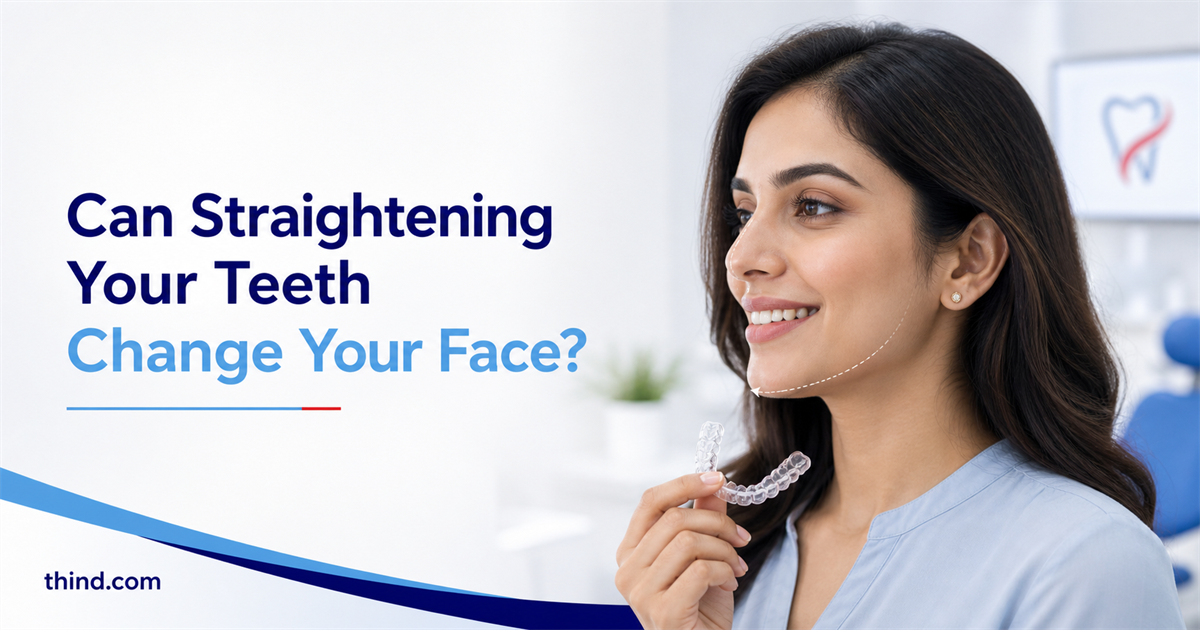
Clear aligners are transparent, removable plastic trays used to gradually move teeth into better alignment, without metal wires or brackets. Straightening your teeth can measurably change the profile of your face, though not in the dramatic way social media often suggests. A 2022 systematic review and meta-analysis in the European Journal of Orthodontics found that orthodontic treatment improved facial attractiveness ratings by about 9 percent compared with untreated controls, mainly through better lip support and a more balanced bite line. As of August 2026, the honest answer for most adults is: modest, real, and measurable, but not magic.
Does Straightening Your Teeth Actually Change the Shape of Your Face?
Yes, but the change is subtle and depends on the starting bite. Straightening teeth shifts how the lips rest against them, which can soften a protruding profile or fill out a thin upper lip line.
The clearest evidence comes from a 2022 systematic review and meta-analysis published in the European Journal of Orthodontics, which pooled results across multiple studies and found that orthodontic treatment raised facial attractiveness ratings by roughly 9 percent compared with no treatment at all. The same review noted the effect was "clinically weak" on its own, meaning it works best as one part of a broader smile and bite correction rather than a standalone cosmetic fix.
This matters because most people associate orthodontics purely with straighter teeth in photos. The research suggests the real payoff also includes how the lower third of the face reads to other people, in meetings, on video calls, and in person.
What Happens When Crooked Teeth or Bite Problems Are Left Untreated?
Left untreated, misaligned teeth and bite problems tend to get harder and more expensive to correct, not easier. They also affect far more of the population than most people assume.
According to a 2015 review of Indian dental studies published in the Journal of Dental Health, Oral Disorders and Therapy, the prevalence of malocclusion across Indian populations has been observed to range from 20 percent to 43 percent, depending on the region studied. That is not a rare cosmetic issue. It is a majority-adjacent dental reality that most adults simply learn to live with.
Living with it quietly has costs. Uneven bite forces wear teeth unevenly over time, crowded teeth are harder to clean thoroughly and are more prone to decay and gum inflammation, and a bite that shifts further out of alignment with age generally needs more complex correction than it would have needed a decade earlier. Delay rarely makes the problem smaller.
Why Are So Many Adults Only Now Choosing to Straighten Their Teeth?
Adults are seeking orthodontic treatment at record levels because the technology finally fits their lives, not because their teeth have suddenly gotten worse. The shift is well documented in industry data.
The American Association of Orthodontists' "Economics of Orthodontics" survey, reported by Orthodontic Products, found that the number of adult orthodontic patients increased 14 percent from 2010 to 2012, reaching a then record high of 1,225,850 patients aged 18 and older. Gayle Glenn, DDS, MSD, president of the AAO at the time, put it plainly: "Adult patients often have gone years, even decades, trying to hide their teeth, while not even entertaining the idea of orthodontic treatment because of misplaced concern about having treatment as an adult."
That hesitation is fading fast as clear aligner technology matures. According to a 2026 market report from Grand View Research, the global clear aligners market was valued at USD 5.5 billion in 2025 and is projected to reach USD 17.9 billion by 2033, growing at a compound annual rate of 15.2 percent, with adults now accounting for 65.1 percent of clear aligner revenue.
India is moving even faster from a smaller base. A separate Grand View Research report on the India clear aligners market valued the segment at roughly USD 96 million in 2022, projecting growth to about USD 967 million by 2030, a compound annual growth rate above 34 percent. Working professionals in Tier 1 and Tier 2 Indian cities are a major part of that curve.
Clear Aligners vs Metal Braces: How Do They Actually Compare?
Clear aligners and traditional metal braces both correct alignment and bite, but they differ most in visibility, comfort, and how they fit around a working schedule. Neither is universally "better," and the right choice depends on the complexity of the case.
Compliance is the variable that decides most outcomes with removable aligners. Wearing them for less than the recommended 20 to 22 hours a day is the single most common reason treatment takes longer than planned, regardless of which brand of tray is used.
How Should You Actually Judge Whether a Teeth-Straightening Option Is Right for You?
The right way to evaluate a teeth-straightening option is to judge the clinic and the technology together, not the price tag alone. A smart patient in 2026 should weigh a short list of criteria before committing.
- Diagnostic accuracy before treatment starts. A full digital scan and X-ray review should come before any aligner or bracket is fitted, so the plan is based on your actual bite, not a generic template.
- Verified hygiene and sterilization standards. Cross-infection risk is real in any clinical setting, so ask directly what sterilization protocol is followed and how it is documented.
- Access to modern, non-invasive technology. Digital scanning, 3D treatment simulation, and cosmetic dentistry tools that reduce guesswork tend to produce more predictable results than manual impressions alone.
- Continuity of care from the same clinical team. Treatment that runs 6 to 18 months benefits from consistent oversight by the same dentist rather than a rotating roster of providers.
- Flexibility across locations and schedules. Working professionals need appointment options that do not require a full day off work every time a check-in is due.
What Should You Look for Before Choosing Where to Get Clear Aligners in Ludhiana?
Before choosing a clinic, look for objective signals of quality rather than marketing claims. The checklist below applies whether you are in Ludhiana or anywhere else in India.
- Look for a clinic that holds recognized quality accreditation, since orthodontic and implant work both carry infection and outcome risk if hygiene protocols are weak.
- Look for a clinic that shows you your own digital scans and X-rays rather than describing your treatment plan verbally only.
- Look for a clinic that offers non-contact and laser-based options for related issues such as cavities, since these generally mean less drilling and less discomfort.
- Look for a clinic with more than one location, which usually signals sustained patient volume and consistent quality control rather than a single-doctor operation.
- Look for a dental team with long-term experience treating both cosmetic and functional cases together, since a purely cosmetic focus can miss underlying bite problems.
- Look for transparent, written treatment timelines and cost breakdowns before you commit, in Indian Rupees, inclusive of applicable GST, so there are no surprises mid-treatment.
Where Ludhiana Patients Are Finding This Combination Today
Thind Dental Clinic is an NABH-approved dental practice across three locations in Ludhiana, Punjab, run by Dr. Rajanbir Singh Thind and Dr. Gurinder Kaur Thind. The clinic combines digital diagnostics, laser dentistry, and clear aligner orthodontics with the accreditation and consistency described above, which is exactly the combination this article has been building toward. Patients considering clear aligners for both alignment and facial profile improvement can book a free smile assessment and consultation to see a digital scan of their own bite before deciding on anything.
If you have been putting off straightening your teeth because of cost, time, or a bad past experience, the data above suggests that delay is the expensive option, not the cautious one. A short, no-obligation visit to explore clear aligner options at Thind Dental Clinic gives you a clear picture of your own bite, your realistic timeline, and your actual cost, in rupees, before you decide anything. That single visit is usually enough to replace guesswork with a plan.
Frequently Asked Questions
Can aligners change facial shape?
Aligners can influence how the lips and lower face appear by correcting how teeth support the lips, which is where most of the measured facial attractiveness improvement comes from. They do not reshape bone structure or dramatically alter your face the way jaw surgery would.
Are invisible aligners painful to wear?
Most patients feel mild pressure for one to two days after switching to a new tray in the series, which is a sign the teeth are moving as planned. This is generally far less discomfort than traditional metal braces cause during adjustments.
How many hours per day should aligners be worn?
Aligners are typically recommended for 20 to 22 hours per day, removed only for eating, drinking anything other than water, and brushing. Wearing them for fewer hours is the most common reason treatment timelines stretch beyond the original plan.
Are aligners better than metal braces?
Neither option is universally better. Aligners tend to suit mild to moderate misalignment with a preference for discretion and removability, while metal braces are often still preferred for complex structural corrections.
What happens if I stop wearing aligners partway through treatment?
Orthodontic movement can partially reverse if aligners are stopped early, since teeth naturally drift back toward their original position without ongoing gentle pressure. Any pause in wear should be discussed with your dentist before it happens, not after.
How do I find out if clear aligners would improve my own facial profile?
The only reliable way is a digital scan and bite assessment with a dentist, since facial response to alignment varies by individual bite and lip position. You can schedule a free smile assessment and consultation to get that specific answer for your own case.
Sources
- Papageorgiou et al., "The effect of orthodontic treatment on facial attractiveness: a systematic review and meta-analysis," European Journal of Orthodontics, 2022
- Agarwal SS, Jayan B, Chopra SS, "An overview of malocclusion in India," Journal of Dental Health, Oral Disorders and Therapy, 2015
- "AAO Study Finds Adults are Seeking Orthodontic Treatment in Record Numbers," Orthodontic Products, American Association of Orthodontists Economics of Orthodontics survey
- "Clear Aligners Market Size And Share Report, 2026-2033," Grand View Research
- "India Clear Aligners Market Size And Share Report, 2030," Grand View Research