Published: August 25, 2026 | Last updated: August 25, 2026
Dr. Rajanbir Singh Thind, Thind Dental Clinic
In December 2025, the American Heart Association published its first scientific statement directly connecting gum disease to heart disease, a link most people have never heard from their own dentist. It is a bigger claim than it sounds, and it changes how gum disease should be thought about.
Quick answer: Gum disease, known clinically as periodontal disease, is now formally linked to cardiovascular disease, not just tooth loss. A December 2025 American Heart Association statement published in Circulation explains that gum disease and poor oral hygiene let bacteria enter the bloodstream, triggering inflammation that can damage blood vessels. The same statement found that adults who brushed once a day or less carried a 13.7 percent ten-year cardiovascular risk, compared with 7.35 percent for those brushing three or more times daily. Left untreated, gum disease also progresses silently, breaking down the bone and ligament that hold teeth in place until teeth loosen with little or no warning pain.
What Is Gum Disease, Exactly, and Is It the Same as Bleeding Gums?
Periodontal disease is a bacterial infection of the tissue and bone that support the teeth. It usually begins as gingivitis, a milder, reversible inflammation of the gums caused by plaque buildup, and can progress into periodontitis, a more advanced stage where the infection starts to destroy the bone anchoring each tooth.
Bleeding gums are usually the first visible sign of gingivitis. Loose or shifting teeth, by contrast, are a sign the disease has already reached the bone, which is a far more serious and much harder stage to reverse.
How Common Is Gum Disease, and Why Does India Carry a Larger Share of It?
Gum disease is not a niche problem. According to a World Health Organization fact sheet updated in March 2025, severe periodontal disease affects more than 1 billion people worldwide, making it one of the most common chronic conditions on the planet.
A July 2025 global burden analysis published in Frontiers in Oral Health put the 2021 figure even more precisely at over 1.06 billion prevalent cases, and found that South Asia recorded the highest number and rate of cases of any region studied. The same analysis projects prevalence will rise close to 40 percent by 2040 if current trends continue.
In the United States, a December 2025 American Heart Association statement in Circulation puts the adult figure at 40 percent of people over 30. Region by region the exact number shifts, but the pattern does not: gum disease is common, it is under-treated, and it rarely announces itself with pain until it has already progressed.
- Gingivitis alone often causes no pain at all, which is precisely why it is so widely ignored.
- Once bone loss begins, the process is not reversible, only manageable, which is why timing matters more than most people assume.
- Because early gum disease is painless, routine screening rather than symptoms is usually what catches it in time.
Why Are Doctors Suddenly Connecting Gum Disease to Heart Disease?
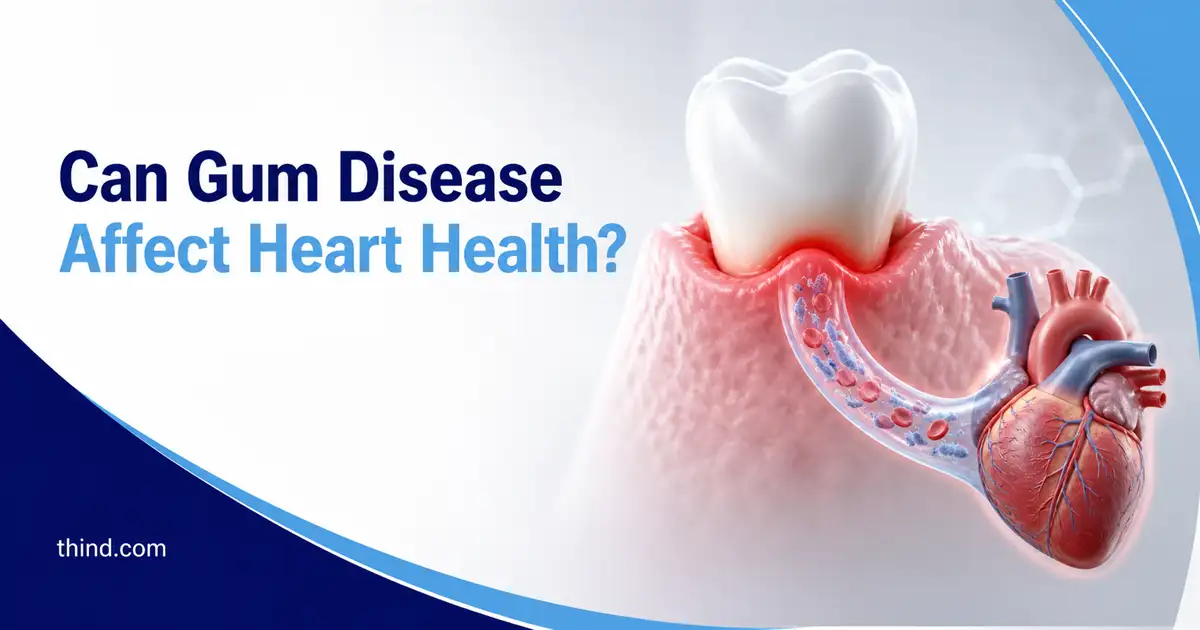
The short answer is inflammation. Bacteria from infected gums can enter the bloodstream and trigger an inflammatory response that researchers now believe contributes to plaque buildup in the arteries, according to the same American Heart Association statement.
Dr. Andrew H. Tran, chair of the statement writing group and Director of the Preventive Cardiology Program at Nationwide Children's Hospital, put it plainly: "Your mouth and your heart are connected. Gum disease and poor oral hygiene can allow bacteria to enter the bloodstream, causing inflammation that may damage blood vessels and increase the risk of heart disease."
The full scientific statement published in Circulation is careful to note that a direct cause-and-effect relationship has not been fully confirmed, and that periodontal treatment has not yet been proven to prevent cardiovascular disease on its own. What the data does show is a clear association: adults who brushed once daily or less had a 13.7 percent modeled ten-year cardiovascular risk, versus 7.35 percent for those brushing three or more times a day, a gap large enough that major cardiology researchers are now paying attention to oral health.
That shift matters because it reframes what gum care is actually protecting. It was always about keeping teeth. As of August 2026, the emerging medical consensus suggests it may also be about a great deal more.
What Should Actually Decide How Seriously You Take Gum Disease?
Since gum disease is largely painless until it is advanced, the right approach is proactive, not reactive. A handful of factors separate gum care that actually works from gum care that only feels reassuring.
- Whether bleeding is ever dismissed as normal. It never is, even without pain, and treating it as routine is how early gingivitis turns into periodontitis.
- Whether cleanings are frequent enough to matter. Plaque that hardens into tartar cannot be removed by brushing alone and needs a professional scaling visit.
- Whether the clinic actually measures gum pocket depth. A visual check alone misses early bone involvement that a simple periodontal probe can catch.
- Whether hygiene and sterilization are visibly maintained. Treating an active infection safely depends on strict cross-contamination control, not just a tidy-looking room.
- Whether the same team can manage both gum health and any restorative work it eventually requires. Gum disease and tooth replacement are often connected problems, not separate ones.
What Should You Look For in Gum Care Before It Becomes a Bigger Problem?
Choosing where to get gum health checked matters as much as choosing to go at all. A short checklist keeps that decision practical rather than guesswork.
- Look for a clinic that measures gum pocket depth at every checkup, not only when you mention a symptom.
- Look for a clinic that explains findings in plain language with visual or digital evidence, rather than a quick verbal note.
- Look for a clinic offering both preventive scaling and, if needed, more advanced periodontal treatment under one roof.
- Look for a clinic that follows a recognized hygiene and sterilization accreditation given that gum treatment involves working with infected tissue.
- Look for a team that can coordinate gum treatment with any related restorative or cosmetic work, since the two are frequently linked.
Where This Leaves You
Thind Dental Clinic is built to catch gum disease at the stage where it is still reversible, using digital periodontal screening across its NABH-approved locations in Ludhiana, run jointly by Dr. Rajanbir Singh Thind and Dr. Gurinder Kaur Thind. If it has been longer than six months since your gums were properly checked, you can book a free smile assessment and consultation to find out exactly where things stand.
There is no obligation attached to that first visit, and no assumption that something is wrong. A short screening and a clear, written explanation of what your gums actually look like beneath the surface is often enough to turn a vague worry into an actual plan. You can schedule a gum health checkup with Thind Dental Clinic whenever it fits your calendar.
Frequently Asked Questions
Is gum disease really connected to heart disease?
Major medical bodies now treat the association seriously. A December 2025 American Heart Association statement links gum disease to blood vessel inflammation and higher modeled cardiovascular risk, though it stops short of confirming a direct cause-and-effect relationship. A gum health screening at Thind Dental Clinic is a straightforward way to know where you personally stand.
Can gum disease happen without any pain at all?
Yes, and this is exactly why it is so often missed. Gingivitis and even early periodontitis frequently cause no pain, which is why routine professional checkups catch far more cases than waiting for symptoms does.
Can gum disease actually make healthy teeth loosen and fall out?
Yes. As periodontitis destroys the bone anchoring a tooth, the tooth can loosen, shift, or eventually be lost, even if the tooth itself has never had a cavity.
Is gingivitis reversible, or is all gum disease permanent?
Gingivitis is generally reversible with professional cleaning and consistent home care. Once the disease progresses into periodontitis and bone is lost, that specific bone loss does not grow back, though further progression can still be stopped.
How often should gum health actually be checked?
Most dental guidance points to a professional checkup and cleaning roughly every six months, though anyone with bleeding gums, a family history of gum disease, or a known systemic condition may need to be seen more often. You can arrange a checkup with Thind Dental Clinic to get a personal recommendation instead of a general rule.
Does brushing more often really lower cardiovascular risk?
The December 2025 American Heart Association statement found a clear difference in modeled ten-year cardiovascular risk between adults who brushed once daily or less and those who brushed three or more times daily, though the statement notes this is an association rather than confirmed proof that brushing habits alone change heart disease outcomes.
Sources
- World Health Organization, "Oral health" fact sheet, updated March 2025
- "Global, regional, and national burden of periodontal diseases from 1990 to 2021 and predictions to 2040," Frontiers in Oral Health, July 2025
- American Heart Association newsroom, "Gum disease may be linked to plaque buildup in arteries, higher risk of major CVD events," December 16, 2025
- "Periodontal Disease and Atherosclerotic Cardiovascular Disease: A Scientific Statement From the American Heart Association," Circulation, 2025