Published: August 25, 2026 | Last updated: August 25, 2026
Dr. Rajanbir Singh Thind, Thind Dental Clinic
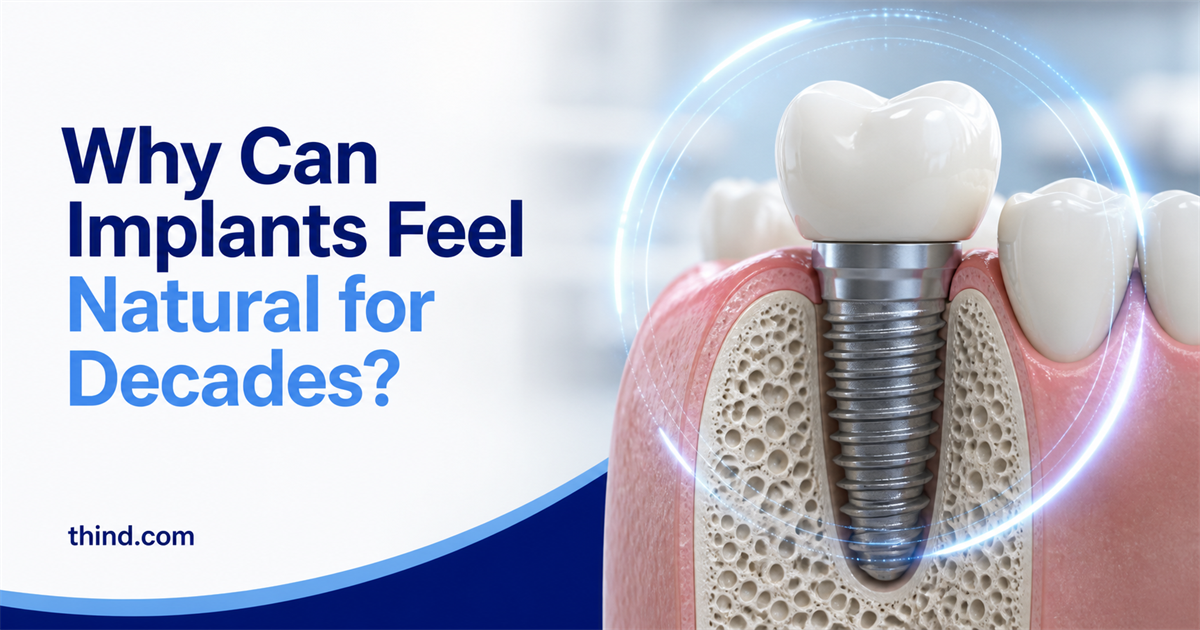
A dental implant is a titanium tooth root that is surgically placed in the jawbone and fuses with living bone through a process called osseointegration. Once healed, it can look, feel, and function like a natural tooth for decades. A 2025 University of Gothenburg follow-up study found implants still working, with bone levels around them virtually unchanged, after 38 to 40 years.
A separate 2025 review of nearly 159,000 implants recorded a 97.79 percent survival rate. The catch is timing: waiting to replace a missing tooth lets the jawbone shrink quickly, and that window, more than the implant itself, decides how natural the final result feels.
What Does It Actually Mean for an Implant to "Bond" With Bone?
Osseointegration is the direct structural and functional connection that forms between living bone and the surface of a titanium implant, so the implant becomes a stable, load-bearing anchor rather than a loose foreign object. This is the mechanism that lets a replacement tooth root behave like a natural one.
The concept was first defined by Swedish researcher P. I. Branemark, and it remains the foundation of modern implant dentistry described in academic reviews such as the 2022 osseointegration overview published in Frontiers of Oral and Maxillofacial Medicine. Titanium is used because bone cells attach to its surface unusually well, which is why implants can carry biting force the way a natural tooth root does.
What Happens to Your Jawbone If You Wait to Replace a Missing Tooth?
Waiting has a cost measured in bone, not just time. According to a 2012 systematic review published in Clinical Oral Implants Research by Tan and colleagues, the alveolar bone that holds a tooth in place can lose 29 to 63 percent of its horizontal width and 11 to 22 percent of its vertical height within just six months of a tooth extraction.
Most of that shrinkage happens fast, then slows down. Once enough bone is gone, replacing the tooth later can require additional bone grafting, more appointments, and a longer timeline than if the socket had been addressed early.
This is also a population-level problem, not a rare one. A study using World Health Organization SAGE survey data found that 16.3 percent of Indian adults aged 50 and above had experienced complete tooth loss, a pattern closely tied to years of untreated dental problems rather than a single event.
Why Are More People in India Choosing Implants Over Bridges or Dentures?
Demand is rising because more patients now understand that implants preserve the jawbone in a way that other options cannot. As of August 2026, industry research from IMARC Group valued the India dental implants market at USD 158.2 million in 2025, projecting growth to USD 279.5 million by 2034 at a compound annual rate of 6.5 percent.
That growth reflects a shift in expectations. Patients increasingly want a fixed, non-removable solution that supports the jawbone and looks proportionate to their own smile, rather than a removable device that sits on top of the gum.
How Long Do Modern Dental Implants Actually Last?
Placed and maintained correctly, a dental implant can outlast most other dental restorations by decades. A 2025 study in the Journal of Functional Biomaterials tracked 158,824 implants across 53,874 patients from 2014 to 2022 and recorded a 97.79 percent overall survival rate, with most failures occurring in the first year.
Longer-term data tells a similar story. Following patients for 38 to 40 years, a 2025 follow-up study covered by Dental Tribune International recorded a 95.6 percent cumulative implant survival rate.
"Even though the study included a small number of patients, the results show that the implants remain in place and that the bone loss around them is virtually unchanged after 40 years," said Sargon Barkarmo, prosthodontist and senior lecturer at the University of Gothenburg, in comments reported by Dental Tribune International in April 2025.
That is a meaningfully different outlook than a removable denture, which typically needs relining or replacing every five to eight years as the jawbone beneath it continues to change shape.
Dental Implants vs Bridges vs Dentures: How Do the Options Actually Compare?
Each tooth replacement option protects the jawbone, appearance, and daily function differently, so the right choice depends on what a patient values most. The table below compares the three most common approaches side by side.
What Should Actually Decide Which Clinic You Choose for Tooth Replacement?
Choosing where to replace a missing tooth matters as much as choosing to do it at all, because the process depends on precision, hygiene, and honest planning. A few criteria separate a dependable choice from a risky one.
- Accreditation over assurances. A clinic that holds recognized quality and hygiene accreditation has been independently audited, not just self-described as clean.
- Diagnosis backed by imaging, not guesswork. Digital scans and full-mouth X-rays let a dentist see bone quality and hidden problems before recommending a plan.
- Comfort-focused technology. Laser-based and minimally invasive tools reduce discomfort and recovery time compared to older techniques.
- Continuity of care. A clinic with more than one location makes follow-up visits and unexpected issues easier to manage around a working schedule.
- Combined expertise under one roof. A team spanning general, restorative, and cosmetic dentistry can plan an implant so it also looks right, not just functions right.
What Should You Personally Check Before Booking a Dental Implant Consultation?
Before committing to any clinic, a short checklist protects both your bone and your budget.
- Ask whether the clinic is NABH-approved or holds equivalent third-party hygiene certification, and ask to see it.
- Request to see your own digital scan or X-ray before any treatment plan is proposed.
- Ask whether laser or non-contact treatment options are available for cavities or gum work alongside implant planning.
- Confirm sterilization protocols are explained clearly, not brushed aside.
- Get a written, itemized estimate before the procedure begins, not a verbal range.
- Ask how many implants the treating dentist has placed and how complications are handled.
Thind Dental Clinic in Ludhiana is built around exactly this kind of standard: an NABH-approved facility offering digital diagnostics, laser dentistry including non-contact laser cavity treatment, and an experienced husband-wife dentist team, Dr. Rajanbir Singh Thind and Dr. Gurinder Kaur Thind, working across three Ludhiana locations. For anyone who has read this far because a missing tooth, or the fear of losing one, has been on their mind, this is usually the point where the next step becomes obvious rather than complicated.
The most useful first step is not a decision to get an implant. It is simply an honest look at where your jawbone and your options currently stand, with a free smile assessment and consultation that includes the kind of digital imaging described above. From there, you can see actual options, in actual numbers, before deciding anything. You can also explore how a NABH-approved dental team approaches implant planning or simply book a visit at whichever Ludhiana location is easiest to reach, and take the conversation from there at your own pace.
Frequently Asked Questions
Can dental implants really feel like natural teeth?
Yes, once osseointegration is complete, most patients report that an implant feels and functions like the tooth it replaced. This is because the implant is anchored directly into bone rather than resting on the gum, unlike a removable denture, which is easiest to judge for yourself through a hands-on evaluation at a NABH-approved clinic.
Can I eat normally after getting dental implants?
Yes, after the implant has fully healed and been fitted with its final crown, most patients can chew most foods normally. Recovery diets are typically softer for a short period immediately after surgery, then return to normal as healing completes.
How long do dental implants actually last?
Well-placed and properly maintained implants can last decades, and long-term follow-up data covered by Dental Tribune International in 2025 recorded implants still functioning after 38 to 40 years with minimal bone loss. Regular checkups and good oral hygiene remain essential to that longevity.
Are dental implants safe for older adults?
Yes, age alone is rarely a barrier to dental implants, as long as the jawbone has adequate density and any medical conditions are managed appropriately. A dentist evaluates bone quality and overall health individually rather than applying an age cutoff.
What is the recovery time after a dental implant procedure?
Initial healing around the implant site typically takes a few days to two weeks before daily discomfort settles. Full osseointegration, when the implant is completely fused with bone, generally takes a few months before the final crown is placed, and a personalized timeline is easiest to discuss during a one-on-one treatment planning session.
Sources
- Tobias et al., "Dental Implant Survival Rates: Comprehensive Insights from a Large-Scale Electronic Dental Registry," Journal of Functional Biomaterials, 2025
- Tan et al., "A systematic review of post-extractional alveolar hard and soft tissue dimensional changes in humans," Clinical Oral Implants Research, 2012
- "Prevalence of Loss of All Teeth (Edentulism) and Associated Factors in Older Adults in China, Ghana, India, Mexico, Russia and South Africa," International Journal of Environmental Research and Public Health, 2014
- "India Dental Implants Market Size, Share and Forecast," IMARC Group, 2025
- "Dental implants show longevity and continued function after four decades," Dental Tribune International, April 2025