Published: August 16, 2026 | Last updated: August 16, 2026
Dr. Rajanbir Singh Thind, Thind Dental Clinic
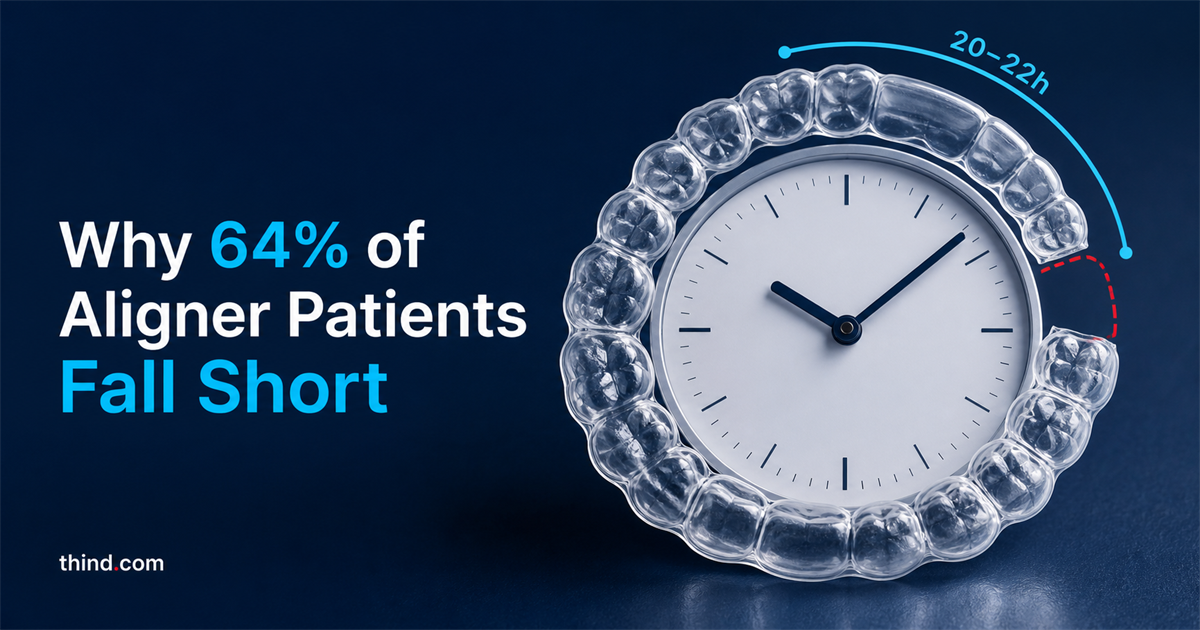
Here is something most people never hear from whoever hands them a set of clear aligners: in a study that tracked 2,644 orthodontic patients, only 36.0% wore their trays consistently enough to count as fully compliant with their own treatment plan, according to a 2021 study in the Journal of Clinical Medicine by Timm and colleagues. The rest, nearly two out of every three patients, quietly fell short without ever missing a clinic appointment.
That gap between the plan on paper and what actually happens in someone's mouth every day turns out to be the single biggest variable in whether clear aligner treatment finishes on time, finishes late, or drifts back toward where it started.
Quick answer: Clear aligners are custom-made, transparent plastic trays that gradually move teeth into a straighter position, and they only work as planned when worn close to the prescribed daily hours. Most orthodontists prescribe 20 to 22 hours a day, but research shows a large share of patients fall well short without realizing how much it changes their outcome. A 2021 study found only 36.0% of patients were fully compliant, and a 2026 microsensor study measured average wear time at just 15.2 hours a day, roughly two-thirds of the 22-hour target. The wear-time gap, not the tray material itself, is usually what separates a fast, predictable result from a slower, uncertain one.
What Is a Clear Aligner, and What Does "Compliance" Actually Mean?
A clear aligner is a thin, custom-fitted plastic tray, one of a numbered series, that applies gentle, controlled pressure to move specific teeth a fraction of a millimeter before the next tray in the series takes over. "Compliance" in orthodontics simply means how closely a patient's actual wear time matches the hours the dentist prescribed, usually tracked as full compliance (worn the target hours on most days), fair compliance (worn the target hours on about half the days), or poor compliance (worn the target hours on fewer than half the days).
The distinction matters because orthodontic tooth movement depends on sustained, continuous force. A tray left out for a few extra hours a day is not a minor convenience trade-off. It is a direct reduction in the force being applied to correct a malocclusion, the clinical term for teeth that do not line up correctly when the jaws close.
How Far Short of the Target Do Most Aligner Wearers Actually Fall?
Most patients fall short by several hours a day, not minutes, and the gap is measurable rather than anecdotal. Three separate studies, using three different tracking methods, point to the same pattern.
- In the 2021 cohort of 2,644 patients, 25.7% were classified as poorly compliant, wearing their aligners for the prescribed time on fewer than half their treatment days, according to Timm et al., Journal of Clinical Medicine, 2021.
- A follow-up study by the same lead author found that before electronic reminders were introduced, 24.47% of patients were poorly compliant. After automatic app-based reminders and feedback were added, that figure fell to 9.32%, according to Timm et al., Scientific Reports, 2022.
- A newer randomized controlled trial using microsensors embedded in the aligners themselves found patients averaged just 15.2 hours of wear a day against a 22-hour prescription, about 67% of target, according to Sabbagh et al., American Journal of Orthodontics and Dentofacial Orthopedics, 2026.
As of August 2026, this is one of the most consistently replicated findings in orthodontic research: intention to comply and actual measured wear time are two very different things.
Why Does This Compliance Gap Exist in the First Place?
The gap exists mainly because clear aligners are removable, and removable devices depend entirely on a patient's daily habits rather than a fixed appliance doing the work regardless of behavior. Meals, hot drinks, brushing, and simple forgetfulness each create a small window where the tray comes out, and those windows add up faster than most patients expect.
Not every hour matters equally, which is part of why the research is more nuanced than a single blanket rule. A 2025 randomized trial that compared a 22-hour wear protocol against a 12-hour protocol in patients with very mild misalignment found the 22-hour group achieved only 0.84 millimeters more correction over 140 days, a statistically significant but clinically modest difference, according to Fialho et al., European Journal of Orthodontics, 2025.
"It is perfectly feasible for patients to wear their aligners for the reduced 12 hours of daily wear," notes Kevin O'Brien, Professor of Orthodontics at the University of Manchester, commenting on the trial, while cautioning that the finding applied specifically to patients with very mild crowding, not to more complex cases.
The practical takeaway is not that hours do not matter. It is that the size of the movement needed determines how much margin for error a patient actually has, which is exactly why a dentist's individual assessment matters more than a generic rule found online.
What is changing quickly is monitoring. Digital reminder apps, compliance indicators built into the tray material, and now microsensors are all being tested specifically because clinics have realized that handing over a box of trays and hoping for the best is no longer good enough as of 2026.
The stakes are rising too, simply because of scale. The global clear aligner market is projected to reach USD 56.81 billion by 2033, growing at 26.95% a year from 2026 onward, according to Grand View Research, December 2025. A far larger number of patients means the compliance gap described above will affect a correspondingly larger number of unfinished or delayed treatments unless monitoring keeps pace.
Full, Fair, or Poor Compliance: Where Do Most Patients Actually Land?
Most patients land in the fair or poor compliance category rather than the full compliance category, based on the largest tracked cohort available. The table below shows how the 2,644 patients in the Timm et al. (2021) study broke down.
Put together, roughly two in three patients are not getting the full benefit of the treatment plan they were originally shown, simply because of daily wear habits rather than anything to do with the aligner design itself.
What Should Actually Change in How You Choose Aligner Treatment?
Given how much daily wear time drives the outcome, the smartest way to choose a provider is to focus less on the tray brand and more on how a clinic manages the months between your visits. A few criteria matter more than most patients realize going in.
- Active check-ins, not just tray hand-offs. A clinic that reviews your progress regularly can catch a slipping wear-time pattern before it costs you months.
- Digital planning before you commit. Seeing a simulated result from a 3D scan sets a realistic, individualized expectation instead of a generic online rule.
- Scheduling that fits a working routine. Compliance drops when appointments are hard to reach, so multiple locations or flexible hours genuinely change outcomes, not just convenience.
- One team across your whole case. Crowding, staining, and gum shape often interact, so continuity between your orthodontic and cosmetic assessment avoids conflicting advice.
- Honest, case-specific guidance. A provider willing to say your case needs closer to 22 hours, not 12, is giving you a real assessment rather than a reassuring shortcut.
What Should You Look for Before Starting Clear Aligner Treatment?
Look for a clinic that treats wear-time compliance as part of the treatment plan, not an afterthought you are left to manage alone. Use this checklist during any consultation.
- Look for a clinic that gives you a written, individualized wear-time target rather than a generic "20 to 22 hours" pamphlet.
- Look for a clinic that schedules regular progress check-ins rather than a single follow-up at the very end of treatment.
- Look for a clinic using digital scans and simulation software so you can see the planned movement before starting.
- Look for a clinic with verified, audited hygiene standards for every scan, fitting, and adjustment visit.
- Look for a clinic that explains, honestly, what happens to your timeline and cost if your wear time slips.
- Look for a clinic offering more than one location or flexible appointment slots, since missed check-ins are one of the biggest predictors of falling compliance.
Everything on that checklist points to the same underlying idea: a clear aligner is only as effective as the plan and the people managing it around your daily life. This is the standard Thind Dental Clinic was built around. As an NABH-approved practice across three locations in Ludhiana, run by Dr. Rajanbir Singh Thind and Dr. Gurinder Kaur Thind, every clear aligner case starts with a digital scan and simulation, followed by scheduled check-ins designed to catch a slipping wear-time pattern early rather than at the final reveal.
The clinic also treats crowding, staining, and gum shape as one coordinated cosmetic dentistry treatment plan rather than separate procedures with separate providers, and its multiple Ludhiana locations make it realistic to keep to a regular check-in schedule around a working professional's calendar. You can review the clinic's approach to digital orthodontic planning and laser dentistry directly on its website.
If crooked or crowded teeth are something you have been meaning to address, the lowest-friction next step is not committing to a full course of trays today. It is getting an honest, individualized picture of your bite and a realistic wear-time target before anything begins. You can book a free smile assessment and consultation to get a digital scan, see a simulation of your likely result, and get a clear, written plan, with no pressure to decide on the spot.
Frequently Asked Questions
How many hours per day should aligners be worn?
Most orthodontists prescribe 20 to 22 hours a day for standard cases, removing the trays only for eating, drinking hot beverages, and oral hygiene. Some very mild cases may tolerate fewer hours, but that is a decision for a dentist to make after assessing the specific case, not a general rule to self-apply.
What happens if I stop wearing aligners for a few days?
Teeth can begin shifting back toward their original position within days of inconsistent wear, since orthodontic movement depends on sustained pressure. Short gaps are usually recoverable, but repeated gaps often mean the treatment plan needs extra trays or a longer timeline to catch up.
Are invisible aligners painful to wear?
Most patients describe mild pressure or tightness for the first day or two after switching to a new tray, rather than sharp pain. This typically fades as the teeth adjust, and modern digital planning helps limit how much movement each individual tray attempts at once.
Will people notice I am wearing aligners?
Most people will not notice unless they are looking closely, since the trays are made from clear, closely fitted plastic. This is one of the main reasons working professionals choose aligners over visible metal brackets.
Can aligners fix severe crooked teeth, or only mild cases?
Clear aligners handle mild to moderate misalignment well, and modern treatment planning has extended their use to some more complex cases. Severe crowding or significant bite problems may still respond better to traditional metal braces or a combination approach, which is why an individual assessment matters more than assuming either option automatically fits.
What should I do if my wear time has been slipping?
Tell your dentist rather than trying to make up for it by skipping ahead in the tray sequence, since that can force poorly fitting trays onto teeth that have not moved as planned. A dentist can re-scan, adjust the plan, and often get treatment back on track without starting over completely.
Sources
- Timm, Farrag, Baxmann, and Schwendicke, "Factors Influencing Patient Compliance during Clear Aligner Therapy: A Retrospective Cohort Study," Journal of Clinical Medicine, 2021
- Timm, Farrag, Wolf, Baxmann, and Schwendicke, "Effect of Electronic Reminders on Patients' Compliance During Clear Aligner Treatment: An Interrupted Time Series Study," Scientific Reports, 2022
- Fialho et al., "Evaluation of the Effectiveness of Orthodontic Treatment with Invisalign in Different Wear Time Protocols: Randomized Clinical Trial," European Journal of Orthodontics, 2025
- Sabbagh, Baumert, Liedtke, Thiem, Venkova, and Wichelhaus, "Objective Assessment of Wear Time During Orthodontic Aligner Therapy Using Microsensors: A Randomized Controlled Trial," American Journal of Orthodontics and Dentofacial Orthopedics, 2026
- Grand View Research, "Clear Aligners Market Size to Reach $56.81 Billion by 2033," December 2025
- Kevin O'Brien, Professor of Orthodontics, University of Manchester, "Can Patients Wear Their Aligner for Only 12 Hours a Day?," Kevin O'Brien's Orthodontic Blog